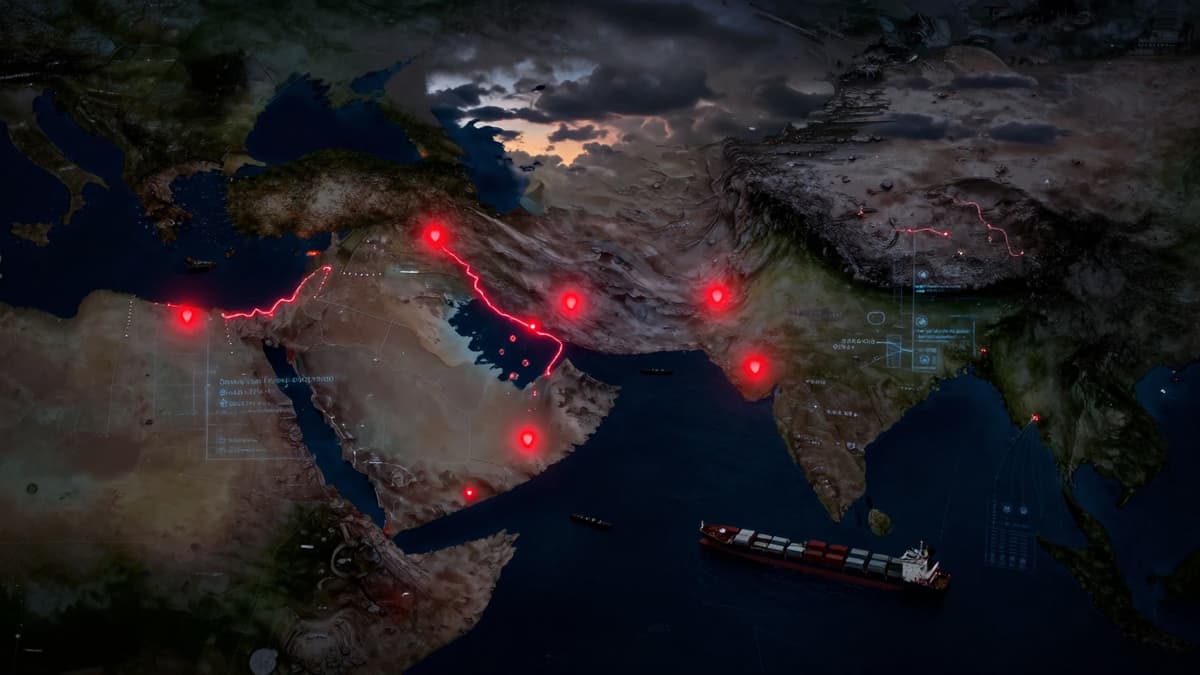
The Middle East war intensifies as Iran expands demands, Houthis enter the fight, and Russia supplies intelligence, threatening critical shipping chokepoints.
Ukrainian President Volodymyr Zelensky reported that Russia is conducting surveillance of US bases in the Middle East and Gulf regions, potentially aiding Iran's expansion of the war.
This intelligence claim follows reports that Russia is providing Tehran with specific location data on US military assets and tactical advice for targeting with Shahed drones.
US officials confirmed that Iran recently launched two intermediate-range ballistic missiles at the joint US-British base on Diego Garcia, demonstrating its long-range capabilities. As the conflict enters its second month, diplomatic efforts are intensifying in Islamabad, where foreign ministers from Egypt, Turkey, and Saudi Arabia are convening for four-way talks.
The war in the Middle East has deepened significantly, drawing in new actors and complicating the geopolitical landscape. According to CNN, multiple people familiar with US intelligence reporting have stated that Russia is providing Iran with intelligence on the location and movement of US military assets. A Western intelligence official added that Moscow is also giving Tehran tactical advice on targeting with its Shahed drones. This level of coordination suggests a robust Russia-Iran military cooperation that is shifting the balance of power in the region.
Ukrainian President Volodymyr Zelensky claimed that seven areas had been surveilled or photographed this week, including US, Middle Eastern, and British bases in Kuwait, Saudi Arabia, Turkey, Qatar, and Diego Garcia. While CNN reached out to the Russian Embassy in the US for comment, and the Department of Defense declined to comment on intelligence matters, the reports from US officials regarding the missile strike on Diego Garcia lend credence to the intelligence sharing allegations.
The Vatican has entered the fray with a stark moral stance. Pope Leo XIV, the first US-born pontiff, rejected attempts to co-opt God as a justification for war, a move widely seen as aimed at the Trump administration and US Defense Secretary Pete Hegseth, who has quoted scriptures to support military action. Leo stated during Palm Sunday Mass that God "rejects war" and that "no one can use [God] to justify war." This spiritual condemnation contrasts sharply with the physical reality on the ground, where the Mass in Jerusalem has been cancelled for the first time in recent memory due to the conflict.
Diplomatic maneuvers are currently underway in Pakistan, which has emerged as a key intermediary. The foreign ministers of Egypt and Turkey are in Islamabad, with Saudi Arabia's foreign minister expected to arrive shortly. They are engaging in four-way talks to de-escalate the war between the US, Israel, and Iran. Pakistan, maintaining cordial ties with both Washington and Tehran, delivered a 15-point peace plan proposed by Washington to Tehran. However, Pakistani defense analyst Lieutenant General (Retired) Muhammad Saeed cautioned that a "quick breakthrough" is not realistic, noting that the talks may instead focus on conveying conditions from Gulf leadership to the Iranian regime.
The most immediate and tangible impact of the escalating conflict is the severe disruption of global trade and energy supplies. Iran has long threatened to close the Strait of Hormuz in the event of an attack, but the current crisis has seen the waterway, through which a fifth of the world's oil and liquefied natural gas (LNG) passes, nearly grind to a halt. The Islamic Republic has added recognition of its sovereignty over this critical waterway to its list of demands, seeking to turn this leverage into a source of billions in annual revenue and a permanent pressure point on the global economy.
Shipping through the chokepoint has been severely curtailed, sending global energy markets into turmoil and forcing nations far beyond the Persian Gulf to take emergency measures to secure fuel supplies. The scale of this disruption has expanded Tehran's ambitions, suggesting a move from sporadic threats to a sustained strategy of economic warfare.
The conflict has now expanded to include another vital waterway: the Bab al-Mandab Strait. Yemen's Iran-backed Houthi rebels officially entered the war on Saturday, firing two missiles towards southern Israel, one ballistic, in their first attempt to target the nation since February 28. Both were intercepted, but the move signals a dangerous escalation. The Houthis, who control the territory on the eastern shore of the Bab al-Mandab, have hinted they may attack shipping in the strait, through which around 12% of total seaborne-traded oil passes.
This threat brings the vulnerabilities of the Bab al-Mandab into sharp focus. Unlike the Strait of Hormuz, there is an alternative route: ships can bypass the Bab al-Mandab by traveling around Africa. However, the logistical cost is astronomical. Analyst Muyu Xu from Kpler noted that a voyage from Rotterdam to Singapore via the Suez Canal and Bab al-Mandab takes roughly 27 days, whereas rerouting around the Cape of Good Hope extends the journey to about 40 days. If Saudi Arabia's oil exports, currently being re-routed to the port of Yanbu, face a closure, the journey to China could take nearly 50 days, more than doubling the required transit time.
The intersection of religious observance and military conflict reached a poignant moment during Palm Sunday. The procession in Jerusalem, which usually draws thousands of participants, was cancelled due to the war. Cardinal Pierbattista Pizzaballa, the Latin Patriarch of Jerusalem, stated, "Due to the war, this year we were unable to experience the traditional Lenten journey in Jerusalem." This cancellation underscores the profound disruption the war has caused, extending its reach even into the most sacred traditions of the region.
The Israeli military has acknowledged the changing reality on the ground. Nadav Shoshani, the IDF's international spokesman, stated that the military is ready for a "multi-front war" after the Houthis entered the conflict. He noted that Israel has been fighting threats from various fronts for the last two and a half years and must now prepare for the Houthi front as an integral part of this ongoing war. The Houthis, led by Abdel-Malik al-Houthi, emphasized their loyalty to Tehran, stating that Iran was the only state that officially stood with them against the aggression on their country.
As the conflict enters its second month, the four-way talks in Pakistan aim to bridge the widening gap between the belligerents. The presence of foreign ministers from Turkey, Egypt, and Saudi Arabia highlights the urgency felt by neighboring nations, all of whom face direct threats. Turkey, a NATO member, reports that multiple missiles launched from Iran have been shot down over its airspace. Meanwhile, Saudi Arabia has endured daily missile and drone attacks from the Islamic Republic.
The discussions in Islamabad are expected to focus on the 15-point peace plan delivered to Tehran. Analyst Muhammad Saeed suggests that while a quick resolution is unlikely, the talks could serve as a conduit for conveying specific conditions from Gulf leadership to Iran. If Iran agrees to these conditions, the Saudi leadership might play a more proactive role in mediation and engagement with the West. The high security presence in Islamabad reflects the delicate nature of these diplomatic efforts, as the region teeters on the brink of a broader, more devastating regional conflagration.
The ongoing conflict threatens to permanently alter global energy trade routes, forcing a shift from just-in-time logistics to long, inefficient detours. If the Strait of Hormuz or the Bab al-Mandab Strait remains closed or severely disrupted, the global economy will face sustained inflationary pressure and potential shortages. The expansion of the war into multiple fronts, backed by Russia-Iran military cooperation, suggests that these disruptions may not be temporary. As nations like Saudi Arabia attempt to reroute exports via the Red Sea, any further closure of the Bab al-Mandab could force a massive, costly shift of shipping lanes around Africa, fundamentally changing the cost of energy and the stability of global markets for the foreseeable future.
Jun 8, 2026 02:17 UTC
Magnitude 7.8 Quake Shakes Philippines, Urging Immediate Evacuations
Jun 8, 2026 00:51 UTC
Trump Claims Iran Nuclear Deal Imminent Despite Diplomatic Fractures
Jun 8, 2026 00:47 UTC
Iran Fires Missiles at Israel After Beirut Strike
Jun 7, 2026 22:00 UTC
US, Iran Peace Hops Fade 100 Days Into War
Jun 8, 2026 04:15 UTC
Trump Urges Netanyahu to Halt Iran Strike for Peace


