
Section
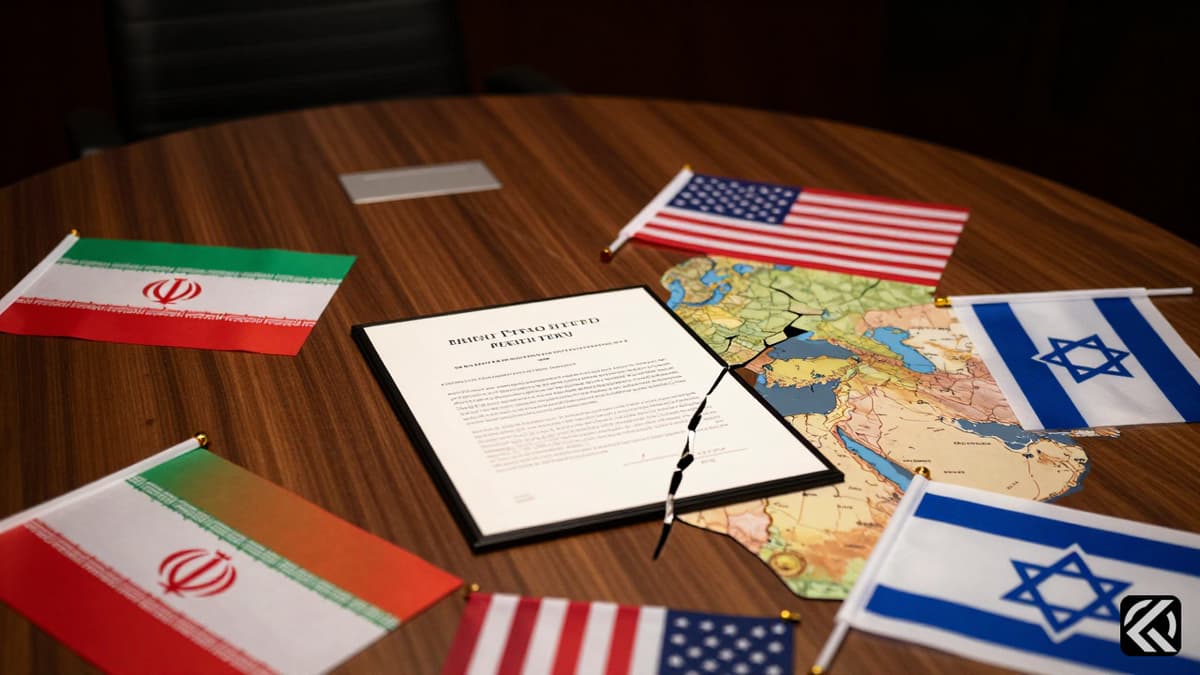
Iran suspends diplomatic talks with the U.S. following renewed Israeli military operations in Lebanon, while Kuwait intercepts hostile attacks, escalating regional tensions.
The diplomatic landscape in West Asia fractured further on Monday, June 1, 2026, as Iran officially suspended ongoing talks with the United States. This decisive pause in negotiations comes in direct response to Israel’s intensified military assault on Lebanon, marking a critical escalation in the ongoing regional conflict.
German and Norwegian ministers were forced to abort their solidarity mission to Beirut, landing in Cyprus due to the rapidly worsening security situation. Meanwhile, Kuwait’s air defenses intercepted hostile missile and drone attacks, with the nation holding Iran fully responsible for the aggression against its airspace.
Amidst these developments, the US-Iran ceasefire appears increasingly fragile. Iranian officials stated that the probability of the ceasefire ending is high if Israeli attacks on Lebanon do not cease. European Union officials, including High Representative Kaja Kallas, urged Israel to halt its military escalation and respect Lebanon’s sovereignty, while also acknowledging Pakistan’s role as a key mediator in preventing a full-scale war.
The immediate trigger for the diplomatic breakdown was Israel’s order to target the southern suburbs of Beirut, a Hezbollah stronghold. Israeli Prime Minister Benjamin Netanyahu and Defence Minister Israel Katz justified the decision by citing repeated ceasefire violations by Hezbollah and attacks on Israeli cities. This marks Israel's deepest incursion into Lebanon in two decades, with troops reportedly raising the Israeli flag at the strategic Beaufort Castle.
In a statement on social media platform X, Iranian Foreign Minister Abbas Araqchi emphasized that "violation on one front is a violation of the ceasefire on all fronts," assigning responsibility for the consequences to both the U.S. and Israel. Iranian Foreign Ministry spokesperson Esmaeil Baghaei added that the delay in the diplomatic process stems from a lack of trust, Washington’s contradictory positions, and the impact of Israel strikes Lebanon. Baghaei noted that negotiations have started amid severe suspicion, with the opposing party constantly changing views and putting forward contradictory demands.
The conflict has spilled over into neighboring countries, particularly Kuwait. On Monday, Kuwait’s military announced that its air defenses had intercepted missile and drone attacks. The Kuwaiti Army General Staff clarified that any sounds of explosions were the result of these defensive intercepts. Shortly after, Kuwait’s Foreign Ministry issued a statement holding Iran fully responsible for the "heinous attacks," despite the ongoing ceasefire between the U.S. and Iran.
Earlier in the weekend, U.S. forces in Kuwait had also intercepted two Iranian ballistic missiles targeting American troops, though no personnel were harmed. These incidents highlight the volatility of the region, where diplomatic channels are struggling to contain military realities. The U.N. Security Council is expected to hold an emergency meeting regarding Israel’s expansion of operations in Lebanon, further underscoring the international concern over the destabilizing violence.
The international community has reacted with urgency. The European Union called on Israel to stop its military escalation and respect Lebanon’s territorial integrity. EU spokesman Anouar El Anouni issued a firm warning against further military actions. Meanwhile, the humanitarian situation remains dire. German and Norwegian ministers had planned to visit Beirut to show solidarity with the Lebanese people but were forced to return to Berlin and land in Cyprus, respectively, due to military reasons. Their aborted trip signals the danger faced by diplomats and the breakdown of safe passage in the region.
In response to the broader geopolitical tension, Iran has taken steps to manage economic fallout. Iranian President Masoud Pezeshkian promised Japanese Prime Minister Sanae Takaichi that his country would enable the passage of Japanese ships through the Strait of Hormuz. This waterway has been mostly closed since the start of the West Asia war in February. U.S. Central Command reported guiding around 70 commercial ships through the strait in the past three weeks, with many vessels turning off transponders to avoid detection.
France’s President Emmanuel Macron also weighed in, encouraging U.S. President Donald Trump to pursue his "determined efforts" to reach a ceasefire deal. Macron stated that a swift agreement represents a unique opportunity to build a new security framework for the region. However, the ground reality on the ground, marked by heavy artillery in Beirut and air defense activations in Kuwait, contradicts these diplomatic overtures.
Hezbollah continues to resist Israeli advances. The group reported that its fighters are engaged in a "battle of attrition" near Beaufort Castle, day after Israel claimed to have seized the fortress. Hezbollah has also fired rockets at northern Israel, including the outskirts of Haifa, further complicating any potential de-escalation.
The death toll in the conflict has risen. The Israeli army announced the death of Staff Sergeant Adam Tzarfati, 20, in fighting in southern Lebanon, bringing the total number of Israeli military deaths since early March to 26. This loss underscores the human cost of the deepening military engagement.
The suspension of talks between Tehran and Washington creates a dangerous vacuum in crisis management. With Iran viewing Israeli actions as inseparable from U.S. strategy, the breakdown of trust makes a unified front against escalation nearly impossible. The continued hostilities in Lebanon and the attacks in Kuwait suggest that local military commanders may be operating independently of diplomatic directives. If the US-Iran ceasefire collapses entirely, the risk of a broader regional war involving multiple state actors increases significantly. The world must monitor the Strait of Hormuz and diplomatic mediation efforts closely to prevent further unintended escalation in West Asia.
Jun 11, 2026 17:21 UTC
Bangladesh Opposition Mobilizes Against India-Bangladesh Border Push-Ins and BSF Killings
Join 50,000+ readers getting the global briefing every morning.
No spam. Unsubscribe anytime.
Jun 11, 2026 17:40 UTC
Boelter Pleads Guilty in Minnesota Political Assassinations
Jun 11, 2026 17:21 UTC
Bangladesh Opposition Mobilizes Against India-Bangladesh Border Push-Ins and BSF Killings
Jun 11, 2026 17:21 UTC
John Healey Quits as UK Defence Secretary Over Funding Dispute
Jun 11, 2026 16:19 UTC
UK Defence Secretary John Healey Quits Over Funding Dispute


