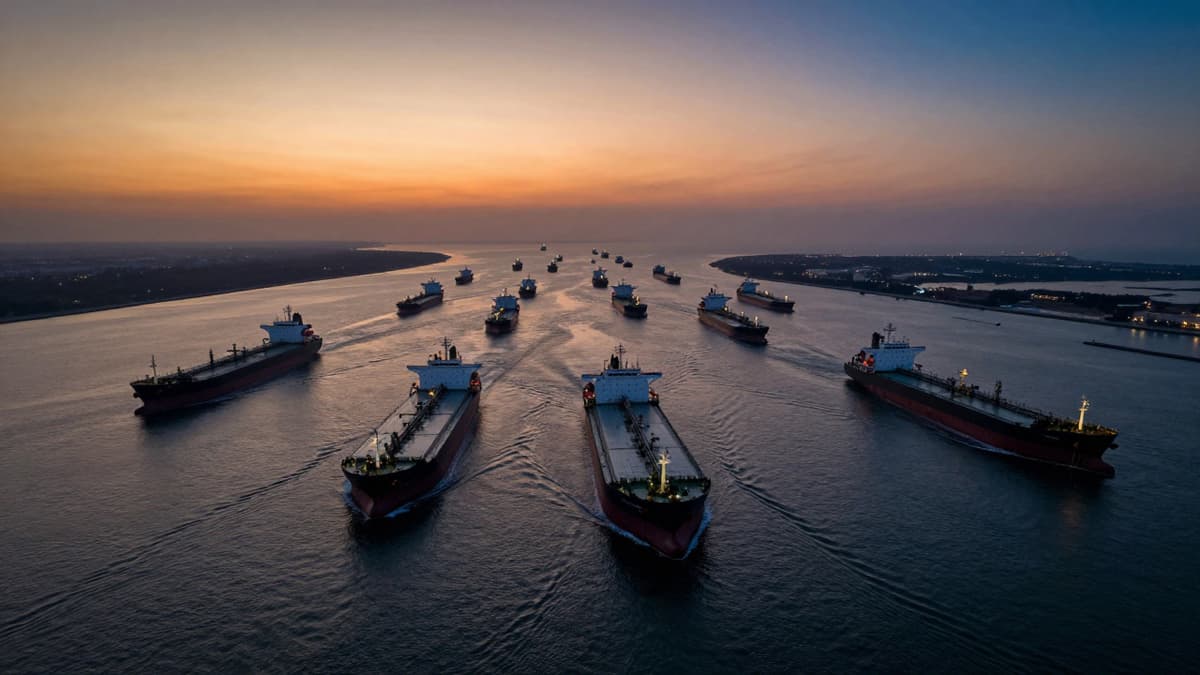
Iran has introduced a bold new demand to end the conflict: establishing a toll system at the Strait of Hormuz, a move that could reshape global trade and revenue streams.
When an Iranian official outlined a fresh set of demands to end the war initiated by the United States and Israel, he introduced a critical new element not previously on Tehran's list: the demand for international recognition of Iran's sovereignty over the Strait of Hormuz. This narrow waterway, which typically handles a fifth of the world's oil and liquefied natural gas (LNG), has transformed into the Islamic Republic's most potent strategic weapon. The regime is now attempting to convert this leverage into a dual mechanism: a source of potentially billions of dollars in annual revenue and a significant pressure point on the global economy.
While Iran has long threatened to close the strait in response to an attack, few anticipated the execution would be so effective in disrupting global trade flows or the scale of the impact that would expand Tehran's ambitions. The new demands suggest a strategic shift from merely threatening closure to monetizing the chokepoint's status. Dina Esfandiary, Middle East lead at Bloomberg Economics, noted that Iran has been "taken aback by how successful its (Hormuz) strategy has been," highlighting how "cheap and how comparatively easy it is to hold the global economy hostage."
Washington is acutely aware of the risks associated with this new strategy. US Secretary of State Marco Rubio warned that a primary challenge following the war will be Tehran's attempts to establish a tolling system at Hormuz. Speaking after a G7 meeting in France, Rubio declared that such a move would not only be illegal and unacceptable but also dangerous to the world. Foreign ministers from the group stressed the "absolute necessity" to restore "safe and toll-free freedom of navigation" immediately. In a direct nod to the growing strategic weight of the waterway, Mojtaba Khamenei, identified as Iran's new supreme leader in his first purported address, stated that the leverage of blocking the waterway "must continue to be used."
This marks a significant departure from previous negotiation rounds, where Iran pushed for sanctions relief and recognition of its right to peaceful nuclear technology but did not demand control over the Strait of Hormuz. Iran is now signaling that this leverage could be formalized into a permanent system. Iranian lawmakers are actively considering a bill that would require countries using the strait for shipping fuel and goods to pay tolls. Furthermore, an adviser to the supreme leader has spoken of a "new regime for the Strait of Hormuz" following the war, a system designed to allow Tehran to impose maritime restrictions on adversaries and tie access to one of the world's most critical shipping lanes to its geopolitical disputes.
Experts remain skeptical of the legality and feasibility of such a move. James Kraska, a professor of international maritime law at the US Naval War College, stated that imposing transit fees constitutes a violation of the rules of transit passage. According to Kraska, there is no legal basis under international law for a coastal state to charge fees in an international strait like Hormuz. He explained that while the Strait of Hormuz involves overlapping territorial seas of Iran and Oman where both laws apply, the status as an international strait ensures the right of transit passage for all states. This right permits unimpeded surface, overflight, and submerged transit. These rules are set out in the UN Convention on the Law of the Sea (UNCLOS). Although neither Iran nor the United States is a party to the convention, Kraska noted that many of its core principles apply as widely accepted customary international law.
There is little historical precedent for a state successfully charging for passage through an international strait. Kraska pointed to the 19th century, when Denmark imposed transit fees through the Danish Straits. Following protests from multiple states, Denmark agreed to the Copenhagen Convention of 1857, which permanently abolished the so-called Sound Dues. Despite this history, Iran is exploring what a tolling system could look like and how lucrative it might be. Experts question whether Iran could establish a tolling system that would gain international acceptance, but if it does succeed, revenues could rival those generated by Egypt's Suez Canal.
CNN calculations suggest the financial stakes are enormous. Normally, around 20 million barrels of crude oil and oil products pass through the Strait of Hormuz each day, roughly equivalent to about 10 very large crude carriers (VLCCs). At a reported fee of $2 million per tanker, this would translate to around $20 million a day, or about $600 million a month, from oil alone. If LNG shipments are included, that figure could rise to more than $800 million a month. This potential revenue is equivalent to about 15%-20% of Iran's monthly oil export revenue in 2024. For comparison, Egypt earns between $700 and $800 million a month from the Suez Canal in a typical year, though revenues have dropped sharply over the past year due to Red Sea disruptions.
The drive to monetize Hormuz may also be fueled by Iran's severe economic pressures. Esfandiary stated that Tehran views charging for passage as a method to "make up for some of its economic shortfalls" under sanctions, describing it as a relatively "easy" and "low-cost" mechanism to compensate for restricted access to global markets. Iran remains one of the world's most heavily sanctioned countries, second only to Russia. Officials claim the Strait remains open but not unconditionally, stating that "non-hostile" vessels may transit only if they coordinate with Iranian authorities. The foreign ministry conveyed this position in a letter to the UN Security Council and the International Maritime Organization.
Tehran appears to be testing a controlled system of passage in practice. Ship-tracking data indicates some tankers are using a route closer to Iran's coast, with reports that certain operators may have paid for safe passage. Lloyd's List reported that more than 20 vessels have used a new corridor through the strait, with at least two ships understood to have paid to do so, one reportedly around $2 million. Although no country, importer, or ship operator has publicly acknowledged paying a fee, and details remain unclear, the Islamic Revolutionary Guard Corps has established a registration system for approved vessels. Richard Meade, editor in chief of Lloyd's List, noted that the shipping industry is effectively in paralysis, predicting the practice will increase if negotiations do not progress.
Iran's new demand to formalize tolls at the Strait of Hormuz represents a calculated shift from defensive threats to active economic weaponization, driven by a desire to generate billions in revenue and mitigate the crushing effects of international sanctions. If Tehran successfully implements a tolling system, the global maritime community faces a precedent-setting disruption that could fundamentally alter international trade laws. While the US and its allies have warned that such a move violates customary international law and threatens global energy security, the immediate paralysis in the shipping industry suggests the strategy is already influencing vessel routes and operator behavior. The long-term impact hinges on whether the international community can enforce toll-free navigation or if Iran's economic desperation will force a new, costly equilibrium for global energy transit.
Jun 8, 2026 02:17 UTC
Magnitude 7.8 Quake Shakes Philippines, Urging Immediate Evacuations
Join 50,000+ readers getting the global briefing every morning.
No spam. Unsubscribe anytime.
Jun 8, 2026 02:17 UTC
Magnitude 7.8 Quake Shakes Philippines, Urging Immediate Evacuations
Jun 8, 2026 00:51 UTC
Trump Claims Iran Nuclear Deal Imminent Despite Diplomatic Fractures
Jun 8, 2026 00:47 UTC
Iran Fires Missiles at Israel After Beirut Strike
Jun 7, 2026 22:38 UTC
Congress Party Claims Unity for INDIA Bloc Delhi Meeting


