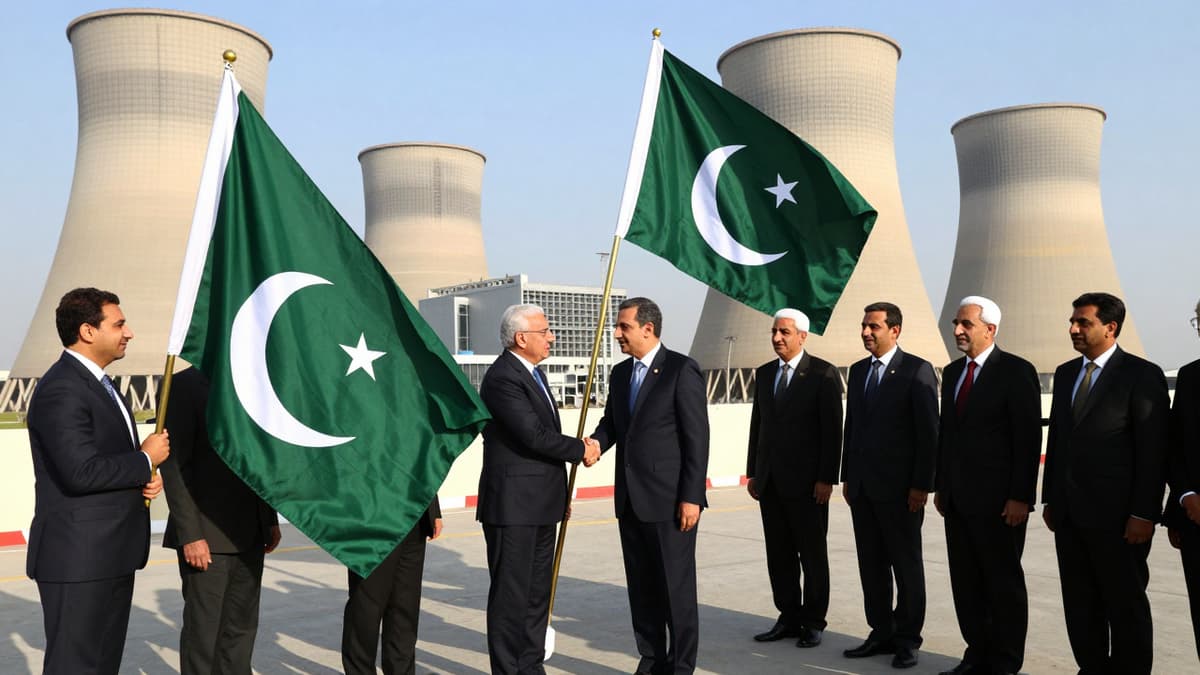
Amidst escalating hostilities, Iran's President credits Pakistan for mediation efforts while reporting a new strike near the Bushehr Nuclear Plant, intensifying regional fears.
Iran's President Masoud Pezeshkian has lauded Pakistan for its mediation efforts to halt the escalating Iran-United States-Israel Conflict, calling for trust to facilitate future talks. This diplomatic engagement comes as the situation surrounding the Bushehr nuclear power plant continues to deteriorate following a fresh attack. On Saturday, Pezeshkian spoke with Pakistani Prime Minister Shehbaz Sharif, thanking Islamabad for its role in addressing what Tehran describes as aggression against the Islamic Republic.
The urgency of this diplomatic push was underscored by developments at the Bushehr facility, where the head of Russia's state nuclear corporation Rosatom warned that attacks pose a direct threat to nuclear safety. This was the third incident near the site in ten days, though the International Atomic Energy Agency confirmed no radiation release or damage to the operating reactor. Meanwhile, the conflict has spread across multiple fronts, with Iran claiming it targeted a Ukrainian anti-drone system depot in Dubai intended to assist US forces, a claim Kyiv immediately dismissed as disinformation.
As hostilities continue into a second month, the military capability of the region's air defense systems is under intense scrutiny. While Israel's military has dismissed reports that it is running low on interceptors, analysts suggest that the prolonged war has significantly drained allied resources, particularly regarding long-range defense systems. The ability of Israel's sophisticated defenses to intercept the steady stream of missiles and rockets remains a critical, albeit debated, factor in the unfolding crisis.
The diplomatic maneuvering on Saturday highlighted a complex web of alliances and accusations. During a call lasting over an hour, President Pezeshkian emphasized the necessity of trust to facilitate mediation on the West Asia conflict. He specifically praised Pakistan's diplomatic efforts and was briefed on contacts made with the United States and various Gulf states. This conversation coincided with preparations for a meeting of foreign ministers from Saudi Arabia, Egypt, and Turkey in Islamabad, signaling a potential regional coalition effort to de-escalate tensions.
Simultaneously, Iran's military narrative of the conflict expanded. The Khatam Al-Anbiya operational command stated that a hideout for American commanders and soldiers in Dubai was targeted alongside the Ukrainian anti-drone system. However, Ukraine's foreign ministry spokesman Georgiy Tykhy firmly refuted these claims, labeling them as lies and part of a broader disinformation campaign by Tehran. Ukraine has been rapidly sharing anti-drone expertise with Gulf nations, a move necessitated by the surge in attacks on those countries.
The human and economic toll of the Bushehr Nuclear Plant Strike and related incidents is mounting. Iranian media reported that strikes on residential areas in Borujerd and Zanjan killed more than a dozen people overnight. In Borujerd, seven were killed and 36 wounded, while Zanjan saw at least five deaths and seven injuries. These figures, reported by local officials to agencies like Fars News and ISNA, could not be independently verified by AFP but contribute to the grim picture of civilian impact.
Further complicating the regional stability is the impact on critical infrastructure and logistics. In Oman, operations at the port of Salalah were suspended for 48 hours after a drone attack injured a worker and damaged a crane. Similarly, Kuwait International Airport suffered significant damage to its radar system from multiple drone attacks, though no casualties were reported. The attacks on the port and airport suggest a widening scope of the conflict, targeting economic arteries in the Gulf.
The economic ripple effects are also being felt in India. Officials at an inter-Ministerial Conference reported that since February 28, approximately 4.97 lakh passengers have returned to India from the West Asia region. With the partial reopening of airspace in Qatar, officials expect additional non-scheduled flights from the UAE and Qatar to land in India, indicating a gradual, albeit cautious, return to normalcy in some sectors.
Production at a major steel factory in Iran's Khuzestan province has also been halted following US-Israeli strikes on Friday. The Khuzestan Steel Company confirmed that its production lines were shut down after several units and steelmaking facilities were hit. This industrial disruption highlights the deepening impact of the war on Iran's domestic economy and supply chains.
The debate over Israel's defensive capabilities remains a focal point of international analysis. Reservist Brigadier General Pini Yungman, a key developer of the country's air defenses, stated that while every area in Israel is under multi-layer defense, "there is no 100% in defence." This admission adds weight to analyst concerns that the Israel Air Defence Interceptors might be nearing depletion, despite official denials. The presence of U.S. THAAD anti-missile batteries in Israel further underscores the international dimension of the defense effort, though the sustainability of these resources under continuous fire remains a critical question.
The involvement of Iraq in the conflict has also intensified. The U.S. embassy in Baghdad announced the creation of a "High Joint Coordination Committee" with Iraq to prevent attacks on U.S. facilities and ensure Iraqi territory is not used for assaults. Since the war began, pro-Iran Iraqi armed groups have conducted drone and rocket attacks on U.S. targets, including the embassy itself. These factions, some integrated into the Iraqi security forces, have in turn been targeted by strikes blamed on the U.S. or Israel.
Bushehr Nuclear Plant Safety Concerns Loom Large The convergence of persistent attacks near the Bushehr facility and the international community's heightened awareness suggests a precarious future for the plant. With the International Atomic Energy Agency confirming a third strike in ten days, the likelihood of a major containment breach, despite current reports of no radiation release, presents a looming global hazard. If the cycle of strikes continues without a definitive diplomatic breakthrough, the threat of a radiological disaster could force the UN and IAEA to intervene more aggressively. The involvement of Russian officials calling for "unequivocal condemnation" indicates that nuclear safety has moved from a regional concern to a global diplomatic imperative.
Simultaneously, the strained defense capabilities of Israel and its allies point toward a potential escalation in the intensity of retaliatory strikes. As analysts warn of depleted interceptor stocks, the window for purely defensive strategies may be closing. This could lead to a shift in tactics, either through increased reliance on ground operations or a hardening of resolve against further attacks on infrastructure. The diplomatic talks initiated by Pakistan and supported by key Arab nations may serve as the only viable path to preventing a scenario where the Israel Air Defence Interceptors become obsolete, potentially leading to catastrophic civilian casualties and a complete breakdown of regional stability. The coming weeks will likely determine whether the mediation efforts can halt the aggression or if the momentum of the Iran-United States-Israel Conflict will drive the region toward an even more dangerous phase.
Jun 8, 2026 02:17 UTC
Magnitude 7.8 Quake Shakes Philippines, Urging Immediate Evacuations
Jun 8, 2026 00:51 UTC
Trump Claims Iran Nuclear Deal Imminent Despite Diplomatic Fractures
Jun 8, 2026 00:47 UTC
Iran Fires Missiles at Israel After Beirut Strike
Jun 7, 2026 22:00 UTC
US, Iran Peace Hops Fade 100 Days Into War
Jun 8, 2026 04:15 UTC
Trump Urges Netanyahu to Halt Iran Strike for Peace


