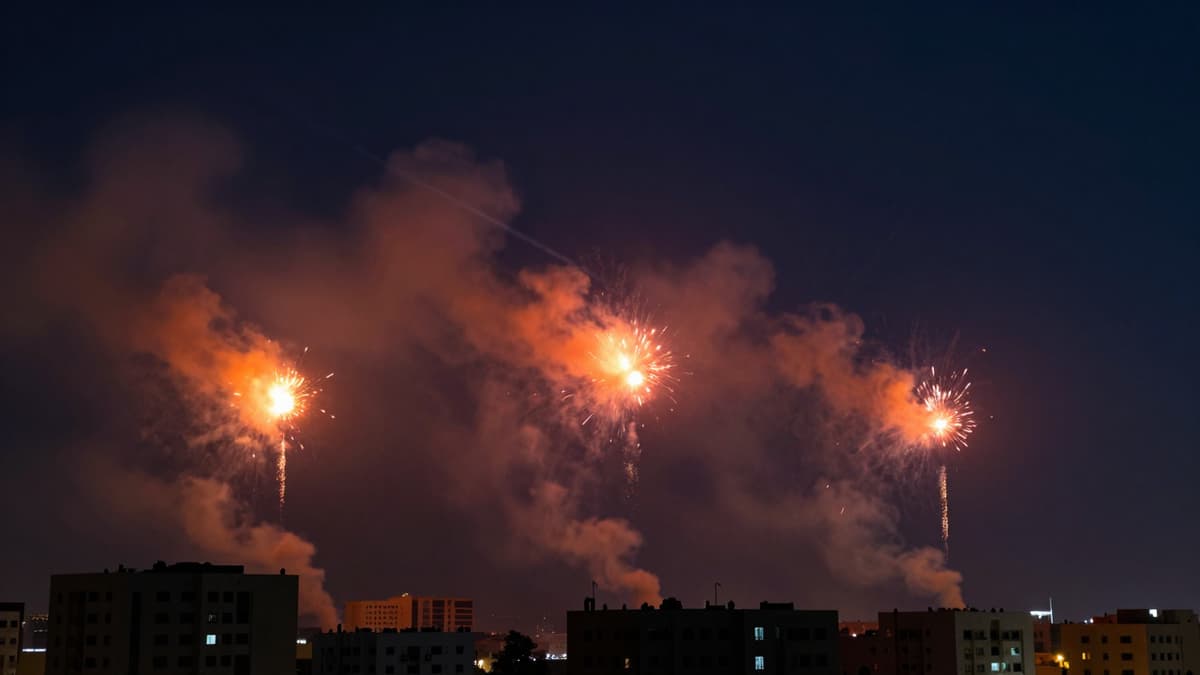
Iran rejects negotiations as Houthi rebels claim joint missile attack with Iran on Israel, while US President Trump suggests a potential war resolution within weeks.
Iran's Foreign Minister Abbas Araghchi has firmly declared that there are currently no grounds for negotiations with the United States regarding the ongoing conflict. Speaking in an interview with Al Jazeera on Wednesday, April 1, 2026, Araghchi explicitly stated that Tehran has not responded to a reported 15-point proposal from Washington aimed at ending the war. Despite this official stance rejecting talks, the Foreign Minister acknowledged that some direct messages had been exchanged between Tehran and US special envoy Steve Witkoff, though the Foreign Minister confirmed that Iran-United States negotiations have not progressed to a formal level.
The escalation of violence continued with a significant claim from Yemen's Houthi movement on the same day. On Wednesday, April 1, 2026, the Houthis asserted responsibility for a new missile attack targeting Israel. The group stated that this strike was launched jointly with their backers, Iran, and Lebanon's Hezbollah group. This incident marks the third such attack by the Houthis since they entered the war recently, signaling a deepening regional entanglement.
Simultaneously, security concerns spread to neighboring Gulf states. An Iranian drone attack targeted fuel tanks at Kuwait's international airport, sparking a large fire. According to Kuwaiti state news agency KUNA, the attack caused no casualties, but the breach of a critical infrastructure hub highlights the widening scope of the hostilities.
The conflict has also introduced specific threats against the global technology sector, directly involving major American entities. On Tuesday, March 31, Iran's Revolutionary Guards issued a stark warning regarding potential US tech firms retaliation. The military branch stated they would target approximately 18 leading U.S. technology companies, specifically naming Apple, Google, and Meta, if further Iranian leaders were killed in targeted assassinations. The statement warned that the destruction of relevant units belonging to these firms could be expected starting from 8:00 p.m. (1630 GMT) Tehran time on Wednesday, April 1, 2026.
Amidst these rising tensions, U.S. President Donald Trump provided a prediction regarding the timeline of the conflict. In his latest statement, Trump suggested that the war with Iran "may be over in two or three weeks," offering a counter-narrative to the immediate escalation of attacks. Meanwhile, reports from the Wall Street Journal, citing Arab officials, indicate that the UAE is preparing to assist the United States and other allies in opening the strait by force, suggesting a potential shift toward direct military intervention in critical waterways.
The complex interplay of these developments creates a volatile picture where diplomatic channels remain largely closed, yet the threat landscape expands to include economic and infrastructural targets across the region. The specific timing of the threats against technology firms and the Houthi claims of joint operations underscore the coordinated nature of the regional aggression, while the US President's timeline for the war's conclusion offers a glimmer of potential resolution amidst the chaos.
The situation on the ground indicates a fragile but intensifying crisis. The dismissal of the US proposal by Iran's Foreign Minister suggests that diplomatic avenues for de-escalation are currently blocked, potentially forcing other geopolitical actors to consider alternative measures. The involvement of the Houthis and Hezbollah in the attack on Israel, as well as the drone strike on Kuwait, demonstrates a unified front of proxy forces challenging US and Israeli interests.
The warning regarding the destruction of US technology units adds a new dimension to the conflict, moving beyond traditional military targets to include the digital and economic infrastructure of the United States. If the Revolutionary Guards follow through on their threat, the repercussions could extend beyond the immediate region, affecting global supply chains and market stability. The preparation by the UAE to assist in opening the strait by force further signals that military options are being actively considered to maintain or restore regional access to vital waterways.
The Houthi involvement, specifically their claim of a Houthi missile attack Israel conducted in coordination with Iran and Hezbollah, represents a critical escalation. By confirming their entry into the war and the coordination with Iran, the Houthis have transformed from a local insurgent force into a significant regional player capable of launching direct strikes on Israel. This development complicates the security calculus for Israel and its allies, necessitating a broader defense strategy that accounts for multiple fronts of attack. As the war enters its third week, the cumulative effect of these coordinated actions and threats will likely dictate the immediate future of the conflict and the stability of the entire West Asia region.
Jun 8, 2026 02:17 UTC
Magnitude 7.8 Quake Shakes Philippines, Urging Immediate Evacuations
Jun 8, 2026 00:51 UTC
Trump Claims Iran Nuclear Deal Imminent Despite Diplomatic Fractures
Jun 8, 2026 00:47 UTC
Iran Fires Missiles at Israel After Beirut Strike
Jun 7, 2026 22:00 UTC
US, Iran Peace Hops Fade 100 Days Into War
Jun 8, 2026 04:15 UTC
Trump Urges Netanyahu to Halt Iran Strike for Peace


