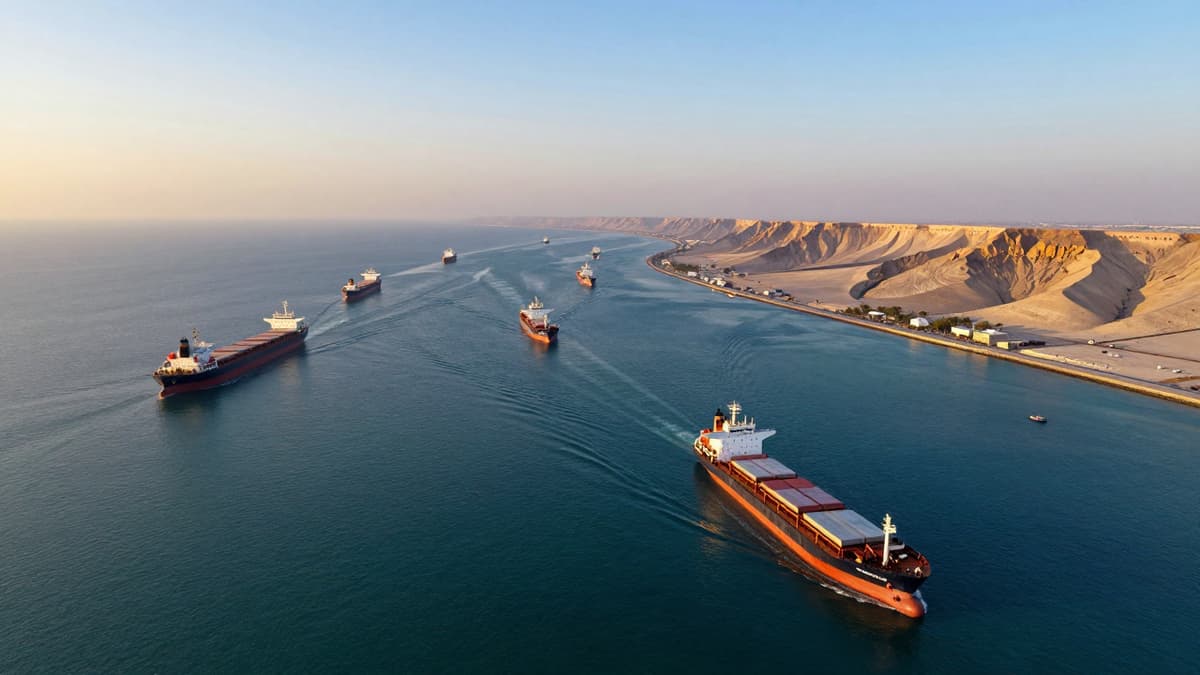
Iran has officially permitted India and four other friendly nations to transit the Strait of Hormuz, asserting its Iran sovereignty despite ongoing conflicts.
Iran's Foreign Minister Abbas Araghchi has confirmed that India and four other "friendly nations" have been granted permission to move their ships through the Strait of Hormuz. This announcement comes as Tehran firmly reasserts its control over the critical waterway connecting the Persian Gulf and the Gulf of Oman. The statement was made in an interview with the Iran News Network, broadcast on the night of March 25, 2026, during an ongoing period of high tension.
Araghchi stated that Iran sovereignty is now firmly established over the territorial waters involved in the strait. He emphasized that while new arrangements will be made after the war, the immediate decision allows specific nations to pass safely. The countries identified by the Foreign Minister include China, Russia, India, Iraq, and Pakistan. This decision follows a period where the strait, which previously saw more than a hundred ships pass daily, has seen traffic plunge to single digits since the conflict began.
The context of this decision is deeply rooted in the recent escalation of hostilities. The announcement comes shortly after an Iranian vessel, the IRIS Dena, was sunk in a U.S. attack in the Indian Ocean. The attack occurred on March 4 off the coast of Sri Lanka while the frigate was returning from exercises in Visakhapatnam. At least 87 sailors were killed in the incident. Araghchi expressed gratitude to India and Sri Lanka for their "significant help" in transferring the two other surviving Iranian ships, the IRIS Lavan and IRIS Bushehr, to safe locations in Kochi and Trincomalee, respectively.
Regarding the broader geopolitical landscape, Araghchi clarified the Iranian stance on dialogue with the United States. He stated firmly that "there has been no negotiation with the U.S." However, he noted that the American side has been sending various messages through different intermediaries recently. Iran has responded to these messages by stating their positions, describing the interaction as a simple exchange through friends. The Iranian position remains one of resistance and defense, with no current intention of negotiating under duress.
U.S. President Donald Trump, who had threatened strikes on Iran's power infrastructure, postponed such an attack on Monday. Trump subsequently claimed that Washington is in talks with Tehran. Pakistan's Deputy Prime Minister and Foreign Minister Ishaq Dar suggested that "indirect talks" are indeed taking place, facilitated by Pakistan relaying messages. Dar wrote that the United States has shared 15 points, which are currently being deliberated upon by Iran, with support from Turkey and Egypt.
In response to the U.S. initiative, Iran's state media reported on Wednesday that Tehran has dismissed the American proposal. Tehran has instead laid out a five-point plan to end the war. This plan includes demands for security guarantees against future aggression, war reparations, and a new framework to operate the Strait of Hormuz. Trump has warned Iran to "better get serious soon" in talks, stating that once a certain point is reached, there is "no turning back." Meanwhile, American media report that the Pentagon is moving troops to West Asia in preparation for a potential ground offensive.
Araghchi interpreted the U.S. move toward negotiation as an "admission of failure." He questioned why the U.S. was mobilizing its highest officials to negotiate after previously demanding "unconditional surrender" from Iran. He warned that a ceasefire without guarantees would create a "vicious cycle that repeats the war." Iran's position is clear: they did not seek war, but they will not accept a ceasefire that allows the enemy to attack them again. Since the U.S. and Israel launched the U.S.-Iran war on February 28, at least four India-flagged ships-the Jag Vasant, Pine Gas, Shivalik, and Nanda Devi-have successfully transited the strait under the new permissions.
Iran has formally rejected the U.S. proposal and presented a five-point plan to end the war, which serves as the new diplomatic foundation. This plan prioritizes security guarantees against future aggression and demands war reparations, signaling a shift from passive resistance to active condition-setting. If the U.S. fails to address these specific demands, the conflict is likely to deepen, potentially leading to a ground offensive as reported by Western media. The establishment of a new framework for the Strait of Hormuz could permanently alter regional trade dynamics, favoring nations that align with Tehran's security demands while excluding those who supported the initial hostilities.
Jun 8, 2026 02:17 UTC
Magnitude 7.8 Quake Shakes Philippines, Urging Immediate Evacuations
Join 50,000+ readers getting the global briefing every morning.
No spam. Unsubscribe anytime.
Jun 8, 2026 02:17 UTC
Magnitude 7.8 Quake Shakes Philippines, Urging Immediate Evacuations
Jun 8, 2026 00:51 UTC
Trump Claims Iran Nuclear Deal Imminent Despite Diplomatic Fractures
Jun 8, 2026 00:47 UTC
Iran Fires Missiles at Israel After Beirut Strike
Jun 7, 2026 22:38 UTC
Congress Party Claims Unity for INDIA Bloc Delhi Meeting


