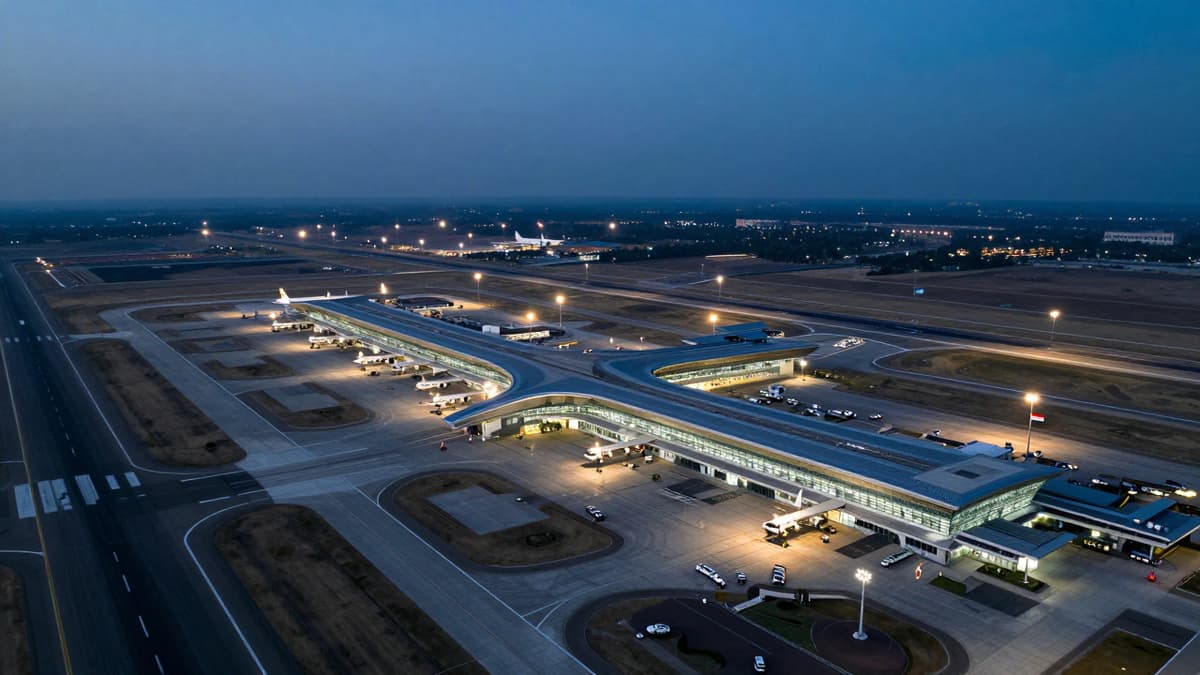
Prime Minister Narendra Modi inaugurates a colossal new aviation hub in Noida, signaling a massive infrastructure push to transform India into a global travel leader.
The world's most populous nation has officially opened one of its most ambitious infrastructure projects, marking a pivotal moment for Indian aviation. Prime Minister Narendra Modi inaugurated the Noida International Airport on March 28, more than four years after he laid the foundation stone for the facility. This massive development, located in the town of Jewar within Delhi's National Capital Region, is touted as one of the largest aviation hubs in South Asia.
The timing of this inauguration serves as a strategic public relations boost for India's aviation sector, which is currently navigating a global fuel shortage crisis. The sector is particularly sensitive to the ongoing conflict between the US, Israel, and Iran, which has blocked numerous oil ships in the Middle East. Despite these external pressures, India is aggressively pushing forward with its infrastructure goals, positioning itself as the third-largest aviation market globally.
The new facility, identified by the call sign DXN, represents a significant milestone in the country's transportation network. It follows the recent debut of the Navi Mumbai International Airport, which began operations last October to serve India's financial capital. The opening of Noida International marks the most significant step for Indian aviation since that earlier launch. Uttar Pradesh, the surrounding state, is now recognized as India's first state to boast five international airports.
Located approximately 50 miles southeast of New Delhi, the airport is designed to alleviate congestion at the busy Indira Gandhi International Airport. However, full operations will not commence immediately. Flights are scheduled to begin in mid-April, with services ramping up gradually. The initial capacity target is set to accommodate 12 million passengers annually. This figure is projected to grow significantly over the decades, reaching a staggering 70 million by 2050. This long-term target would surpass the pre-war passenger numbers recorded at Dubai International, currently the world's busiest airport.
The financial scale of the project is immense, with a total cost of 296 billion rupees, equivalent to $3.13 billion USD. The project has faced a complex history and multiple delays. Originally conceived in 2001 as the Taj International Airport, real planning for the facility began much later, in 2018 and 2019. Although the name was changed, the strategic location south of Delhi was intended to facilitate access to the Taj Mahal, the UNESCO World Heritage site in Agra. This location is crucial for the "golden triangle" tourism route, which includes Delhi, Agra, and Jaipur, a path explored by many first-time travelers to India.
Subhash Goyal, chairman of the country's Aviation and Tourism Committee, noted that the airport was long overdue. He highlighted that major global cities like Paris, Beijing, and New York all operate multiple airports to distribute crowds effectively. India, similarly, aims to compete with these top-tier travel markets. The press release from the airport states that the goal is to connect the greater Delhi area and Western Uttar Pradesh with destinations across India and the rest of the world.
Uttar Pradesh holds special significance as the home constituency of Prime Minister Modi. His Bharatiya Janta Party government has actively pursued the development of India's second-tier cities. Modi stated during the ceremony, "Aircraft will fly from here to the world, and this airport will also become a symbol of a developed Uttar Pradesh taking flight." He further emphasized that the area is strengthening the resolve of Aatmanirbhar Bharat. This policy, meaning "self-reliant India," is a cornerstone of Modi's agenda to transform the country into a hub that is less dependent on external technology and manufacturing sources.
Despite the grand opening, experts urge a realistic view of the airport's immediate impact. Sanjay Lazar, an Indian aviation analyst, cautioned that the new airport is not a "magic bullet" for all of the capital's transportation challenges, particularly regarding traffic. While the expressway connecting the airport is complete and described as a boon, Lazar noted that interconnectivity is not yet fully realized. He suggested that ideally, a high-speed rail or metro line should connect the airports directly to Delhi to fully maximize efficiency.
Nevertheless, the momentum behind Indian aviation remains strong. At the unveiling of the Navi Mumbai International Airport last year, Modi highlighted the rapid expansion of the sector. He pointed out that in 2014, India had only 74 airports. A decade later, that number has risen to 160 and continues to grow. Lazar, the analyst, confirmed that aviation is booming in India and will likely continue to expand at a robust pace for the next two decades.
As India welcomes the world to its latest aviation gateway, the nation stands on the precipice of a transformative era in travel infrastructure. The shift from a single hub strategy to a multi-airport model, exemplified by the integration of Noida and the earlier Mumbai launch, signals a decisive move toward managing surging domestic and international demand. With passenger capacity targets stretching toward 70 million annually by 2050, the airport is poised to not only relieve congestion at Delhi's existing facilities but also serve as a catalyst for economic development in Western Uttar Pradesh. The alignment with the Aatmanirbhar Bharat initiative suggests that this infrastructure boom is just the beginning of a broader effort to establish India as a self-sufficient global powerhouse in aviation technology and tourism. While connectivity challenges remain, the trajectory indicates a sustained period of growth, positioning India as a critical node in the global aviation network for years to come.
Jun 8, 2026 02:17 UTC
Magnitude 7.8 Quake Shakes Philippines, Urging Immediate Evacuations
Jun 8, 2026 00:51 UTC
Trump Claims Iran Nuclear Deal Imminent Despite Diplomatic Fractures
Jun 8, 2026 00:47 UTC
Iran Fires Missiles at Israel After Beirut Strike
Jun 7, 2026 22:00 UTC
US, Iran Peace Hops Fade 100 Days Into War
Jun 8, 2026 04:15 UTC
Trump Urges Netanyahu to Halt Iran Strike for Peace


