
Section
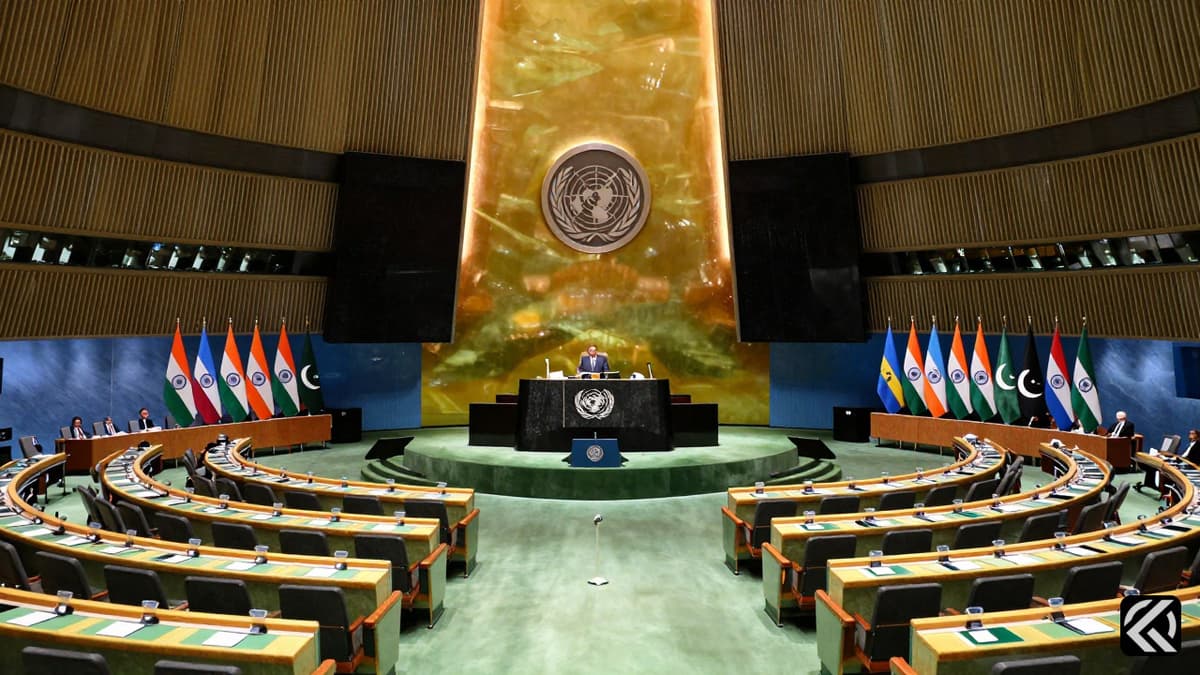
India firmly rebukes Pakistan at the UN General Assembly, condemning the misuse of the UN Security Council seat to propagate misleading narratives about Jammu and Kashmir.
India has firmly condemned Pakistan for its recent actions at the United Nations, describing its references to the Union Territory of Jammu and Kashmir as an "unwarranted" attempt to exploit a global platform for biased political narratives. The strong rebuttal came from India’s Permanent Representative to the United Nations, Ambassador Parvathaneni Harish, during the UN General Assembly session on Friday, June 5, 2026. Harish addressed Pakistan’s Permanent Representative, Ambassador Asim Iftikhar Ahmad, who had raised the Kashmir issue during his remarks on the ‘Annual Report of the Security Council’. The incident highlights the ongoing diplomatic friction between the two neighbors, with India asserting that the UN should not be used as a venue for internal political disputes.
The conflict in rhetoric escalated as Harish pointed out that Pakistan, despite its current status as a non-permanent member of the Security Council, has repeatedly attempted to misuse august UN platforms for divisive interests. He noted that Pakistan’s tenure on the Security Council is set to end this year, yet it has chosen not to spare the current forum from its "characteristic misuse." Harish specifically cited the circulation of "misinformed and misleading communications" by Pakistan as evidence of a counter-productive approach. He reminded the Pakistani delegation that holding a seat on the UN Security Council is a "huge responsibility" that requires adherence to international norms rather than the propagation of false narratives.
Harish emphasized that any assertions suggesting otherwise regarding Jammu and Kashmir are "baseless, devoid of and inconsistent with historical facts." He clarified that the territory is, is, and will always remain an "integral and inalienable part of India." The Indian envoy stated that such "empty rhetoric and hollow claims" by Pakistan would not alter this fundamental reality. To save time for the wider UN membership, Harish indicated he would not delve further into the specific details of Pakistan's claims, instead focusing on the broader structural issues within the United Nations itself.
Beyond the immediate diplomatic spat, Harish used the platform to address the urgent need for Security Council reform. He argued that the current structure, which reflects geopolitical realities of 1945, is unfit for contemporary challenges. The "marginal" reforms of the 1960s, which only expanded the non-permanent category, have not significantly changed the fundamental mode of functioning of the body. Harish asserted that retaining the status quo has prevented effective functioning in the past and will continue to do so in the future. He stressed that "expansion of both permanent and non-permanent categories is central to implementing real and meaningful reform."
This push for reform aligns with the proposals put forward by the G4 nations-India, Brazil, Germany, and Japan. These nations have advocated for increasing Security Council membership from the current 15 to 25 or 26 members. The proposed reformed Council would consist of 11 permanent members and 14 or 15 non-permanent members. Currently, the powerful UN organ comprises five veto-wielding permanent members: China, France, Russia, the UK, and the US. The remaining 10 members are elected for two-year terms as non-permanent members. India last held a non-permanent seat during the 2021-22 term, providing it with recent firsthand experience of the council's dynamics.
Harish’s statements serve as a clear warning to Pakistan regarding its conduct as a council member. By linking the criticism of Pakistan’s narrative tactics to the broader argument for structural reform, India positions itself as a proponent of a more representative and effective international body. The Indian envoy’s refusal to engage further with Pakistan’s specific claims underscores New Delhi’s stance that the issue of Kashmir is strictly internal and not subject to international adjudication or narrative disputes. This approach reinforces India’s diplomatic strategy of isolating Pakistan’s efforts to internationalize the Kashmir issue while simultaneously advocating for changes that could bolster India’s own long-term diplomatic interests through council expansion.
India’s rebuttal to Pakistan’s narrative attempts underscores the necessity for a reformed Security Council that reflects modern geopolitical realities rather than 1945 power dynamics. As the G4 nations continue to push for expanded membership, the current non-permanent tenure of countries like Pakistan highlights the transient nature of council influence. The ongoing diplomatic tension suggests that future sessions will likely see increased scrutiny of how member states utilize their platforms. If structural reforms are not realized, the disconnect between the council’s composition and contemporary global challenges will persist, potentially limiting its effectiveness in handling future international disputes. The focus on internal sovereignty, as asserted by India, indicates that such territorial disputes will remain non-negotiable within international forums unless resolved bilaterally.
Jun 11, 2026 17:21 UTC
Bangladesh Opposition Mobilizes Against India-Bangladesh Border Push-Ins and BSF Killings
Join 50,000+ readers getting the global briefing every morning.
No spam. Unsubscribe anytime.
Jun 11, 2026 17:40 UTC
Boelter Pleads Guilty in Minnesota Political Assassinations
Jun 11, 2026 17:21 UTC
Bangladesh Opposition Mobilizes Against India-Bangladesh Border Push-Ins and BSF Killings
Jun 11, 2026 17:21 UTC
John Healey Quits as UK Defence Secretary Over Funding Dispute
Jun 11, 2026 16:19 UTC
UK Defence Secretary John Healey Quits Over Funding Dispute


