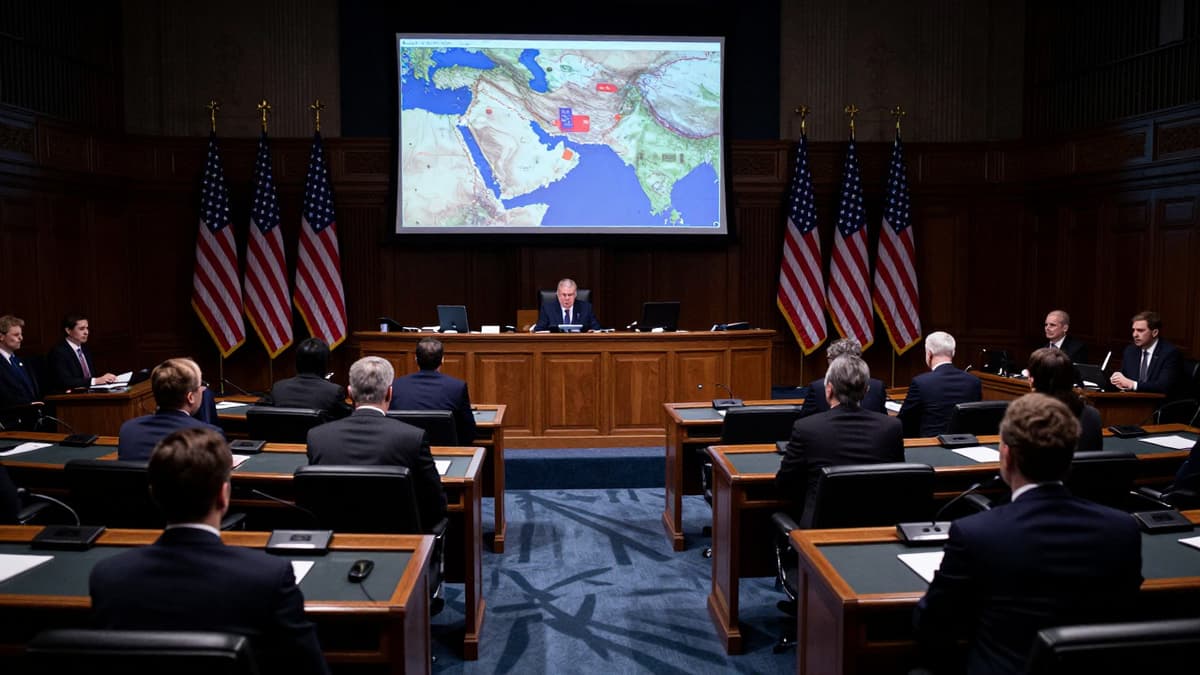
Lawmakers voice deep dissatisfaction with Trump administration war details, while polls show US public turning against military action in Iran.
Members of the House Armed Services Committee voiced their dissatisfaction with a recent Trump administration briefing regarding the ongoing conflict in Iran, marking a significant moment of internal friction. The frustration stems from lawmakers feeling that officials failed to provide sufficient clarity on the war's specific objectives and the projected timeline for its conclusion. This lack of transparency has sparked growing angst regarding the war effort, even among members of the President's own party. The committee members are now bracing for a supplemental request to fund the war effort and restock the munitions that have already been depleted.
Rep. Nancy Mace, a Republican from South Carolina, stated she felt "misled" during the session, noting that the officials "didn't have a lot of answers." Consequently, she declared she would not vote for additional funding at this time, warning that "the longer this goes on, the less support for the war." In contrast, Rep. Clay Higgins, also a Republican, expressed personal satisfaction with the briefing despite describing the session as "contentious." Higgins suggested that some members entered the room determined to remain unsatisfied with the administration's performance. Other committee members, such as Rep. Derrick Van Orden, a Navy SEAL veteran, indicated opposition to deploying troops on the ground in Iran while remaining supportive of approving requests for more military funding.
The House Armed Services Committee frustration was further amplified by top Democrats. Rep. Adam Smith, the committee's ranking member, highlighted a persistent "gap" between the administration's stated objectives and the ability to effectively execute them. He argued that his GOP colleagues are now "caught" in a difficult messaging position. Rep. Jason Crow, a combat veteran, echoed these sentiments, stating that Congress is still "not getting answers" regarding the strategy and end game. Crow noted that with the war now entering its fourth week, there are "more questions than answers."
Public sentiment has turned sharply against the military intervention. According to a new Pew Research survey released Wednesday, 59% of Americans believe the US made the wrong decision in using military force in Iran, compared to 38% who disagree. Only 25% of Americans say the military action is going "extremely or very well," while 45% feel it is going "not too well or not at all well." Furthermore, a 61% majority disapprove of how President Donald Trump is handling the military action, with only 37% approving.
Recent polling data underscores a divided nation. An AP-NORC poll found that 59% of US adults believe the recent military action has "gone too far," while 26% think it has been "about right." A Quinnipiac University poll shows registered voters opposing the action 54% to 39%, with views sharply polarized by party. While 92% of Democratic voters and 64% of independent voters oppose the action, 86% of Republican voters support it. Despite this polarization, the overall level of opposition remains stable compared to earlier polls taken in March.
Amidst this political turbulence, White House Press Secretary Karoline Leavitt addressed reporters, stating that "productive" talks continue despite Iran's initial rejection of a 15-point US plan to end the war. Leavitt maintained the US timeline remains four to six weeks, noting that President Trump's preference is "always peace." However, when asked if the President would seek congressional authorization before deploying additional troops, she declined to promise such a step, asserting that at the moment, it is "unnecessary" and that the President "likes to maintain options at his disposal." Leavitt also denied reports that Vice President JD Vance is becoming an active participant in negotiations, though she admitted it is "too soon to say" if the administration is satisfied with new Iranian leadership.
The human cost of the conflict continues to escalate across the region. CNN, tracking figures from regional authorities, reports that the death toll is mounting in Iran, Lebanon, and Iraq. In Iran, state-run IRNA reported that more than 1,750 people have been killed since the war began on February 28. A separate report by the US-based Human Rights Activists News Agency (HRANA) estimated at least 1,455 civilians, including 217 children, and 1,167 military personnel killed, with 669 other fatalities categorized as unclassified.
In Lebanon, the Health Ministry stated that at least 1,094 people have been killed in Israeli strikes since March 2, including 121 children. In Iraq, authorities report at least 96 deaths since the conflict began, including seven Iraqi service members killed in an attack on a Defense Ministry clinic. The Kurdistan Regional Government reported at least 13 deaths in the region, including six Kurdish Peshmerga fighters.
Violence has also struck Israel, where at least 17 people have been killed by strikes inside the country, including a civilian killed by friendly fire. A woman was also killed by Hezbollah rocket fire, and two Israeli soldiers died in Lebanon in early March. On the US side, thirteen service members have been killed since the start of the conflict, including a tragic crash of a refueling aircraft in Iraq and an Iranian strike on a makeshift operations center in Kuwait. Deaths have also been reported in the United Arab Emirates, Qatar, Kuwait, the occupied West Bank, Oman, Bahrain, and Saudi Arabia.
As the conflict enters its fourth week, the White House is reportedly working to arrange a meeting in Pakistan to discuss an off-ramp to the war. President Trump's stance appears to have shifted from an initial ultimatum regarding the Strait of Hormuz to seeking a negotiated settlement, following conversations with a mystery official in Tehran. While the US has shared a 15-point list of expectations via Pakistan, an Iranian official has outlined five conditions for ending the war, though they continue to reject the idea of a ceasefire. Given the high levels of public disapproval and the deepening concerns within Congress regarding the lack of a clear strategy, the coming weeks will likely see intensified pressure on the administration to define a concrete path to resolution or face significant political fallout. The stability of the region and the administration's domestic standing now hinge on the success of these diplomatic overtures versus the realities of a prolonged and costly military engagement.
May 9, 2026 19:32 UTC
Hardliners Sabotage Iran-US Negotiations Amidst Fractured Regime
May 9, 2026 17:43 UTC
Moscow's Stripped-Down Victory Day: A Shift in Military Display
May 8, 2026 19:28 UTC
Iran Transforms Destroyed B1 Bridge Into Symbol of Resistance
May 8, 2026 15:53 UTC
China Confirms Technical Aid for J-10CE Fighter Jets in Regional Conflict
May 10, 2026 07:57 UTC
Celebrate 2026 Mom with Heartfelt Tributes and Humor


