Section
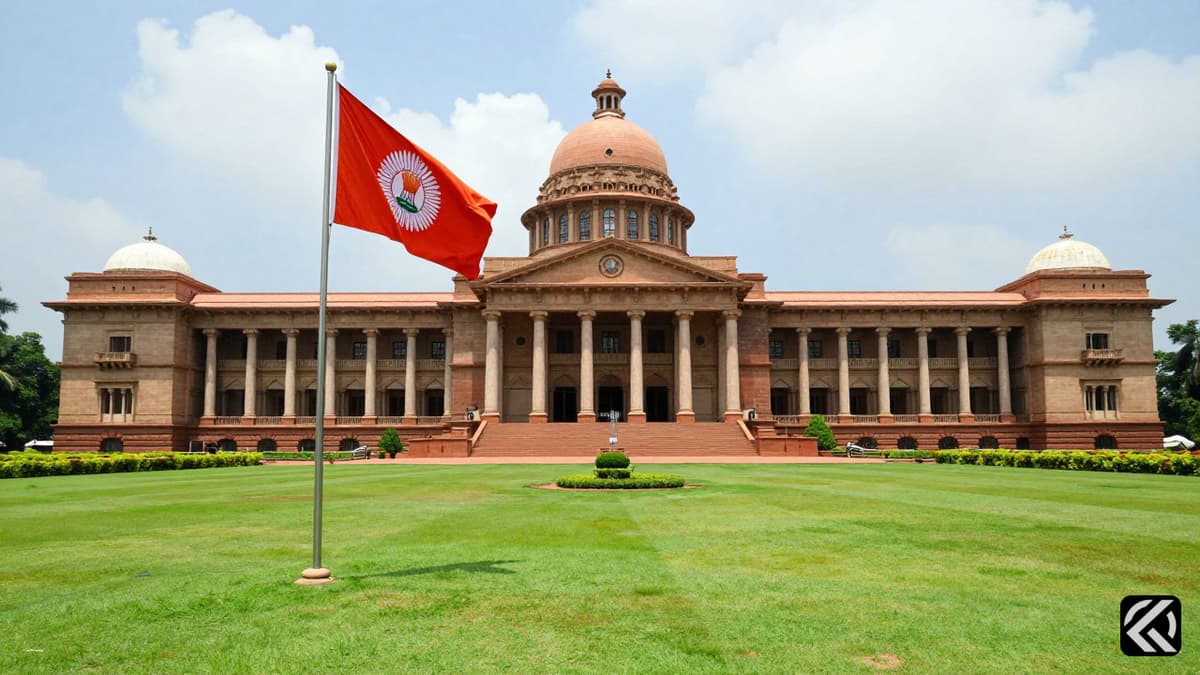
Tamil Nadu faces a pivotal political moment as the Governor demands proof of majority support from Vijay, with Congress extending crucial backing.
The political landscape in Tamil Nadu has shifted dramatically following the recent assembly election results. Governor Rajendra Vishwanath Arlekar has formally requested that C. Joseph Vijay, the president of the Tamilaga Vettri Kazhagam (TVK), provide concrete evidence of support from 118 legislators. This number represents the simple majority required to form a government in the 234-member Assembly. The Governor arrived in the afternoon at Lok Bhavan from Kerala, where he also holds office, to meet with Vijay and other senior party leaders. Sources indicate that the Governor insists on seeing these letters before extending the invitation to form the government, a legal entitlement given that the combined strength of the existing DMK front (68 seats) and AIADMK front (53 seats) would theoretically exceed the coalition's numbers.
This demand comes amidst a significant realignment of political alliances in the state. The Indian National Congress, which secured five seats as part of the DMK alliance, has abruptly terminated its over two-decade-old partnership with the Dravidian major party. Instead, Congress has chosen to extend its support to Vijay’s TVK. Reports suggest that if the coalition forms a government, Congress could be offered two Cabinet berths. This move is described by AICC in-charge Girish Chodankar as being founded on "mutual respect, appropriate share, and shared responsibility." Chodankar emphasized that this alliance aims not only for immediate governance but also for future local, Lok Sabha, and Rajya Sabha elections. The support is conditional, specifically requiring the TVK to exclude any communal forces that do not uphold the Constitution of India.
The math of the new coalition presents both opportunity and challenge. The TVK won 108 seats in the recent election. However, because C. Joseph Vijay holds two seats, he must resign one to join the government, while the other will be held by the Speaker, who can only vote in the event of a tie. Consequently, the effective number of legislators available to the TVK is 107. With Congress’s five MLAs joining the fold, the coalition’s total strength becomes 112. Therefore, the TVK still needs the backing of at least six to seven additional legislators to reach the 118 mark. This has put pressure on other allies. The Communist Party of India (Marxist), the CPI, and the Viduthalai Chiruthaigal Katchi, which won two seats each, have indicated they are seeking separate discussions with the TVK. However, their leaders stated they would make final decisions only after holding internal party meetings. Meanwhile, the Indian Union Muslim League, another DMK ally with two legislator-elects, has already announced it will not extend support to the TVK.
Opposition parties have been quick to react to these developments. AIADMK senior leader K.P. Munusamy categorically dismissed rumors of cooperation. Following a meeting chaired by party general secretary Edappadi K. Palaniswami, Munusamy told journalists that reports claiming the AIADMK would support the TVK were "not true." This firm stance from the AIADMK highlights the tight margins the TVK faces in securing a stable government. The Governor’s requirement for hard proof of numbers is thus not merely procedural but a critical test of the coalition's actual viability. Without additional allies, the TVK-Congress combination falls short of the majority needed to govern effectively.
The timing of these events adds further complexity. The Governor dissolved the 16th Tamil Nadu Legislative Assembly with effect from May 5, 2026, creating a vacuum of authority. In the evening of May 6, top government officials met at Vijay’s residence in Foreshore Estate to extend greetings, a gesture that suggests continuity and acknowledgment of the political shift. However, the administrative machinery remains in limbo until a government is sworn in. The Congress’s decision to break ties with the DMK is viewed by analysts as a strategic move to gain influence in future elections, aiming to bring back the "glory days" of Kamaraj and uphold the social justice ideals of Periyar and Ambedkar. Chodankar stated that Vijay and Rahul Gandhi have jointly pledged to respect the people’s verdict for a secular and progressive government, particularly addressing the dreams of Tamil Nadu's youth.
The immediate future of Tamil Nadu’s administration hinges on the TVK’s ability to secure the remaining legislative support required to cross the majority threshold. The Governor’s demand for proof of 118 MLAs is a strict legal filter that cannot be bypassed. If the TVK fails to attract additional allies from the Communist parties or other unaligned legislators, the state may face a period of prolonged uncertainty or even fresh elections. The Congress’s conditional support offers a lifeline but also inserts significant ideological and policy constraints into the potential coalition. The denial of support from the AIADMK leaves the opposition fragmented, reducing their immediate ability to challenge the new government if it forms. Long-term, this break in the DMK-Congress alliance could reshape the political fabric of Tamil Nadu, potentially leading to new political blocs or a realignment of Dravidian politics. The TVK’s success or failure in navigating these narrow margins will define its initial political capital and relationship with traditional allies in the coming years.
Jun 11, 2026 12:59 UTC
US Strike on Settebello Kills Indian Sailors Amid Strait of Hormuz Tensions
Jun 11, 2026 12:49 UTC
Air India Flight 171 Crash Sparks Debate Over Boeing 787 Dreamliner Faults
Jun 11, 2026 08:51 UTC
US-Iran Conflict: Indian Seafarers Killed in Gulf Strike
Jun 11, 2026 18:04 UTC
Healey Quits Government Over Defence Spending Dispute