
Section
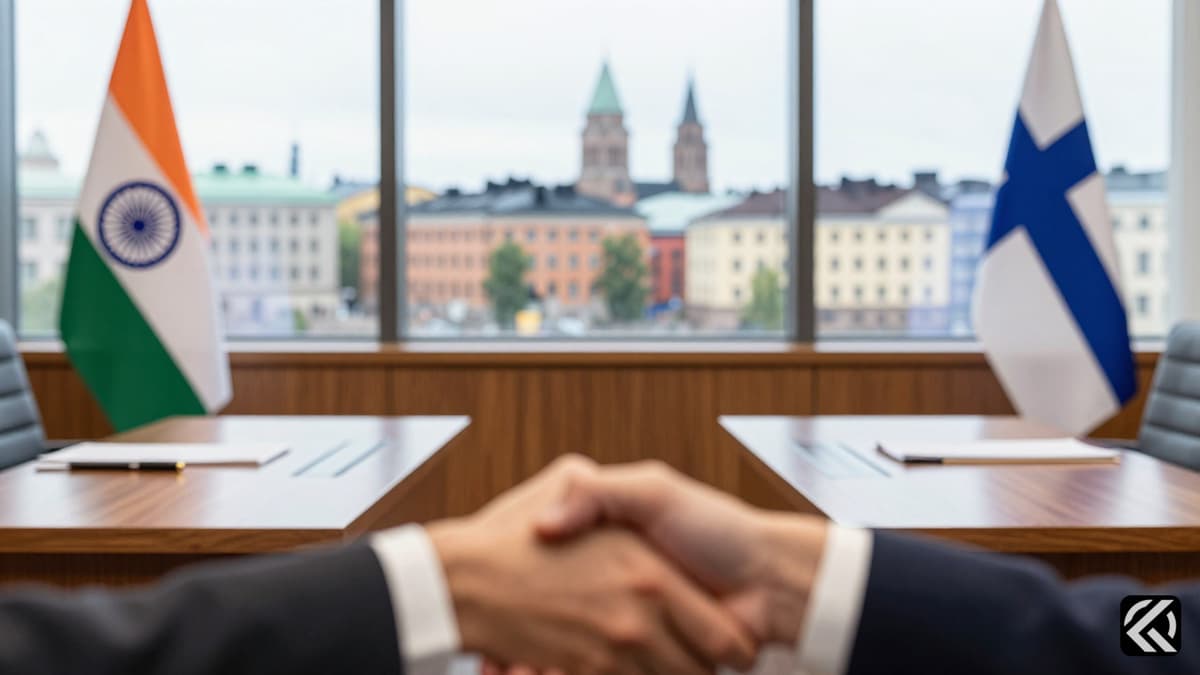
Amidst heightened diplomatic engagement, Finland Prime Minister Petteri Orpo urges India to accelerate the India-EU FTA and leverage its influence to help resolve the ongoing conflict in Ukraine.
The diplomatic relationship between India and Finland has intensified significantly this year, marked by high-level engagements that underscore both economic ambition and geopolitical alignment. This strategic deepening was highlighted by Prime Minister Narendra Modi’s hosting of Finnish Prime Minister Petteri Orpo during the Artificial Intelligence Summit in Delhi earlier this year. Following that, Finnish President Alexander Stubb served as the chief guest at the Ministry of External Affairs’ signature event, the Raisina Dialogue, in March. The momentum continued in Oslo, where Mr. Modi held bilateral talks with Mr. Orpo again, subsequently engaging him at the Nordic-India summit. Speaking on the sidelines of this recent summit, Mr. Orpo articulated clear expectations for New Delhi, expressing Finland’s hope that the India-EU FTA is ratified by all 27 member states and signed at the earliest possible opportunity. Furthermore, the Finnish leader reiterated Helsinki’s keen interest in seeing Mr. Modi play a constructive role in ending the protracted Russia-Ukraine conflict. This diplomatic push comes as Mr. Modi returns from a comprehensive four-nation tour to the Netherlands, Sweden, Norway, and Italy, with further European engagements, including the G-7 Summit, already scheduled for later in the year.
The timeline of engagements reveals a rapid acceleration in Indo-Finnish political interaction. The year began with significant virtual and physical high-level contacts, setting a tone of collaborative intent. The hosting of the Artificial Intelligence Summit by Mr. Modi and the presence of President Stubb at the Raisina Dialogue were not isolated incidents but part of a broader strategy to integrate India into key European security and economic frameworks. Finland, having joined the North Atlantic Treaty Organization (NATO) in 2023 as one of the last European countries to do so, approaches these bilateral relations with a heightened sense of strategic security and economic partnership. During the Nordic-India summit, Mr. Orpo’s comments to The Hindu were explicit regarding the trade agreement. He emphasized that Finland is eager for the full ratification process across the European Union’s 27 nations to conclude swiftly. This diplomatic urgency is mirrored in Prime Minister Modi’s recent schedule. After concluding his visit to Italy on Thursday, May 21, 2026, Mr. Modi’s itinerary points toward sustained engagement with European leadership. He is scheduled to return to Europe in June for the , a visit to Nice in France, and a bilateral visit to Slovakia. These planned movements suggest that the trade discussions initiated by Finnish leaders are likely to be echoed by other European counterparts during these upcoming interactions.
Sources indicate that the Prime Minister is expected to make another trip to Brussels later this year, specifically for the signing of the India-EU FTA. This anticipated event underscores the tangible nature of the diplomatic goals discussed in Helsinki. The push for early ratification by Finland aligns with broader European desires to formalize trade links with India, a major emerging market. However, the simultaneous request for India’s role in the Ukraine conflict highlights the complex geopolitical balancing act New Delhi must navigate. Finland’s recent accession to NATO has sharpened its focus on security cooperation with non-aligned but strategically vital partners like India. The dual focus on trade and peace mediation reflects a holistic diplomatic approach, where economic benefits are intertwined with broader international stability. Mr. Modi’s engagement with Mr. Orpo in Oslo and at the Nordic-India summit serves as a precursor to these larger multilateral and bilateral commitments. The explicit mention of the FTA’s signing in Brussels suggests that negotiations are in advanced stages, with Finland acting as a vocal proponent for swift implementation. This diplomatic trajectory, marked by frequent summits and clear policy objectives, indicates that India-EU relations are entering a phase of concrete implementation rather than mere exploratory dialogue.
The intensified diplomatic dialogue between New Delhi and Helsinki suggests a near-term acceleration of trade formalizations and a potential shift in regional security dynamics. With Finland advocating for the early ratification of the India-EU FTA and India’s leadership preparing for high-profile summits, the trade deal may see significant momentum. Concurrently, Finland’s continued pressure on India to mediate in Ukraine indicates that New Delhi’s geopolitical leverage is increasingly valued by European NATO members. As Prime Minister Modi prepares for the G-7 Summit and subsequent visits to France and Slovakia, these bilateral pressures are likely to broaden into multilateral consensus, potentially stabilizing European trade policies and influencing future peace mediation efforts in Eastern Europe.
Jun 11, 2026 17:21 UTC
Bangladesh Opposition Mobilizes Against India-Bangladesh Border Push-Ins and BSF Killings
Join 50,000+ readers getting the global briefing every morning.
No spam. Unsubscribe anytime.
Jun 11, 2026 17:40 UTC
Boelter Pleads Guilty in Minnesota Political Assassinations
Jun 11, 2026 17:21 UTC
Bangladesh Opposition Mobilizes Against India-Bangladesh Border Push-Ins and BSF Killings
Jun 11, 2026 17:21 UTC
John Healey Quits as UK Defence Secretary Over Funding Dispute
Jun 11, 2026 16:19 UTC
UK Defence Secretary John Healey Quits Over Funding Dispute


