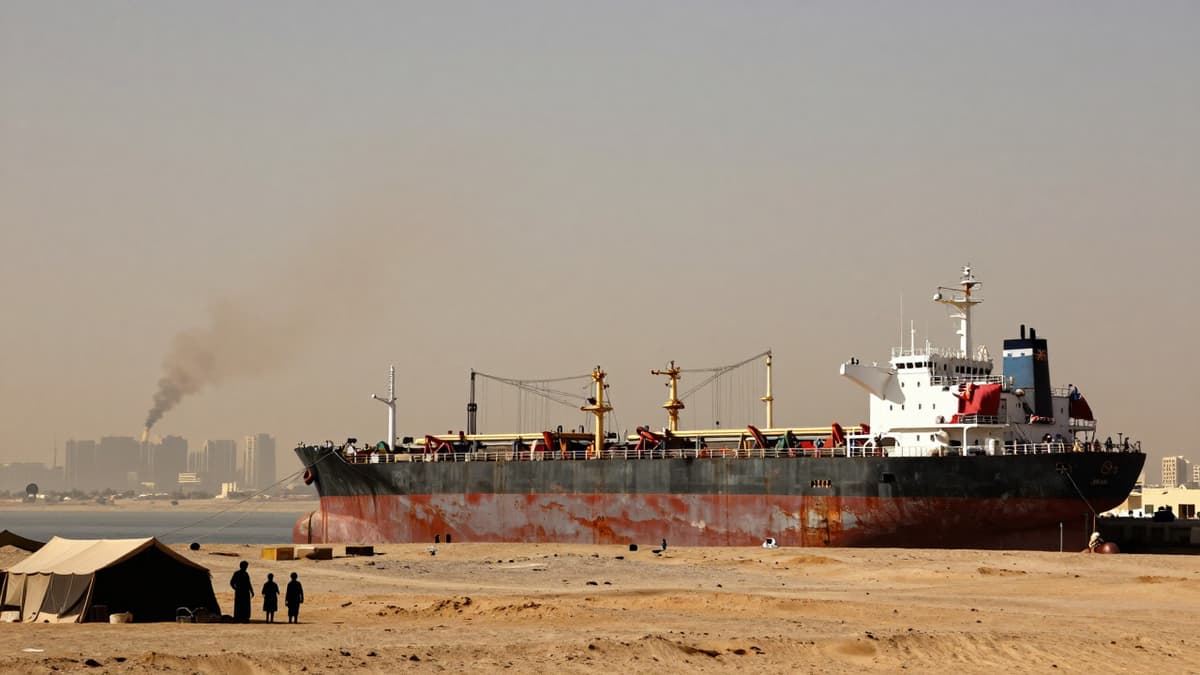
Global tensions surge as the Iran-Israel War drives oil prices higher, prompting Australia to underwrite fuel purchases, while Lebanon displacement leaves hundreds of thousands in peril.
The Iran-Israel War has intensified, sending oil prices soaring and forcing Australia to implement new Australian fuel security measures on Saturday. Prime Minister Anthony Albanese confirmed that the government will underwrite fuel purchases to ensure supply, while UNICEF warns that relentless bombardment is causing severe Lebanon displacement.
This emergency response comes as the conflict in the Middle East disrupts global energy markets and creates a humanitarian catastrophe. Australia's government explicitly stated that this support is not "business as usual." Prime Minister Albanese explained that the underwriting applies to "additional supplies that are available on the international market" to physically transport shiploads of fuel to the nation. Energy Minister Chris Bowen highlighted the urgency, noting that demand in rural Australia is exceptionally high during the busy agricultural season, yet current supplies remain insufficient. To alleviate immediate shortages, officials had earlier released 763 million liters of petrol and diesel from reserves to aid farmers.
The humanitarian cost of the escalating hostilities is particularly acute in Lebanon. The UN's children's agency, UNICEF, reported that children are trapped in a "relentless cycle of bombardment and displacement," with nearly 20% of the population forced to flee. Many have been displaced multiple times since March 2, with over 367,000 school-age children facing significant disruption to their education. Marcoluigi Corsi, the UNICEF country representative, emphasized that there is "no safe space" for people to shelter. The danger is compounded by Israeli strikes near makeshift shelters in central Beirut, where displaced people are huddled together, according to Karolina Lindholm Billing of the UN's refugee agency.
The geopolitical landscape is shifting rapidly, with US President Donald Trump addressing the Future Investment Initiative summit in Miami Beach. Regarding the Iran-Israel War, Trump stated that there are "another 3,554" targets remaining to be hit, asserting that the conflict is "not finished yet." He introduced a specific legal distinction, calling the situation a "military conflict" rather than a "war," citing a "legal reason" for this terminology. Trump also suggested the US might scale back spending on NATO allies who he claimed "are not there for us." Furthermore, he referred to the Strait of Hormuz as the "Strait of Trump" and claimed Iran allowed oil tankers to transit the waterway to "make up for their misstatement" after denying involvement in negotiations. He also urged more Middle Eastern nations to sign the Abraham Accords.
Casualty figures across the region continue to climb, painting a grim picture of the war's impact. In Iran, the Iranian Red Crescent reported that at least 1,900 people have been killed and 20,000 injured since February 28. The head of the Iranian delegation, Maria Martinez, described harrowing scenes where paramedics rescuing survivors from flattened buildings have discovered the bodies of their own family members. In Lebanon, the Ministry of Health confirmed that Israeli strikes have killed 1,142 people and injured 3,315 others since March 2, including 122 children and 42 health workers.
The violence has also extended to Iraq and Israel. At least 96 people have been killed across Iraq, with 13 fatalities in the Kurdistan Region. In Israel, the military reported that 19 civilians have been killed since the latest escalation, alongside four soldiers killed in southern Lebanon. Additionally, an Iranian missile attack in the Israeli-occupied West Bank killed four Palestinians, while an Israeli cluster munitions strike in Israel injured two others. US Central Command confirmed that 13 US service members have been killed since late February, with a recent attack on Prince Sultan Air Base in Saudi Arabia injuring at least 10 more.
The nuclear infrastructure of Iran is also under fire. The Atomic Energy Organization of Iran stated that the Bushehr nuclear power plant was struck by a projectile late Friday night, marking the third attack on the facility in recent days. In response, Iran's Foreign Minister Abbas Araghchi condemned the strikes on nuclear facilities and threatened a "HEAVY price for Israeli crimes." Meanwhile, US special envoy Steve Witkoff indicated that negotiations with Iran could take place "this week."
On the ground, the human toll is visible in the devastated neighborhoods. CNN analysis of images published by Iranian state media revealed US-origin anti-tank land mines scattered in a residential area near Shiraz. In Beirut, video footage from Reuters showed families, including newborns and the elderly, huddled in improvised shelters where Israeli bombs have destroyed entire neighborhoods. The healthcare system is depleted, with women reporting the psychological shock of giving birth without doctors and newborns lacking access to adequate medication. UN Women reports that 620,000 women and girls have been forced to flee, with many skipping meals to feed their children and older women unable to access chronic disease medication.
The conflict continues to reshape regional alliances and defense postures as the US and Iraq agree to intensify their defense cooperation, explicitly aiming to keep Iraq out of the direct war with Iran. While US special envoy Steve Witkoff expects negotiations with Iran to occur this week, the President maintains a hardline stance on military targets, suggesting the "legal reason" for his terminology may influence future strategic decisions. As the war enters its fourth week, with nearly 73,000 deaths in Gaza alone since October 7, 2023, and over 1,900 new deaths in Iran, the humanitarian outlook remains dire. The convergence of energy crises, driven by soaring oil prices, and mass Lebanon displacement suggests that without immediate de-escalation, the region faces a prolonged period of instability, potentially leading to further economic disruptions for nations like Australia that rely on stable global supply chains.
Jun 8, 2026 02:17 UTC
Magnitude 7.8 Quake Shakes Philippines, Urging Immediate Evacuations
Jun 8, 2026 00:51 UTC
Trump Claims Iran Nuclear Deal Imminent Despite Diplomatic Fractures
Jun 8, 2026 00:47 UTC
Iran Fires Missiles at Israel After Beirut Strike
Jun 7, 2026 22:00 UTC
US, Iran Peace Hops Fade 100 Days Into War
Jun 8, 2026 04:15 UTC
Trump Urges Netanyahu to Halt Iran Strike for Peace


