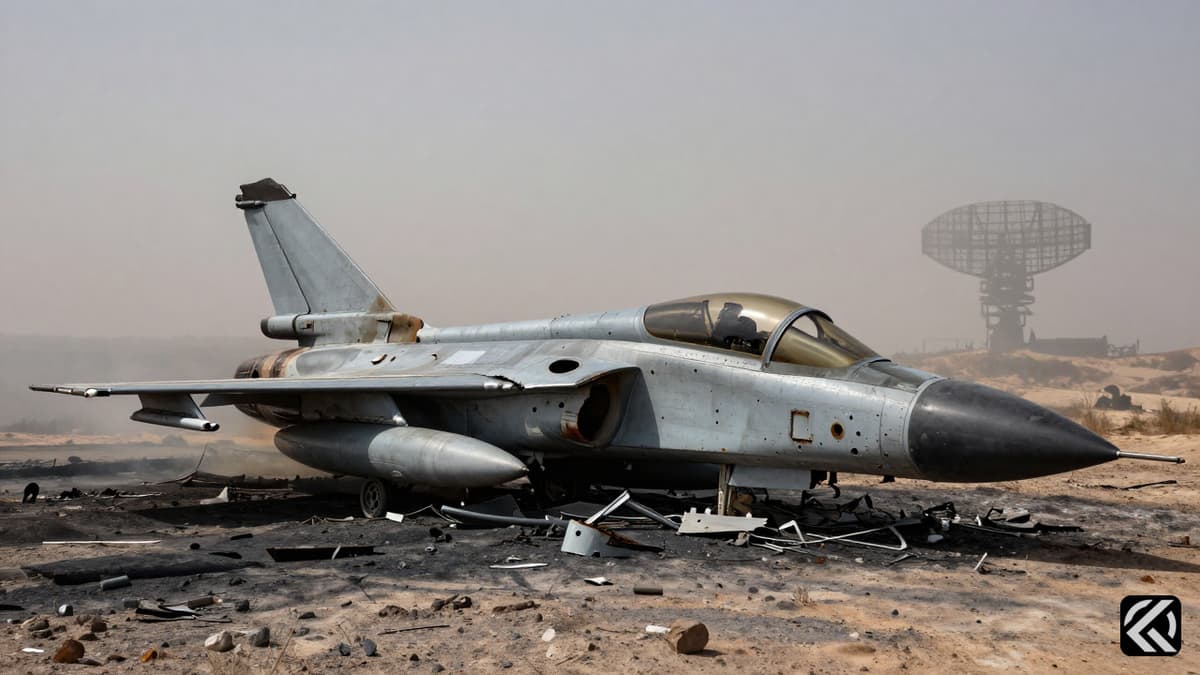
As an unpopular conflict deepens, the downing of a US fighter jet over Iran shatters the administration's narrative of total air supremacy, revealing harsh realities of asymmetric warfare.
An Iran war that was already proving quite unpopular with the American people has entered a new, problematic phase following reports that a US fighter jet shot down over Iranian territory. This development marks a significant challenge to the narrative of military invulnerability that has dominated recent discourse, occurring as the conflict continues to spiral into further complications. While details regarding the two crew members remain partially obscured, early reports indicate that one member has been rescued and is receiving medical treatment, though the fate of the second pilot remains uncertain.
This tragedy was immediately compounded by news that Iran successfully struck a second US combat aircraft on Friday. In a separate incident, a pilot managed to navigate the damaged plane out of Iranian airspace before ejecting and was subsequently rescued, according to a US official speaking to CNN. Although neither incident suggests Iran has achieved military parity with the United States, and American casualties remain limited with no known deaths in the last three weeks, the events underscore the severe perils of asymmetric warfare.
These events specifically puncture the Trump administration's persistent claims regarding its complete dominance of the skies over Iran. President Donald Trump and Defense Secretary Pete Hegseth have repeatedly asserted that the US and Israel possess free rein to fly over the nation, casting Tehran as entirely incapable of counteracting such moves. Hegseth, during a March 4 briefing, confidently declared that the two most powerful air forces in the world would achieve complete control of Iranian skies within a week, describing the airspace as "uncontested." He further insisted that "Iran will be able to do nothing about it," a statement that now stands in stark contrast to recent aerial combat results.
President Trump has echoed these sentiments with increasing fervor over the past two weeks. On March 24, he stated, "We literally have planes flying over Tehran and other parts of their country; they can't do a thing about it." He claimed the US could strike power plants and oil facilities with impunity, asserting that Iran had "no anti-aircraft equipment" and that its radar systems were "100% annihilated." Trump has also claimed for weeks that Iran had "no navy," "no military," and "no air force," portraying the US military force as "unstoppable" in the face of a defenseless adversary.
Despite the administration's absolutist rhetoric, the reality of the battlefield tells a different story. The downing of two planes, even if a small fraction of the total sorties, serves as a direct contradiction to claims of "free rein" and "uncontested airspace." The administration has occasionally acknowledged that setbacks or losses of life might occur, with Hegseth noting in the March 4 briefing that "tragic things happen" and that "a few drones get through." However, the specific claims of total air dominance and the non-existence of Iranian defensive weaponry have been characterized as exaggerated and absolutist.
This is not an isolated instance of potential exaggeration regarding military success. Following strikes on Iran's nuclear facilities in June, President Trump repeatedly declared the country's nuclear program "obliterated" and irretrievable, a claim later contradicted by US intelligence assessments. Just nine months later, the administration repositioned Iran as an imminent nuclear threat. Additionally, shortly after the war began, Trump falsely blamed Iran for a strike on an elementary school, which investigations later suggested was likely carried out by the United States. Most recently, reports indicate that claims regarding the destruction of Iran's missile launchers were greatly exaggerated, with the Islamic Revolutionary Guard Corps retaining about half of its capabilities.
The political ramifications of these conflicting narratives are significant, as military success has been touted as the primary justification for the war. However, Americans have expressed little faith in the mission, citing a lack of clear explanation and constantly shifting objectives. The list of four stated goals has changed multiple times, and economic pessimism is rising due to the effective closure of the Strait of Hormuz and subsequent increases in gas prices. Consequently, the public increasingly feels the war is not worth the costs, undermining the administration's efforts to sell the campaign as a triumph.
Defense Secretary Hegseth has argued that the media fails to acknowledge the military successes, claiming the campaign has taken control of Iran's airspace and waterways without deploying ground troops. Yet, a month after the initial declarations, the control of waterways remains an exception rather than a rule, and the completeness of air dominance is now in question. The administration's assertions that Iran has no weaponry to respond or that its radar is fully annihilated appear to be among the most prominent Trump air dominance lies that have been exposed by the recent combat incidents.
The downing of aircraft and the subsequent revelation of Iran's continued capabilities signal a turning point in the public perception of the Iran war. While the administration continues to frame the conflict through a lens of invincibility, the physical reality on the ground and in the sky suggests a more complex and resistant opponent. As the conflict drags on, the disparity between political rhetoric and military outcomes is likely to widen, potentially intensifying economic pressures and public skepticism. The administration's ability to maintain support for the mission may face a severe test as the narrative of "unstoppable" military force is challenged by the tangible evidence of vulnerability. If the pattern of exaggerated success continues without immediate correction, the gap between the stated objectives and the actual progress could lead to a further erosion of public confidence and political capital for the leadership involved in the strategy.
Jun 8, 2026 02:17 UTC
Magnitude 7.8 Quake Shakes Philippines, Urging Immediate Evacuations
Jun 8, 2026 00:51 UTC
Trump Claims Iran Nuclear Deal Imminent Despite Diplomatic Fractures
Jun 8, 2026 00:47 UTC
Iran Fires Missiles at Israel After Beirut Strike
Jun 7, 2026 22:00 UTC
US, Iran Peace Hops Fade 100 Days Into War
Jun 8, 2026 04:15 UTC
Trump Urges Netanyahu to Halt Iran Strike for Peace


