Section
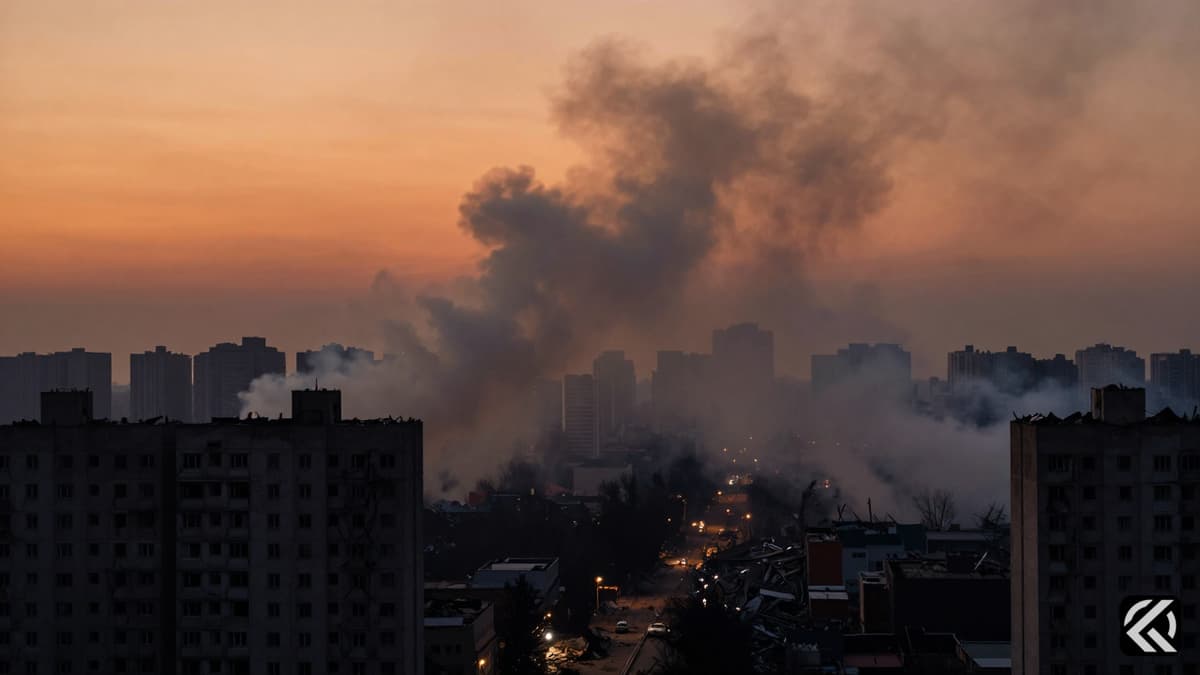
Devastating overnight Russian assaults on Ukrainian cities have killed at least nine people and injured dozens more, intensifying fears amid warnings of systematic targeting.
The recent military escalation has resulted in a tragic loss of life and widespread infrastructure damage across eastern and central Ukraine. At least nine individuals have been confirmed dead, with dozens more sustaining injuries following a massive overnight assault launched by Russia targeting urban centers. The timing of these strikes, occurring in the early hours of Tuesday, caught many residents off guard despite prior intelligence warnings, highlighting the persistent and volatile nature of the ongoing conflict.
Kyiv, the capital city, bore the brunt of the overnight bombardment, where four people were killed and at least 51 others were injured. The severity of the impact in the capital was underscored by Mayor Vitali Klitschko, who confirmed that two high-rise apartment buildings were directly struck. These structural failures have led to legitimate fears that people remain trapped under the resulting piles of concrete and rubble, complicating rescue efforts. Simultaneously, Dnipro suffered a significant toll, with five fatalities and 25 injuries reported. The total number of hospitalized individuals in Kyiv alone stands at 35, indicating the acute medical emergency facing the city's healthcare systems.
The immediate aftermath of the strikes paints a grim picture of urban devastation. Large plumes of smoke were visible rising from the center of Kyiv, marking the locations of intense combustion. Mayor Klitschko detailed that the explosions ignited fires near a gas station, a construction site, and several other apartment blocks and houses. The destructive power of the weaponry also led to widespread blackouts across the city, severing power for thousands of residents during a critical time. The auditory experience of the attack was described as a continuous buzz of drones interspersed with more than a dozen loud explosions as the strikes made their impacts.

The current wave of violence follows a direct threat issued by Moscow last week, which promised "systematic strikes" against Ukraine. This escalation is reportedly Moscow's response to a drone attack last month on a dormitory in the Russian-held Luhansk region, an incident that claimed the lives of 21 people. In its statement, the Russian General Staff indicated that it would specifically target military and decision-making centers in Kyiv. As part of this coercive strategy, Russia also urged foreigners to leave the city, framing the violence as a justified retaliation.
In response to the immediate danger, Kyiv authorities have issued urgent directives for public safety. Mayor Klitschko repeatedly urged people to stay in shelters, emphasizing the lethal nature of the incoming projectiles. Tymur Tkachenko, the head of Kyiv's City Military Administration, clarified the type of weaponry being used, stating, "The enemy is striking with ballistic missiles." Air raid warnings were activated across most of Ukraine, signaling that the threat was not isolated to the capital but part of a broader, nationwide offensive.
The timing of this assault was preceded by explicit warnings from Ukrainian leadership. On Monday, Ukrainian President Volodymyr Zelensky reiterated intelligence assessments regarding a possible large Russian strike. In his nightly video address, Zelensky stated, "Intelligence warnings regarding Russian strikes remain in effect. A massive strike is possible, they have prepared one." His warning proved accurate, as the strikes materialized shortly after his address. Zelensky had specifically urged residents to pay special attention to air raid alerts, a precaution that likely saved lives but could not prevent the physical damage to infrastructure.
The conflict's narrative is further complicated by conflicting accounts regarding the initial provocation. Russia claimed the retaliation was in response to Ukraine deliberately striking a dormitory in Strabolinsk. However, the General Staff of Ukraine's Armed Forces issued a statement at the time clarifying the nature of the incident. They acknowledged carrying out an attack near Starobilsk on the night of May 21-22 but maintained that their target was a Russian military unit, not a civilian dormitory. This dispute over the initial trigger underscores the broader information war accompanying the kinetic operations on the ground.
The convergence of ballistic missile attacks and drone strikes has demonstrated a clear intent by Russia to degrade Ukraine's urban resilience and morale. With apartment buildings and critical utilities like gas stations targeted, the long-term impact includes not only immediate casualties but also the destabilization of housing and energy security for civilians. The explicit warning from Moscow to strike "systematic" targets suggests that this is not an isolated incident but part of a sustained campaign. As air raid warnings remain active across the country, the population is forced into a cycle of disruption, relying on shelters and reacting to intelligence warnings. The confirmation of trapped individuals under rubble and the widespread blackouts indicate that recovery efforts will be protracted. Future developments will likely see continued targeting of decision-making centers, as threatened by Moscow, necessitating sustained international support for emergency response and infrastructure repair in Ukraine.
Jun 11, 2026 17:21 UTC
Bangladesh Opposition Mobilizes Against India-Bangladesh Border Push-Ins and BSF Killings
Join 50,000+ readers getting the global briefing every morning.
No spam. Unsubscribe anytime.
Jun 11, 2026 17:40 UTC
Boelter Pleads Guilty in Minnesota Political Assassinations
Jun 11, 2026 17:21 UTC
Bangladesh Opposition Mobilizes Against India-Bangladesh Border Push-Ins and BSF Killings
Jun 11, 2026 17:21 UTC
John Healey Quits as UK Defence Secretary Over Funding Dispute
Jun 11, 2026 16:19 UTC
UK Defence Secretary John Healey Quits Over Funding Dispute