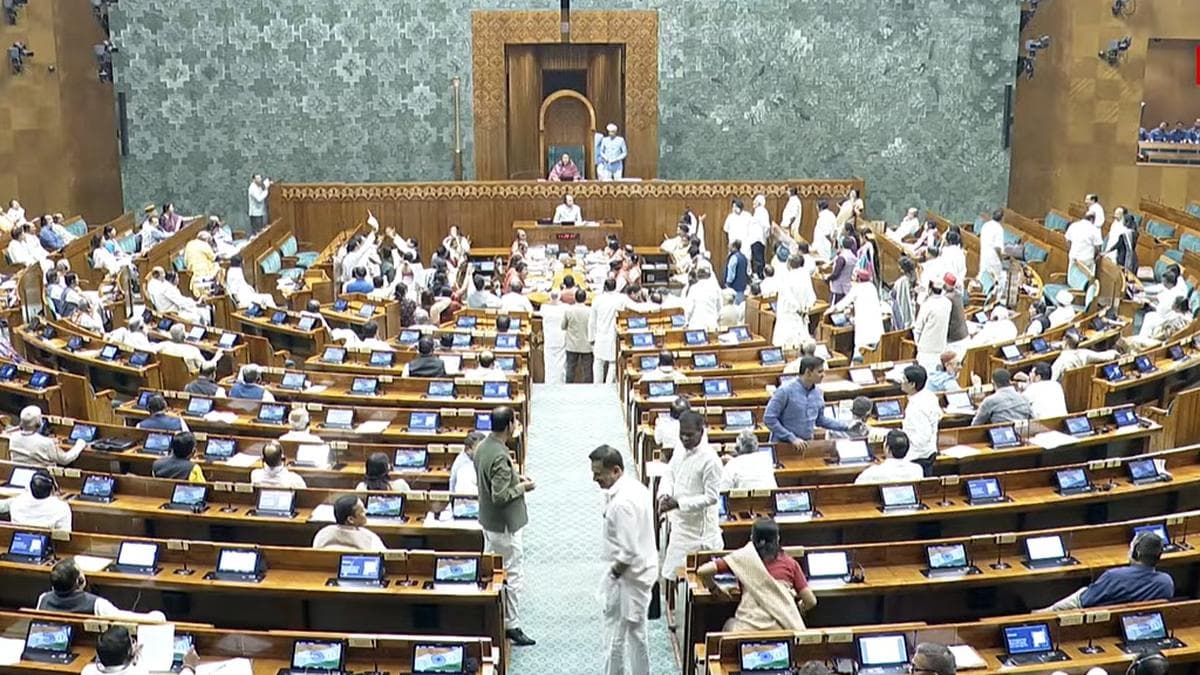
A heated Budget session unfolds in the Lok Sabha as Opposition MPs move a resolution to remove Speaker Om Birla, sparking procedural disputes over microphone access and chairmanship powers.
The 2026 Parliament Budget session has descended into intense procedural warfare, centering on a bold move by the Opposition to challenge the authority of the Lok Sabha Speaker. On March 10, 2026, the Lower House became the battleground for a debate that transcends standard legislative business, as Members of Parliament grappled with conflicting interpretations of constitutional rules regarding the removal of the Speaker and the role of the Deputy Speaker.
The core of the conflict lies in the Opposition’s assertion that the Speaker is presiding over proceedings designed to remove him, a move they claim violates established parliamentary norms. Gaurav Gogoi, speaking on behalf of the Opposition INDIA bloc, argued that despite having nearly 200 members in the Lok Sabha, the House lacks a Deputy Speaker, leaving the country unaware of how the institution is truly being run. This absence has fueled claims that the Treasury Bench members are utilizing the microphone as a weapon, systematically denying the Opposition, particularly Leader of the Opposition Rahul Gandhi, the chance to speak.
The procedural legitimacy of the House’s proceedings has been questioned repeatedly by Gogoi and supported by Congress MPs like K.C. Venugopal. Gogoi highlighted a critical historical precedent: in the last three instances where a resolution was moved against the Lok Sabha Speaker, a Deputy Speaker was present to preside. He noted that under current rules, the Speaker shall not preside while a resolution for his removal is considered. Instead, a chairperson from a panel selected by the Speaker should take over.
Gogoi pressed the Chair on how it was decided that Jagdambika Pal would sit on the Chair during this specific resolution, citing a lack of record regarding the panel of chairpersons. He characterized the current arrangement as a violation of the Constitution and a misuse of the Speaker’s power. In response, Union Minister Amit Shah intervened to assert that the powers of the Speaker remain valid even during an election period or while a motion is pending. He argued that the Opposition was misinterpreting the term "preside," maintaining that while the Speaker may not preside over proceedings personally, the post itself is not vacant.
Jagdambika Pal, currently in the Chair, defended his position by stating he had already issued a ruling confirming the Speaker’s post is not vacant and his appointments are valid with the power to decide on proceedings. He praised the "generosity" of Om Birla for voluntarily notifying the correction of mistakes in the notice before moving the motion. However, this assertion was met with immediate objections from Opposition members who felt the Chair’s remarks were wrong.
The friction extended beyond constitutional interpretation to physical access within the well of the House. Gogoi emphasized that the microphone is being weaponized, noting that while Treasury Bench members are allowed to speak, Opposition members are disallowed from doing so by denying them access to the microphone. Asaduddin Owaisi raised a point of order regarding these rules, stating that when a motion to remove the Speaker is discussed, the Speaker lacks the power to preside. He demanded consensus on who should preside before moving to debate the motion, arguing that no Deputy Speaker has been appointed and the person in the Chair cannot proceed without approval.
The atmosphere grew increasingly volatile as Opposition members resorted to raising slogans and displaying placards. Chairman C.P. Radhakrishnan intervened to state that displaying placards is not allowed inside the House. During Zero Hour, while Opposition leaders demanded a chance for the Leader of the Opposition to speak, the Chair eventually agreed to allow LoP Mallikarjun Kharge to address the house, though he was immediately challenged regarding the Special Intensive Revision (SIR) process which Kharge labeled as "fraud."
Union Agriculture Minister Shivraj Singh Chouhan condemned the sloganeering during discussions on farmers' issues, while Leader of the House J.P. Nadda accused the Opposition of not wanting actual debate inside the House, pointing out their walkouts and refusal to discuss electoral reforms properly. Despite these disruptions, the House managed to settle briefly after a minute of protest, though repeated requests from Ms. Sandhya Ray yielded no result as Opposition members continued their display of placards until she adjourned the House briefly till 12 p.m.
Beyond the Speaker removal motion, the session included significant financial and international discussions. Union Finance Minister Nirmala Sitharaman was scheduled to make a statement on Supplementary Demands for Grants - Second Batch for 2025-2026, with statements being tabled in both Houses. In the Rajya Sabha, Union Environment Minister Bhupender Yadav was set to reply to discussions on his Ministry’s working, alongside a discussion on the Ministry of Rural Development.
International concerns were also raised when Rajya Sabha MP Sanjay Singh submitted a notice under Rule 267 seeking to suspend matters and discuss the ongoing West Asia conflict. He argued that the conflict poses serious risks to India’s trade, economy, and energy security due to rising crude prices caused by uncertainty in global shipping routes. Meanwhile, Congress MPs indicated they would move the no-confidence motion against Speaker Om Birla if the House functions smoothly, noting that 118 Opposition MPs have signed the motion alleging partisan behavior following Rahul Gandhi's alleged inability to speak.
The 2026 Budget session has been defined by a fierce contest over parliamentary procedure and the authority of the Speaker’s office. With 118 Opposition MPs backing the resolution to remove Om Birla, the House witnessed intense exchanges between Gogoi, Pal, and various ministers regarding constitutional rules and microphone access. While financial and international matters were slated for discussion, the procedural standoff dominated proceedings, leaving the legitimacy of the Chair under constant challenge from the Opposition side.
Jun 9, 2026 20:58 UTC
Trump Demands U.S. Action as Iran Shoots Down Second Aircraft
Join 50,000+ readers getting the global briefing every morning.
No spam. Unsubscribe anytime.
Jun 9, 2026 18:37 UTC
Israel Strikes Tyre Despite Iranian Warnings
Jun 9, 2026 16:42 UTC
IAB Framework Data Practices and User Privacy Choices
Jun 9, 2026 16:07 UTC
Madhya Pradesh Congress Departs for Bengaluru to Avoid Rajya Sabha Elections Pitfalls
Jun 9, 2026 14:27 UTC
US Sea Drone Saves Army Helicopter Crew Near Strait of Hormuz