
Section
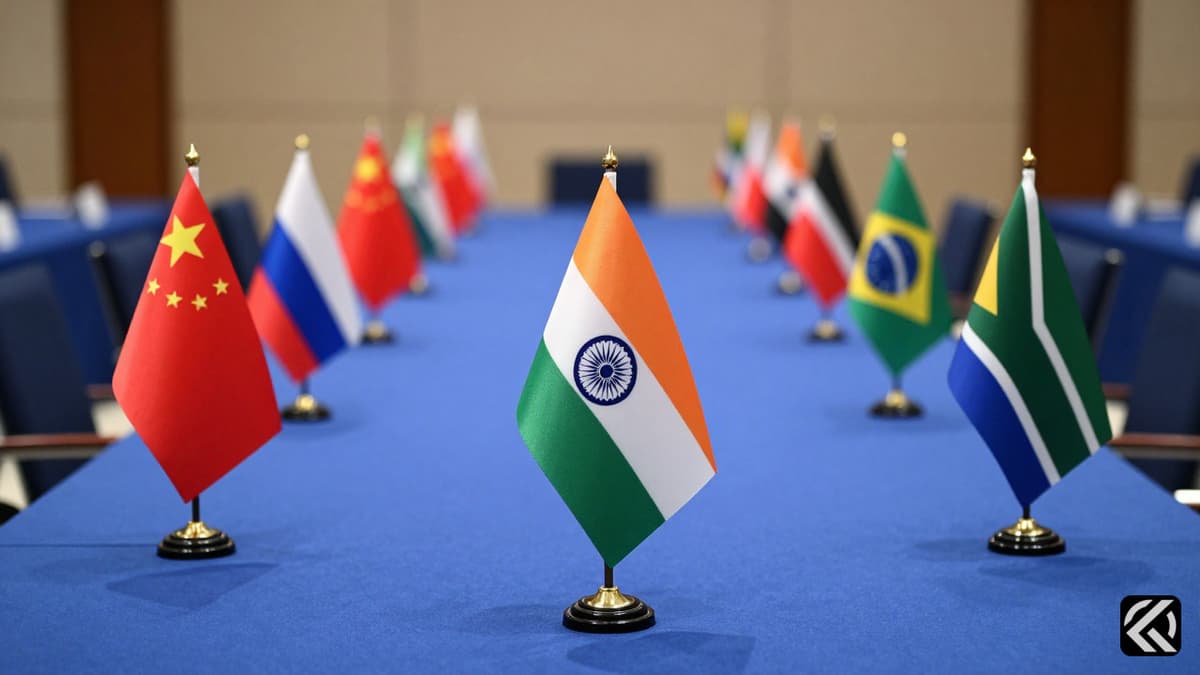
Deep divisions emerged at the recent BRICS foreign ministers meeting, as India’s presidency failed to forge a united front regarding the ongoing Iran war.
The recent BRICS foreign ministers meeting in New Delhi concluded on Friday without a unified stance on the escalating conflict in the Middle East, exposing deep fissures within the emerging economy bloc. The outcome document merely acknowledged that “differing views” remained among the ten member states regarding the Iran war, marking the second consecutive gathering in India to fail in producing a consensus.
The two-day summit, held at Bharat Mandapam under the chairmanship of Indian External Affairs Minister Subrahmanyam Jaishankar, took place against the backdrop of the US-Israel war on Iran, now in its 77th day. The conflict began on February 28 with strikes on Iranian military and nuclear sites, leading to the closure of the Strait of Hormuz and a surge in global energy prices. Diplomatic efforts, including Pakistan-mediated talks, have stalled, and the US has imposed a naval blockade on Iranian ports.
Despite the high stakes, the meeting highlighted the complex dynamics of the India BRICS presidency, which seeks to give the Global South a greater voice in global institutions. The gathering was attended by foreign ministers from Russia, Brazil, South Africa, Indonesia, Egypt, and Ethiopia, alongside Iran’s Abbas Araghchi and the UAE’s state minister Khalifa bin Shaheen Al Marar. Notably, China was represented by its ambassador to India, Xu Feihong, as Chinese Foreign Minister Wang Yi was attending US President Donald Trump’s state visit to Beijing.
Tensions flared immediately as Iranian Foreign Minister Abbas Araghchi accused the UAE of complicity in the aggression against Iran. Araghchi stated that UAE fighter jets had participated in attacks and allowed US forces to use Emirati territory for strikes. He criticized Abu Dhabi for not condemning an attack on a school in Minab city that Iran claims killed 170 students. Araghchi argued that BRICS must become a pillar for a just global order and explicitly condemn what he termed US and Israeli violations of international law.
The UAE’s representative, Al Marar, countered by calling for the condemnation of Iranian actions, noting that Iran had targeted UAE energy infrastructure and civilian facilities. Abu Dhabi reported intercepting over 2,800 Iranian drones and missiles since the conflict began. This exchange exposed the deepest fault line within the expanded bloc, which now includes both Iran and the UAE as full members despite their active conflict.
Jaishankar, navigating the dispute, emphasized the need for safe maritime flows through the Strait of Hormuz and the Red Sea. He reminded members that consensus on important issues is essential for the smooth advancement of BRICS. He held a bilateral meeting with Araghchi afterward, describing it as a “detailed” discussion on regional developments.
While the political deadlock was palpable, the meeting produced results on non-security issues. Member states reached agreement on more than 60 topics, including energy cooperation, trade, digital infrastructure, climate action, and multilateral reform. The final document condemned “unilateral coercive measures” contrary to international law, widely interpreted as a reference to US sanctions on Iran, though Washington was not named.
Iran’s demand for a joint condemnation of US and Israeli aggression went unmet, as did the UAE’s push to condemn Iranian strikes. Araghchi later blamed the UAE’s support for Israel and the US for the lack of a final statement, asserting that the UAE’s relationship with these powers prevented unity.
Jauhar Saleem, a former Pakistani diplomat, noted that consensus was never realistic given the disparate foreign interests of BRICS members. He argued that bloc politics is becoming increasingly irrelevant in an era where even cohesive alliances are fracturing. Saleem suggested that Pakistan’s balanced, bilateral approach to diplomacy is better suited to these times, positioning Islamabad as a mediator between Washington and Tehran.
The failure to produce a joint statement on the Iran war underscores the structural limitations of BRICS as a political bloc during times of acute geopolitical crisis. While the bloc remains effective in coordinating economic policies and advocating for Global South interests in institutions like the UN, its ability to present a unified front on security matters is severely constrained by the conflicting national interests of its members.
As the conflict in the Middle East continues to evolve, the internal divisions highlighted in New Delhi suggest that BRICS will struggle to act as a cohesive counterweight to Western powers in security affairs. The bloc’s future influence may depend on its capacity to maintain economic integration and diplomatic dialogue, rather than attempting to enforce political unanimity on contentious international conflicts. The upcoming leaders’ summit in September will likely test whether these economic collaborations can withstand further geopolitical strains.
Jun 11, 2026 12:59 UTC
US Strike on Settebello Kills Indian Sailors Amid Strait of Hormuz Tensions
Jun 11, 2026 12:49 UTC
Air India Flight 171 Crash Sparks Debate Over Boeing 787 Dreamliner Faults
Jun 11, 2026 08:51 UTC
US-Iran Conflict: Indian Seafarers Killed in Gulf Strike
Jun 11, 2026 18:04 UTC
Healey Quits Government Over Defence Spending Dispute


