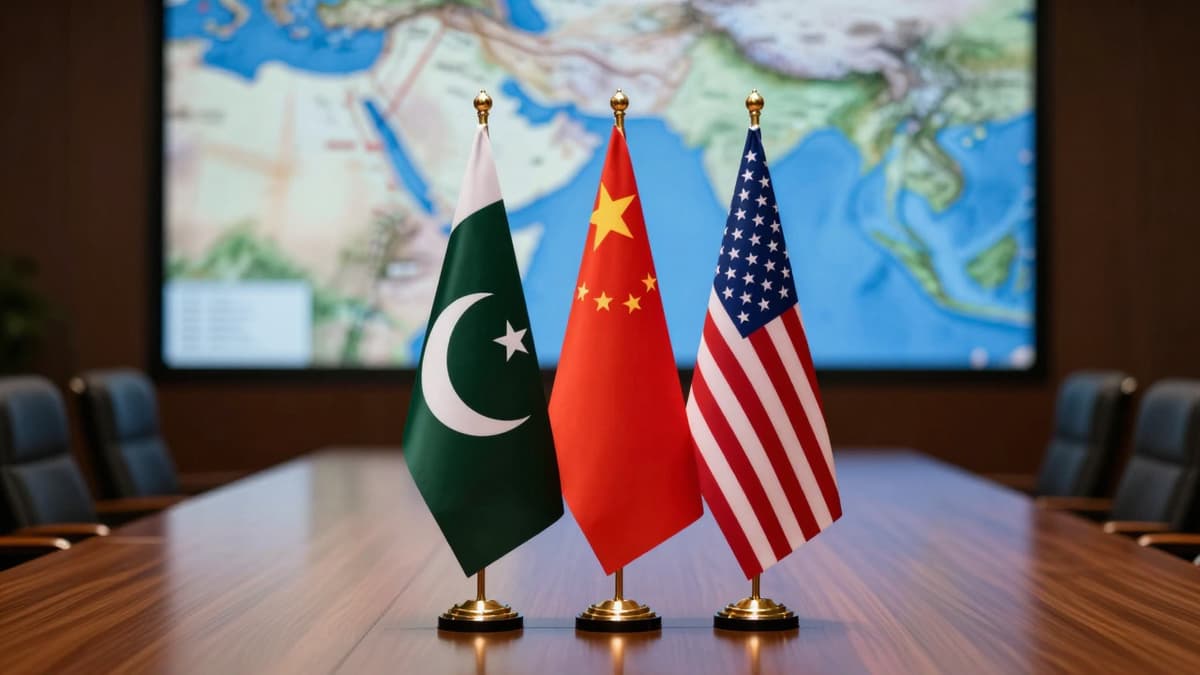
Pakistan's Foreign Minister travels to Beijing to secure a China guarantor role for peace talks, aiming to stabilize the Strait of Hormuz crisis and advance Pakistan-Iran-US mediation efforts.
Islamabad's Ministry of Foreign Affairs confirmed that Deputy Prime Minister Ishaq Dar would travel to Beijing on Tuesday, underscoring the urgency of Pakistan's diplomatic mission to calm the region. This visit occurs just a month after a war began on February 28, which has expanded across multiple Middle East theaters, causing soaring energy prices and a rising risk of global recession. Dar's trip follows a quadrilateral meeting in Islamabad hosted over the weekend with foreign ministers from Turkiye, Egypt, and Saudi Arabia, all aimed at pushing the United States and Iran toward negotiations.
Despite medical advice to rest following a hairline shoulder fracture sustained while receiving Egypt's foreign minister, Dar proceeded with the China visit to underscore the sense of urgency in calming turbulent neighborhood weather. During a March 27 call, Chinese Foreign Minister Wang Yi expressed appreciation for Islamabad's "untiring efforts to cool down the situation," a stance reiterated by spokesperson Mao Ning who commended the mediation for de-escalation. However, analysts suggest Dar's objective extends beyond rhetorical support; with US President Donald Trump shifting daily between diplomacy and threats against Iran, the critical question is whether Islamabad can secure Beijing's active involvement in mediation.
Experts view the trip as a strategic move to brief Chinese leadership on the recent quadrilateral outcome and refine five principles for potential dialogue: an immediate ceasefire, resumption of talks, protection of civilians, maritime security, and adherence to the UN Charter. Baqir Sajjad Syed, a former Pakistan fellow at the Wilson Center, explained that the in-person engagement aims to translate preliminary phone call discussions into a concrete framework or outcome document. Hours after the visit was confirmed, China and Pakistan announced these five principles as the cornerstone of their joint mediation efforts, marking a shift from preliminary calls to detailed coordination.
The conversation around the visit has sparked debate regarding the depth of China's involvement. Vali Nasr, a former US State Department official, suggested that Iran has requested guarantees in any deal with the US, and reports indicate Dar's purpose is to secure a China guarantor role for a potential agreement. Nasr noted that the foreign minister would not visit without floating this idea with Washington and Beijing, suggesting Beijing is now the front line in the diplomatic effort to provide security assurances. However, other voices challenge this premise; Ishtiaq Ahmad, an emeritus professor, argued that the assumption of Beijing stepping in as a guarantor is analytically weak, as guarantees are typically extended by stable actors, not powers aligning with a regime with eroding influence.
The stakes for China are undeniably high, driven by significant economic interests tied to the Strait of Hormuz crisis. Data from Kpler reveals China imported approximately 1.38 million barrels of crude daily from Iran in 2025, accounting for 12 percent of its total imports. The Strait itself carries roughly a fifth of the world's daily oil and gas supplies, with the International Energy Agency estimating that close to 15 million barrels passed through in 2025. Researchers at Columbia University estimate that between 45 and 50 percent of China's crude oil imports transit this waterway, meaning any disruption poses a direct threat to its energy security.
The economic implications extend beyond oil imports to broader trade and infrastructure investments. According to the US-China Economic and Security Review Commission, total trade between China and Iran reached about $41.2bn in 2025. Furthermore, the 2021 25-year strategic cooperation agreement, under which Beijing pledged up to $400bn in investment for discounted oil, highlights the long-term commitment, even if US sanctions have delayed much of the actual funding. Syed described China's motivations as "clear and self-interested," noting that protecting energy security, safeguarding Belt and Road Initiative and CPEC investments, and burnishing its image as a global peace broker are primary drivers.
The China-Pakistan Economic Corridor (CPEC), valued at roughly $62bn, links China's Xinjiang region to the Gwadar port on the Arabian Sea, making regional stability vital for its success. Syed argued that China is likely to rely on diplomatic channels, using Islamabad's on-the-ground shuttle diplomacy to push for de-escalation without engaging Washington directly. This approach allows Beijing to maintain a low-risk presence while advocating for a stabilized Iran-US track that serves its core interests of restoring Hormuz transit and regional peace.
Ahmad offered a counter-perspective, suggesting China remains pragmatic and calculated, assessing the trajectory before fully committing. He noted that while Trump has been transparent about seeking Iranian oil, the closure of the Strait affects Asia and Europe acutely, and China would feel this impact directly. Ultimately, the Chinese strategy appears to be one of cautious engagement, ensuring Iran does not become too destabilized, much like the comparison to Venezuela, while simultaneously pushing for the normalization of trade routes essential for their economic future.
The convergence of Pakistan's mediation efforts and China's strategic interests suggests a near-term push for a ceasefire framework, though the depth of Beijing's commitment remains a subject of expert disagreement. If China opts to support the five principles proposed by Islamabad, the immediate effect could be a reduction in hostilities, securing the flow of oil through the Strait of Hormuz and potentially averting a deeper global recession. However, if the debate over the China guarantor role leads to a stalemate, the Pakistan-Iran-US mediation efforts may rely solely on rhetorical statements without the backing of a major power capable of enforcing guarantees. The outcome of these high-level discussions in Beijing will likely determine whether the region moves toward a stabilized diplomatic track or remains trapped in a cycle of escalating violence driven by energy insecurity.
Jun 8, 2026 02:17 UTC
Magnitude 7.8 Quake Shakes Philippines, Urging Immediate Evacuations
Jun 8, 2026 00:51 UTC
Trump Claims Iran Nuclear Deal Imminent Despite Diplomatic Fractures
Jun 8, 2026 00:47 UTC
Iran Fires Missiles at Israel After Beirut Strike
Jun 7, 2026 22:00 UTC
US, Iran Peace Hops Fade 100 Days Into War
Jun 8, 2026 04:15 UTC
Trump Urges Netanyahu to Halt Iran Strike for Peace


