Section
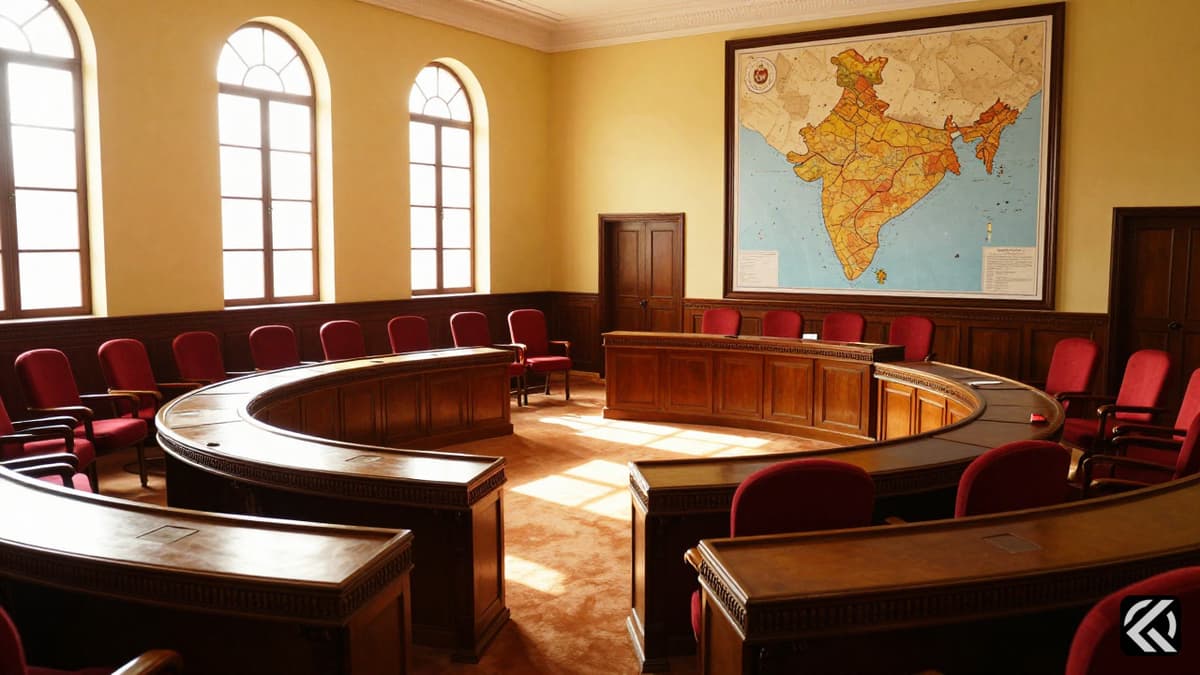
A significant rift in Tamil Nadu politics sees AIADMK rebels backing TVK, while the Madras High Court intervenes in the trust vote proceedings.
The immediate trigger for this political upheaval was the announcement by C.Ve. Shanmugam and S.P. Velumani that their faction of rebel MLAs would extend support to the ruling TVK. This move was framed not merely as a tactical pivot but as a fundamental defense of the AIADMK’s core identity. Speaking to reporters outside the Tamil Nadu Assembly building, Shanmugam clarified that apart from the ruling TVK, his faction is not in alliance with anyone else. He emphasized the historical context of the party’s existence, stating, “We founded this party against DMK. For 53 years, our politics have been against the DMK.”
Shanmugam accused party general secretary Edappadi K. Palaniswami of attempting to form a government with the support of the DMK, a move he described as a “shock” to the rebel camp. He argued that such a proposal suggested that an AIADMK government be formed with the support of the DMK. However, the majority of members in his faction rejected and opposed it. Shanmugam reasoned, “If we were to form an alliance with the DMK, the AIADMK would cease to exist. They refused to accept such a scenario.” This sentiment was echoed by Velumani, who called for an immediate sitting of the party’s general council meeting to address the crisis.
The decision to back the TVK has led to a sharp division among the newly elected AIADMK legislators. Reports indicate that while one group supports Palaniswami, a larger group is throwing its weight behind Velumani. This division was further highlighted when TCK legislator J.C.D. Prabhakar was elected unopposed for the Tamil Nadu Assembly Speaker’s post, reflecting the broader political realignments. As fresh signals of a rift roil the party, the AIADMK is grappling with its future direction, with the rebel camp praising Chief Minister C. Joseph Vijay’s orders to close over 700 retail liquor shops across the State, viewing it as a sign of effective governance.
On the judicial front, the Madras High Court intervened on Tuesday, May 12, 2026, restraining the ruling TVK MLA R. Seenivasa Sethupathy from participating in the trust vote to be held on the floor of the Legislative Assembly on or before May 13, 2026. This restraint was imposed as per the instructions of Tamil Nadu Governor Rajendra Vishwanath Arlekar. A summer vacation Bench of Justices L. Victoria Gowri and N. Senthilkumar passed the interim order after holding hearings on Sunday and Monday regarding an urgent writ petition filed by former DMK Minister K.R. Periakaruppan. Periakaruppan had lost by a single vote to the TVK MLA, highlighting the narrow margins that characterize this volatile political period.
The trust vote itself looms large over these developments. The voting is scheduled to take place on the floor of the Assembly, where the ruling TVK will seek to prove its majority. The restriction placed on Sethupathy could impact the mathematical calculations required to secure a win, adding a layer of uncertainty to the process. Meanwhile, in his maiden speech in the Tamil Nadu Assembly, Chief Minister Vijay quoted Abraham Lincoln, outlining his government’s priorities on governance, welfare, youth development, and transparency. He urged cooperation across party lines, a sentiment that contrasts sharply with the deep divisions currently evident within the opposition camps.
Udhayanidhi Stalin, the Leader of the Opposition, stated in the Assembly that the DMK is senior in governance, positioning his party as the traditional alternative to the current administration. However, the emergence of the Shanmugam-Velumani faction complicates the opposition landscape. By backing the TVK, this group effectively neutralizes a potential block of opposition votes, thereby strengthening Vijay’s position in the trust vote. This strategic alignment underscores the pragmatic nature of Tamil Nadu politics, where historical ideological lines often give way to immediate political necessities.
With rebellion simmering in the AIADMK, marked by the removal of senior MLA K.A. Sengottaiyan from key party posts after he called for the return of estranged leaders, it is a timely moment to revisit some of the most significant uprisings within Tamil Nadu’s two major Dravidian parties. The current rift mirrors past instances where internal dissent reshaped party fortunes. The reasoning provided by Shanmugam-that a collaboration with the DMK would render the party’s disappearance-echoes similar ideological purges in the past, where loyalty to the party’s foundational ethos was prioritized over short-term political gain.
The AIADMK’s establishment to oppose the DMK has long been a defining feature of its political strategy. Any move to collaborate with its rival has historically been viewed as an existential threat. Velumani and Shanmugam’s departure signals that this ideological plank remains a critical fault line within the party. As political twists and turns unfold, the loyalty of individual legislators often shifts based on personal ambition, ideological alignment, or perceived viability. The election of Prabhakar as Speaker unopposed suggests that the rebel faction may have sufficient numbers to influence procedural aspects of the Assembly, even if they are supporting the ruling government in the trust vote.
The close margin of the recent elections, evidenced by Periakaruppan’s loss by a single vote, indicates that the current Assembly is closely balanced. Every vote, and every restrained MLA, carries significant weight. The governor’s involvement in the High Court’s decision highlights the constitutional sensitivity of the situation, ensuring that the process remains above the fray of partisan politics. However, the political ramifications are deeply partisan, with the AIADMK faction’s support for the TVK potentially altering the balance of power for the foreseeable future.
The current political maneuvering in the Tamil Nadu Assembly reveals a fragile but dynamic governing structure. The AIADMK’s internal split, with the Shanmugam-Velumani faction aligning with the TVK, provides Chief Minister Vijay with a crucial advantage in the upcoming trust vote. This support mitigates the risk of a no-confidence motion succeeding, thereby stabilizing the new government’s tenure in the short term. However, the long-term implications suggest a potential realignment of opposition forces. With the AIADMK fractured, the DMK may find itself as the primary opposition, but its ability to mobilize dissent against the TVK will depend on how it navigates the new political realities.
The historical precedent of rebellions within Dravidian parties suggests that such splits often lead to the formation of new political entities or significant realignments in future elections. The current crisis may force the AIADMK to either reunite under Palaniswami or continue to operate as a divided entity, potentially reducing its influence in subsequent political cycles. The closure of 700 liquor shops, praised by the rebels, serves as a policy bridge between the ruling TVK and the rebel AIADMK faction, indicating that welfare and transparency could be common ground for temporary alliances. As the trust vote proceeds, the outcome will not only determine the survival of Vijay’s government but also set the stage for future political alignments in Tamil Nadu, potentially reshaping the Dravidian political landscape for years to come.
Jun 11, 2026 12:59 UTC
US Strike on Settebello Kills Indian Sailors Amid Strait of Hormuz Tensions
Jun 11, 2026 12:49 UTC
Air India Flight 171 Crash Sparks Debate Over Boeing 787 Dreamliner Faults
Jun 11, 2026 08:51 UTC
US-Iran Conflict: Indian Seafarers Killed in Gulf Strike
Jun 11, 2026 18:04 UTC
Healey Quits Government Over Defence Spending Dispute