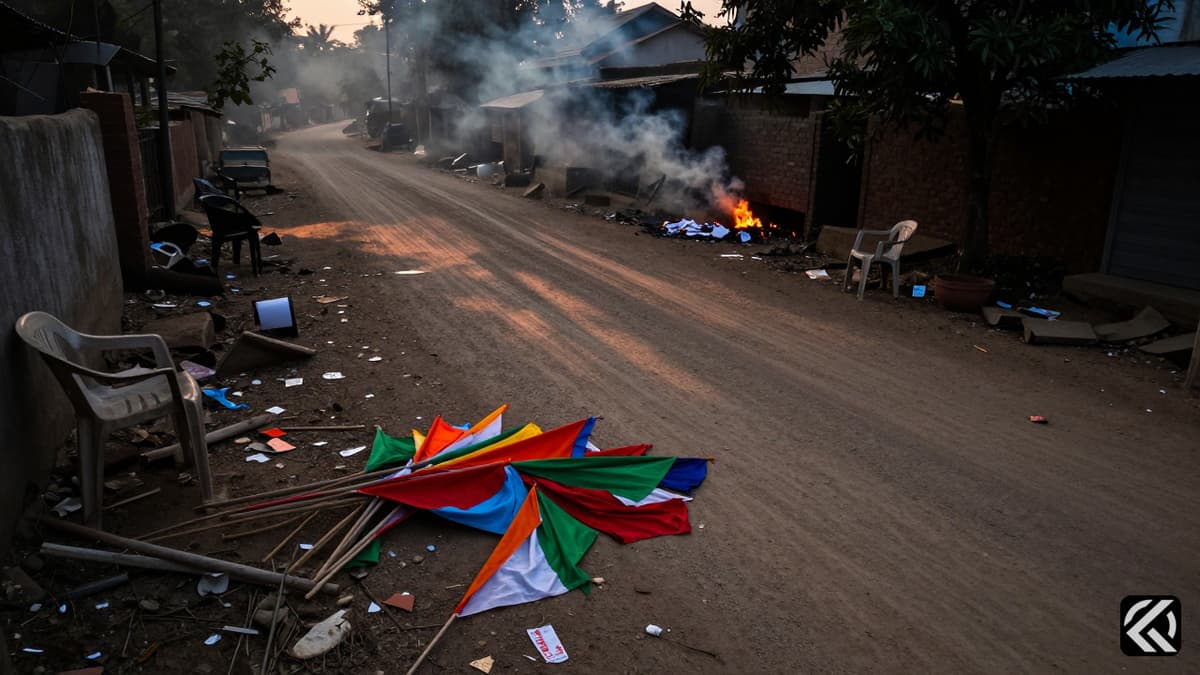
Tensions boiled over in West Bengal’s Murshidabad district on April 23, 2026, as political rivalries turned violent. Authorities moved in swiftly to restore order amidst the escalating conflict.
The first phase of the West Bengal State Assembly polls has been marred by significant unrest in the Murshidabad district. On Thursday, April 23, 2026, serious clashes broke out in the Naoda area, specifically within the Shibnagar village of the Naoda Assembly constituency. The confrontation involved supporters of the Aam Janata Unnayan Party (AJUP) and the ruling Trinamool Congress (TMC). Officials confirmed that the situation escalated rapidly, forcing law enforcement agencies to take immediate and forceful action.
Police and central forces arrived on the scene to manage the growing tension. Due to the aggressive nature of the mobs, authorities resorted to baton charges to disperse the crowds. The intervention was necessary to prevent further injury and to protect the electoral process in the region. The violence highlighted the intense competition and animosity present during this critical phase of the state elections.
The incident in Shibnagar is not an isolated occurrence but part of a broader pattern of political friction in the district. The Naoda Assembly constituency has become a focal point for these clashes. Reports indicate that the supporters of the Aam Janata Unnayan Party confronted those aligned with the TMC. The confrontation was not verbal but physical, leading to the need for heavy police presence. The timing of the violence, occurring during the polling hours, raises concerns about the safety of voters and the integrity of the election process in this specific locality.
Law enforcement officials stated that the baton charges were executed to control the situation. The use of such force indicates the severity of the clash. While no specific casualty reports have been detailed in the initial accounts, the need for baton charges suggests a high level of hostility. The central forces worked alongside local police to ensure that the mob could be dispersed effectively. This collaborative effort is standard procedure in areas where political tensions run high during election periods.
The Naoda area has been identified as a hotspot for political activity. The clash in Shibnagar village serves as a stark reminder of the challenges faced by election commissions in managing rural unrest. The presence of ruling party supporters and opposition supporters in close proximity often leads to friction. In this instance, the friction escalated into physical violence, requiring immediate police intervention.
The role of the TMC as the ruling party adds another layer of complexity to the incident. Accusations and counter-accusations are likely to follow such events. Political rivals often blame each other for instigating violence. However, based on the current facts, the primary observable event is the physical clash and the subsequent police response. The authorities are focused on maintaining peace rather than assigning immediate blame.
As the first phase of the polls continues, the situation in Murshidabad remains under surveillance. The dispersion of the mob by police and central forces is a temporary measure. The underlying tensions between the AJUP and TMC supporters are expected to persist. Election observers will be monitoring the area closely to ensure that such incidents do not recur in other parts of the constituency. The safety of the polling booths and the voters remains the primary concern for the administration.
The incident underscores the volatile nature of the current political climate in West Bengal. The Aam Janata Unnayan Party and the TMC are key players in this dynamic. Their supporters' interactions in public spaces are being closely watched. Any further escalation could lead to more severe disruptions. The police have established a perimeter around the affected areas to prevent further incidents.
The Naoda Assembly constituency is now under strict watch. The government has deployed additional resources to ensure order. The baton charges were a last resort to restore calm. The absence of detailed casualty reports suggests that the police action was successful in dispersing the crowd without major injuries, though the potential for future clashes remains high.
The clash in Naoda demonstrates the fragility of peace in Murshidabad during the 2026 polls. If similar incidents occur across other constituencies, voter turnout could decline significantly due to fear. The reliance on baton charges indicates a failure of political dialogue. This trend may force authorities to declare curfews in sensitive areas, potentially disenfranchising voters. Long-term, this violence could deepen political polarization in the region, making post-election reconciliation more difficult.
Jun 8, 2026 02:17 UTC
Magnitude 7.8 Quake Shakes Philippines, Urging Immediate Evacuations
Join 50,000+ readers getting the global briefing every morning.
No spam. Unsubscribe anytime.
Jun 8, 2026 02:17 UTC
Magnitude 7.8 Quake Shakes Philippines, Urging Immediate Evacuations
Jun 8, 2026 00:51 UTC
Trump Claims Iran Nuclear Deal Imminent Despite Diplomatic Fractures
Jun 8, 2026 00:47 UTC
Iran Fires Missiles at Israel After Beirut Strike
Jun 7, 2026 22:38 UTC
Congress Party Claims Unity for INDIA Bloc Delhi Meeting


