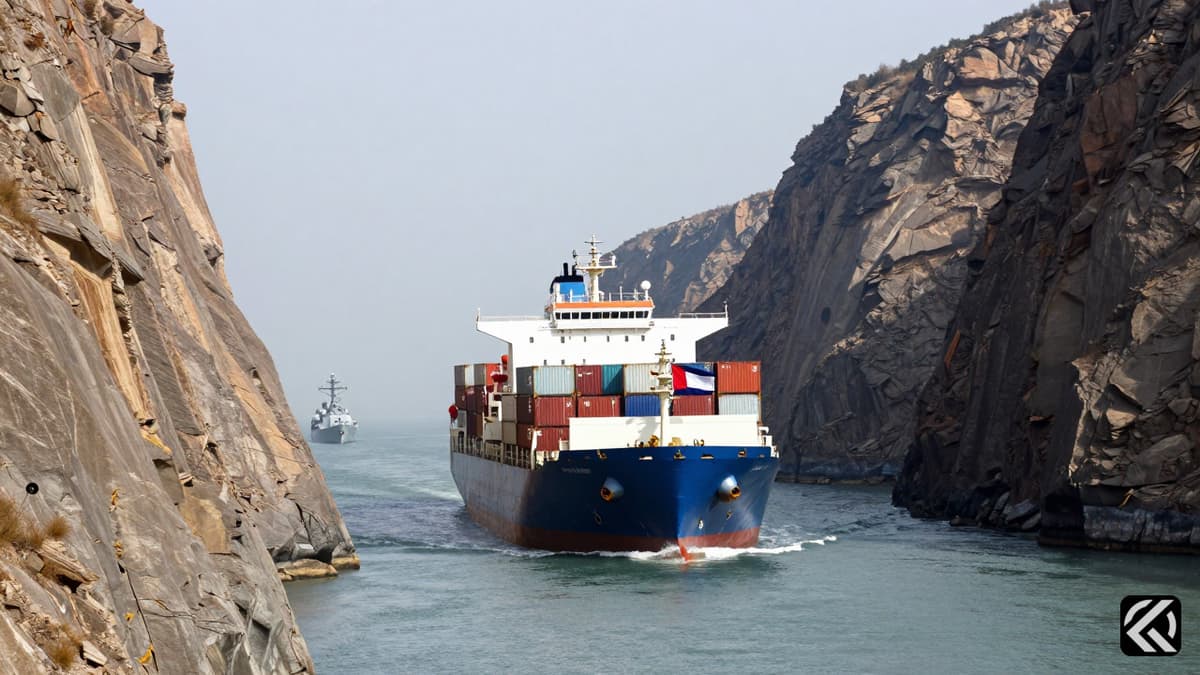
Iran escalates tensions by capturing foreign container ships near the Strait of Hormuz, intensifying the naval standoff with the United States amid ongoing blockades.
Iran on Wednesday captured two foreign container ships attempting to exit the Strait of Hormuz and fired at a third vessel, marking the latest escalation in tensions between Washington and Tehran. This event occurs amidst a United States naval blockade of Iranian ports that commenced on April 13. The incident highlights the volatile nature of the Strait of Hormuz, a critical waterway where both nations have increasingly asserted control over maritime traffic.
In response to previous US military actions, including the interception of Iranian-flagged tankers, Tehran has tightened its grip on the passage. While a ceasefire between the US and Iran remains technically in place, the continuous attacks, captures, and interceptions of ships point to an ongoing Iran-US naval war playing out in the narrow shipping passage.
The strategic importance of the Strait of Hormuz is undeniable, as it links the Persian Gulf to the Gulf of Oman and the Arabian Sea. Approximately 20 percent of global oil and liquefied natural gas supplies pass through this route during peacetime. After the US and Israel launched their war on Iran on February 28, Tehran closed the passage to all vessels. By March 4, the Islamic Revolutionary Guard Corps (IRGC) claimed full control, requiring ships to obtain clearance.
Initially, Iran’s position was that the strait was closed only to enemy countries, specifically the US and its allies. However, the dynamic shifted significantly with the onset of the US naval blockade. On April 13, US Central Command began directing Iran-linked vessels to turn around or return to port. In retaliation and as a counter-strategy, Iran has moved to restrict any foreign ship passage until the US lifts its blockade, which was initially set to end on April 19.
Iran’s First Vice President Mohammad Reza Aref justified the tightened restrictions, stating that “security of the Strait of Hormuz is not free.” He argued that one cannot restrict Iran’s oil exports while expecting free security for others, warning of “significant costs for everyone” if stability is not restored through an end to economic and military pressure.
The recent capture of vessels represents a significant hardening of Iran’s stance. On Wednesday, the IRGC reported capturing two container ships and firing upon another after they allegedly violated maritime regulations and entered the waterway without coordination. Among the captured vessels was the Panama-flagged MSC Francesca, which was hit by gunfire but remained undamaged, and the Greek-owned Epaminondas, which was also fired upon near Oman.
While military tensions rise, Iran’s economy has seen unexpected benefits from the conflict. By imposing a “toll booth” system earlier in the conflict and controlling exits, Iran has continued to export oil aggressively. According to trade intelligence firm Kpler, Iran exported 1.84 million barrels per day of crude oil in March and maintained 1.71 million barrels per day in April.
This output has resulted in Iran earning approximately 40 percent more from oil exports in the past month compared to the period before the war began. With prices consistently staying above $90 per barrel, and often surpassing $100, Iran earned at least $4.97 billion from oil exports between March 15 and April 14. This stands in stark contrast to the pre-war average of $3.45 billion per month, demonstrating that the conflict has financially bolstered Tehran despite international pressure.
The situation has created a complex maritime environment where vessels need approval from both the US and Iran to transit. This dual-control scenario leaves ships vulnerable to interceptions from both sides. The US military has already intercepted at least three Iranian-flagged tankers in Asian waters and detained another oil tanker in the Bay of Bengal, citing global maritime enforcement efforts to disrupt illicit networks.
The capture of ships not linked to the US or Israel signals a deliberate tit-for-tat strategy. Ali Vaez of the International Crisis Group noted that Iran’s actions are part of a broader strategic calculation rather than isolated incidents. By capturing foreign-flagged vessels, Iran aims to raise the stakes and demonstrate its ability to disrupt global energy supplies, thereby increasing leverage in its negotiations and military posturing.
Iran’s aggressive control of the Strait of Hormuz and the US naval blockade have established a fragile equilibrium. If diplomatic pressures do not lead to a de-escalation, the region faces prolonged instability. The continued capture of commercial vessels risks broader international condemnation and further militarization of the waterway. Ultimately, the intersection of economic gain from high oil prices and military posturing suggests that Iran may maintain its current stance of restricted access until tangible concessions are made regarding the blockade.
Jun 8, 2026 02:17 UTC
Magnitude 7.8 Quake Shakes Philippines, Urging Immediate Evacuations
Join 50,000+ readers getting the global briefing every morning.
No spam. Unsubscribe anytime.
Jun 8, 2026 02:17 UTC
Magnitude 7.8 Quake Shakes Philippines, Urging Immediate Evacuations
Jun 8, 2026 00:51 UTC
Trump Claims Iran Nuclear Deal Imminent Despite Diplomatic Fractures
Jun 8, 2026 00:47 UTC
Iran Fires Missiles at Israel After Beirut Strike
Jun 7, 2026 22:38 UTC
Congress Party Claims Unity for INDIA Bloc Delhi Meeting


