Section
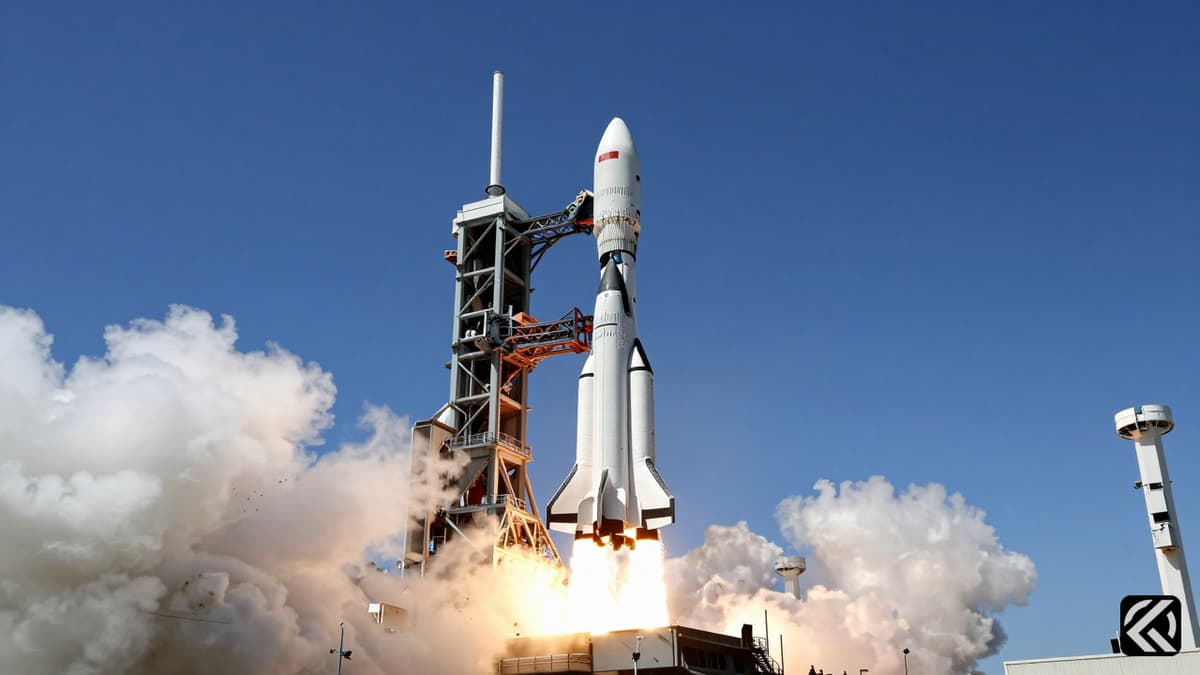
India enters the elite private orbital club as Vikram-1 successfully launches, marking a transformative moment for the nation’s space exploration capabilities.
India achieved a major milestone in its space journey on Saturday (July 18, 2026) as Vikram-1, the country’s first privately developed orbital rocket, successfully placed multiple technology demonstration payloads and postcards into a low earth orbit. This achievement positions India within an exclusive group of nations possessing private orbital launch capabilities.
The mission, dubbed ‘Mission Aagaman’ (meaning arrival), marks India’s entry into this elite group, making it only the third country in the world to achieve the feat through a privately developed launch vehicle. Skyroot Aerospace described the outcome as a “grand success” following the lift-off from the Satish Dhawan Space Centre in Sriharikota.
The rocket lifted off at the rescheduled time of 12:05 p.m., following a temporary hold that delayed the original 11:30 a.m. schedule. Five minutes before the earlier scheduled lift-off, Skyroot Aerospace announced a ‘planned hold’ during the Automated Launch Sequence (ALS). Although the onboard software had initiated the countdown and cleared checkpoints autonomously, the process was halted and subsequently restarted to ensure all systems were cleared.
Developed by private space launch company Skyroot Aerospace, Vikram-1 is a seven-storey-tall, multi-stage orbital launch vehicle. It is built with an all-carbon composite structure and powered by in-house developed propulsion systems, including 3D-printed engines and high-thrust solid-fuel rocket boosters. The rocket is designed to carry small satellites weighing up to 350 kg to Low Earth Orbit (LEO).
The first test flight targeted a 450-km orbit at a 60° inclination. The payload included six technology demonstration payloads from Grahaa Space, Cosmoserve, DCubed, and Skyroot’s own SCOPE. Additionally, the rocket carried Cosmos Diamonds’ artwork “Cosmic Bloom” and a micro-art piece. Notably, a handwritten postcard from Prime Minister Narendra Modi traveled alongside hundreds of cards from well-wishers across the world.
Prior to the launch, Skyroot Aerospace confirmed that launch authorization had been granted by the Indian National Space Promotion and Authorisation Centre (IN-SPACe). The company stated that all stages of the rocket had been successfully integrated and stacked on the launch pad. Final integrated checks from Skyroot’s launch control centre, along with interface checks with telemetry ground stations and tracking radars, were completed successfully.
Pawan Kumar Chandana, co-founder and CEO of Skyroot Aerospace, emphasized the significance of the test flight. “We have done everything to test Vikram-1 on the ground. On July 18, we are eager to see how Vikram-1 performs in a real flight environment for the first time. This is our first test flight, and we will be getting valuable data from it. This will be foundational to Skyroot’s aspirations to establish launch cadence,” Chandana said.
The primary objective of Mission Aagaman is to achieve a successful lift-off, safe clearance of the tower, and gather maximum data throughout the ascent. The flight sequence covers 14 phases, with a total duration of 15.46 minutes from lift-off to orbit injection. This mission follows the successful suborbital flight of Vikram-S, India’s first private rocket to reach space, on November 18, 2022. Skyroot plans to commence full commercial flights after one or two successful demonstrations to orbit.
Vikram-1 is engineered for rapid manufacturing and high launch cadence. Its specifications include a height of 22 metres, a diameter of 1.7 metres, and a configuration of three solid stages and a liquid Orbital Adjustment Module. The launch marks several firsts for the country, including the first privately developed orbital launch vehicle, the first all-carbon composite orbital rocket, and the first 100% 3D-printed engine on an orbital vehicle. It also features India’s longest monolithic carbon-composite rocket stage and the first of its kind ultra-low-shock pneumatic separation systems.
The launch holds historic significance, occurring 46 years after India launched its first experimental Satellite Launch Vehicle-3 (SLV-3). On July 18, 1980, India became the sixth member of the exclusive club of spacefaring nations when the SLV-3 placed the Rohini Satellite (RS-1) into orbit from the same venue.
Following the successful launch, Prime Minister Narendra Modi engaged in a telephone conversation with the Skyroot team. Speaking to Chandana, the Prime Minister described the launch as a defining moment in India’s space journey. “The growing participation of our private sector is opening new frontiers and accelerating innovation. This achievement will encourage countless youngsters to dream bigger and innovate fearlessly,” he stated.
The successful deployment of Vikram-1 signals a pivotal shift in India’s space sector, transitioning from government-led dominance to a robust private-enterprise model. By demonstrating the viability of carbon-composite structures and 3D-printed engines, Skyroot Aerospace has validated a new manufacturing paradigm aimed at high launch cadence. This foundational data will likely accelerate the timeline for full commercial operations, enabling more frequent and cost-effective access to low earth orbit for domestic and international clients. The integration of government oversight via IN-SPACe alongside private innovation suggests a sustainable ecosystem where private entities drive technological advancement while the state facilitates regulatory frameworks, potentially positioning India as a global hub for small satellite deployment and space tourism in the coming years.
Oct 3, 2026 04:08 UTC
FlyDubai Co-Pilot Banned in Oman Over Extremism Concerns
Oct 3, 2026 00:50 UTC
Israel-Mumbai Campaign Honors Captain Smit After Flydubai Incident
Oct 2, 2026 18:13 UTC
Captain Smit Machchhar’s Courage Saves Flydubai Flight FZ1073 From Disaster
Oct 2, 2026 16:45 UTC
Captain Smit Machchhar Saves Plane Mid-Fall
Sep 18, 2026 12:35 UTC
Bolivia's Newly Discovered Feline Species Named Leopardus tilcayo