Despite Iran's diplomatic promises, two massive Chinese ships turned back near the Strait of Hormuz, revealing a new, unpredictable security reality for global maritime trade.
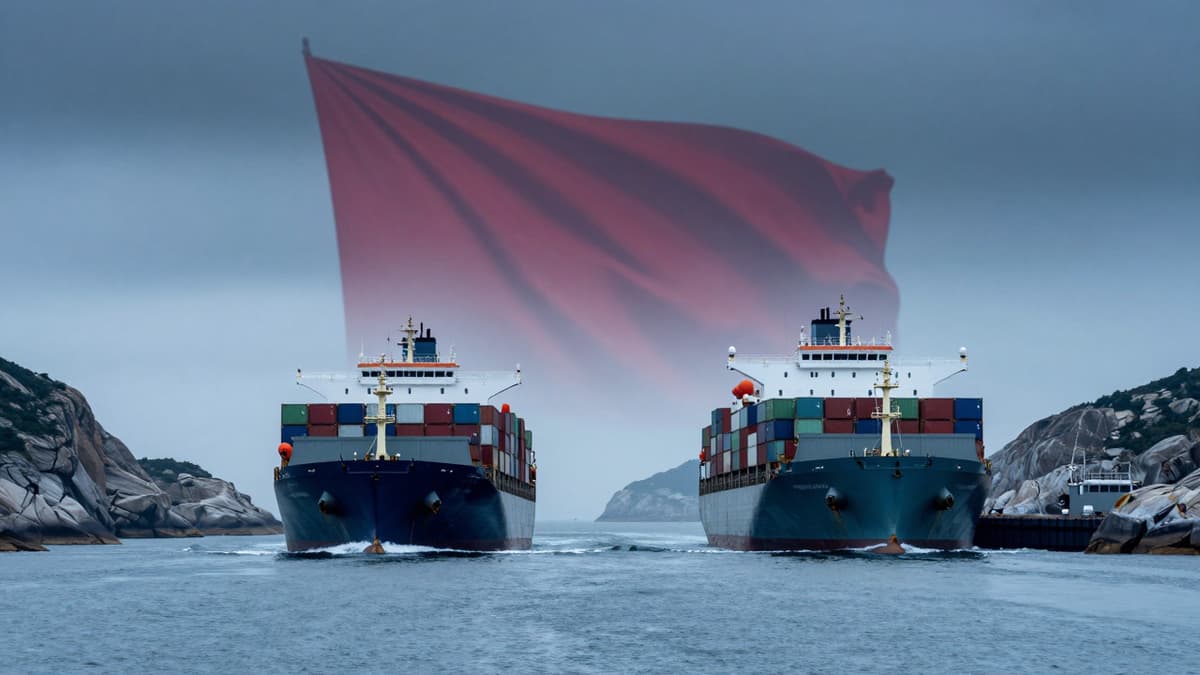
Two large Chinese-linked container ships made a sudden U-turn near the Strait of Hormuz on Friday, aborting their exit from the Gulf despite recent diplomatic assurances from Tehran. The vessels, identified as the CSCL Indian Ocean and CSCL Arctic Ocean, were linked to China's state-owned COSCO Shipping and had attempted to leave the region in the early hours before reversing course close to Iranian waters. This abrupt maneuver marks the first known attempt by a major global shipping operator to exit the Gulf since the conflict escalated, shattering the perception of guaranteed access for friendly nations.
Ship-tracking data revealed the two massive vessels moved toward the narrow passage at approximately 0350 GMT before turning back near Iran's Larak and Qeshm islands. This reversal occurred just a day after Iranian Foreign Minister Abbas Araghchi stated that Tehran would permit safe passage for ships from five "friendly" nations, including China. Analysts cited by the Wall Street Journal described the incident as "unusual," highlighting the stark contradiction between diplomatic messaging and on-the-ground realities. Rebecca Gerdes, an analyst at Kpler, told Reuters that this episode demonstrates that "safe passage could not be guaranteed" despite the high-level assurances given by the Iranian government.
Complicating matters further, Bloomberg reported that the vessels had earlier altered their tracking signals to indicate Chinese ownership and crew, a tactical maneuver previously used by ships seeking to avoid potential confrontation in the waterway. Both ships had been stranded in the region for weeks prior to this aborted exit attempt, adding to the growing backlog of maritime traffic. The incident underscores the volatile nature of the region, where military threats are combined with selective permissions to regulate the movement of international vessels.
Iran has tightened its grip on one of the world's most critical shipping lanes, which normally carries roughly one-fifth of the globe's oil and gas exports. Since the conflict began, the Strait of Hormuz has effectively come under Iranian control, with the Iranian Revolutionary Guard forces reportedly turning back multiple vessels attempting to cross. Industry data and maritime reports now suggest that Tehran is operating a de facto approval system, often described by shipping intelligence firms as a "toll booth" model.
Under this new regime, vessels may be required to submit detailed information regarding their cargo, ownership, and crew before receiving clearance to pass. In some instances, ships have reportedly paid fees, sometimes in Chinese yuan, to secure their passage through the narrow waterway. Approved vessels are sometimes escorted through Iranian-controlled routes, while those linked to countries perceived as backing the United States or Israel face the possibility of being denied passage altogether. On Friday alone, Iranian forces warned off three container ships of different nationalities attempting to cross the strait.
This patchwork system of approvals and restrictions has created a chaotic environment for shipping firms, forcing them to navigate a complex web of geopolitical demands. The disruption has sent shockwaves through global energy markets, with crude oil and liquefied natural gas exports from Gulf producers sharply curtailed. Despite the broader slowdown, Iranian oil shipments, particularly to smaller Chinese refineries, appear to have continued, suggesting Tehran is leveraging its control to maintain key export flows while restricting others.
The human cost of this maritime crisis is severe. At least 20,000 seafarers are believed to be stranded in the Gulf region, with security risks intensifying significantly. Maritime agencies have reported multiple attacks on commercial vessels since the conflict began, resulting in casualties among crew members. In a move reflecting heightened fears of targeting, many ships are now switching off their tracking systems while navigating the region.
The escalating conflict in the Strait of Hormuz is rapidly transforming the global maritime landscape into a high-stakes choke point where access is dictated by political allegiance rather than open trade norms. If the current pattern of selective permissions and "toll booth" enforcement continues, the global shipping industry may face a prolonged period of reduced capacity and elevated insurance costs. With only a fraction of normal daily vessel movements taking place and tensions between the United States and Iran remaining high, the likelihood of further incidents involving strategic U-turns or enforced detentions appears imminent. The situation on the ground and at sea continues to deteriorate, suggesting that without a diplomatic breakthrough, the Strait of Hormuz will remain a precarious barrier to international commerce, with the "toll booth" system likely to persist as the primary mechanism of control for the foreseeable future.
Jun 8, 2026 00:51 UTC
Trump Claims Iran Nuclear Deal Imminent Despite Diplomatic Fractures
Jun 8, 2026 00:47 UTC
Iran Fires Missiles at Israel After Beirut Strike
Jun 7, 2026 22:00 UTC
US, Iran Peace Hops Fade 100 Days Into War
Jun 7, 2026 20:57 UTC
Iran Strikes Israel: IRGC Promises Week of Continuous Offensive
Jun 8, 2026 02:28 UTC
Trump Walks Out of Meet the Press After Rejecting Evidence Demands