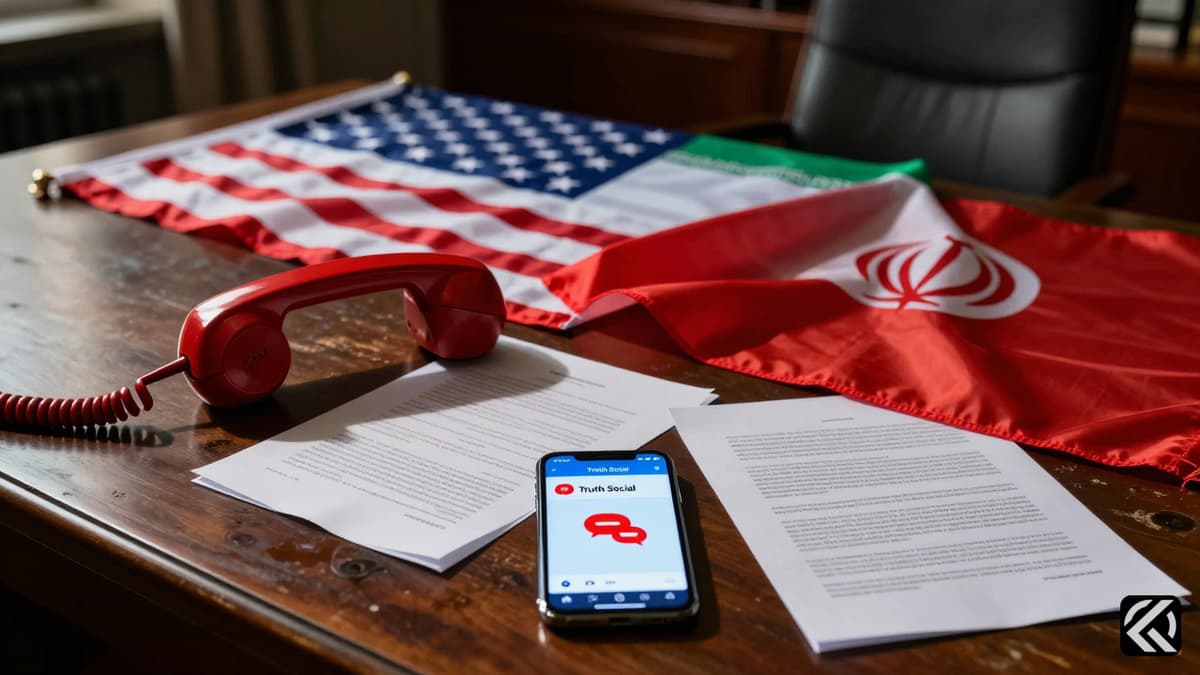
President Trump's public declarations on social media claiming an imminent Iran nuclear deal have sparked confusion and tension, jeopardizing fragile US-Iran ceasefire negotiations.
The approaching weekend brought optimism that the US and Iran were nearing an agreement to end a seven-week war, but that sentiment collapsed when President Trump took to social media. Instead of allowing staff to finalize details, the President posted claims about ongoing talks and spoke to reporters, asserting Iran had already agreed to critical provisions like surrendering enriched uranium. These public declarations, made while Pakistani intermediaries updated him on discussions in Tehran, were immediately rejected by Iranian officials who denied preparing for further talks, effectively tanking the rising hope for a resolution.
Trump's approach appears to have alienated the Iranian negotiating team, led by Parliament Speaker Mohammad Bagher Ghalibaf and Foreign Minister Abbas Araghchi, who view the public maneuvering as a sign of weakness. Senior US officials privately acknowledged to CNN that the President's commentary has been detrimental, noting the deep mistrust between the two nations and the sensitivity of the negotiations. The situation is further complicated by a suspected divide within the Iranian government between the civilian negotiating team and the Islamic Revolutionary Guard Corps, raising questions about who has the authority to sign a final agreement. The President claimed on Truth Social that Iran had agreed to an "unlimited" suspension of its nuclear program and that a meeting would likely occur over the weekend, but these assertions clash with the reality on the ground.
The Truth Social negotiation strategy has created a chaotic environment where conflicting narratives emerge daily. Trump told Bloomberg that Tehran agreed to everything, while simultaneously telling CBS that Iran would work with the US to remove its enriched uranium. However, Iranian officials outwardly rejected these assertions, stating they were not preparing for new talks, which rapidly destroyed the optimism generated by the President's claims. This public posturing has left the future of the peace talks unclear, with the fragile US-Iran ceasefire tested again on Sunday when a US guided-missile destroyer seized an Iranian cargo ship attempting to bypass a naval blockade in the Gulf of Oman.
Confusion also spread regarding the leadership of the US delegation. On Sunday morning, Trump told callers that Vice President JD Vance would not participate due to security concerns, only for senior officials like UN Ambassador Mike Waltz and Energy Secretary Chris Wright to appear on television confirming Vance would lead the delegation in Islamabad. The White House later clarified that "things changed," and by Monday afternoon, Vance was seen arriving at the West Wing before preparing to depart for Pakistan. Despite these logistical clarifications, the timeline for negotiations remains fluid, with talks now expected to commence Wednesday morning in Islamabad rather than Monday evening as previously suggested.
The core of the potential Trump Iran nuclear deal hinges on conflicting terms that the President has publicly stated but which have not been formally agreed upon. Trump has set red lines including a freeze on uranium enrichment and the surrender of near-bomb-grade stockpiles, while Iran insists on maintaining control over the Strait of Hormuz and lifting sanctions. While early US proposals suggested a 20-year pause on enrichment, Iran countered with a five-year suspension, a proposal the US has rejected. A more recent Iranian offer includes a 10-year pause followed by another decade of enrichment at levels well below weapons grade, but Trump has told reporters he wants no enrichment indefinitely and opposes even the 20-year pause.
Amidst these deadlocks, the Trump administration is reportedly considering unfreezing $20 billion in Iranian assets in exchange for the stockpile of highly enriched uranium. However, the President's primary imperative remains avoiding a deal that resembles the Obama-era Joint Comprehensive Plan of Action, which he withdrew from in 2018. While negotiators hope to produce a framework understanding, some warn that Iran could be using this time to unearth buried missile systems. Despite the rising unpopularity of the war and its impact on gas prices, Trump insisted on Monday that he felt no pressure to reach a deal, though he acknowledged the process would happen quickly.
The expiration of the two-week ceasefire, originally set for Tuesday evening following Trump's April 7 announcement, has been pushed to Wednesday evening Washington time, granting 24 additional hours for talks. Trump stated it was highly unlikely he would extend the truce further, yet he has previously offered three different answers to the question of extension: fighting would resume, an extension might happen if necessary, or the question might be moot. As the deadline approaches, the US and Iran remain in a state of uncertainty, with the potential for escalation or a fragile agreement hanging in the balance.
With the two-week truce set to expire Wednesday evening, the window for a final agreement is narrowing as tensions remain high. The conflicting public statements by the President and the reported internal divisions within Iran suggest that reaching a consensus on the nuclear framework will be difficult. If the current pattern of public renegotiation and internal discord continues, the likelihood of a sustained peace agreement decreases, potentially leading to a resumption of hostilities and further escalation in the Gulf of Oman. The outcome of the upcoming talks in Islamabad will determine whether the conflict de-escalates into a formal treaty or spirals into a prolonged military confrontation.
Jun 8, 2026 00:51 UTC
Trump Claims Iran Nuclear Deal Imminent Despite Diplomatic Fractures
Jun 8, 2026 00:47 UTC
Iran Fires Missiles at Israel After Beirut Strike
Jun 7, 2026 22:00 UTC
US, Iran Peace Hops Fade 100 Days Into War
Jun 7, 2026 20:57 UTC
Iran Strikes Israel: IRGC Promises Week of Continuous Offensive
Jun 8, 2026 02:28 UTC
Trump Walks Out of Meet the Press After Rejecting Evidence Demands


