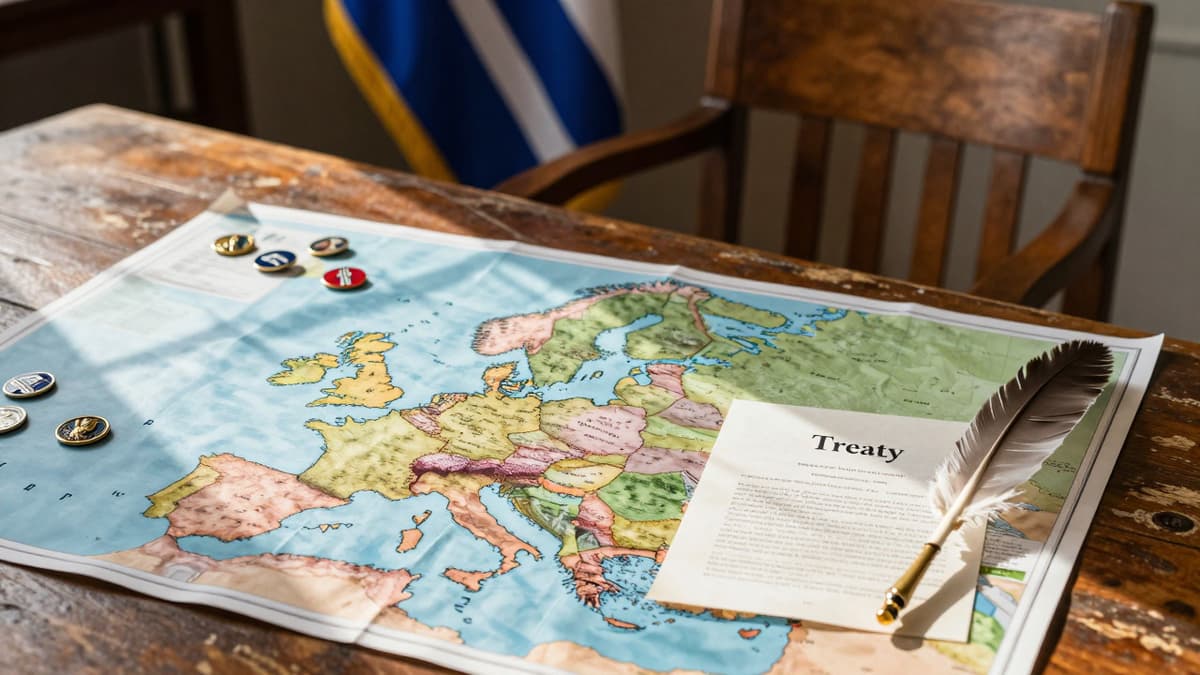
President Trump has reignited tensions, threatening to withdraw from the NATO alliance as allies hesitate to join US military operations against Iran.
Of all the warnings in President Trump's arsenal, quitting the NATO military alliance is among those he's wielded the most. Now, he is doing it again. In a recent interview with Britain's Telegraph newspaper, when asked if he is reconsidering US membership, the President responded with a clear "Oh yes," adding that the decision is "beyond reconsideration." His frustration stems from his partners' refusal to join America's military operations alongside Israel against Iran. Trump emphasized his view that such participation "should be automatic," highlighting a fundamental misunderstanding of the 32-member alliance's operational mechanics.
The core of the alliance, Article 5, commits members to collective defense, stating that an attack on one is an attack on all. However, invoking this principle requires a consensus, and the 1949 treaty originally referred only to crises in Europe and North America. Consequently, one ally after another has held back from joining a war they were not consulted on, particularly given the mixed messaging from the Trump administration. While Article 5 was triggered only once following the September 11th attacks in 2001, the current administration's stance suggests a willingness to bypass these historical precedents. Trump also referenced Ukraine, claiming the US has been "there automatically, including Ukraine," despite NATO as an alliance having avoided direct involvement as a party to the conflict since Russia's full-scale invasion in February 2022.
This is not a new sentiment. Even before entering the White House in 2017, Trump repeatedly dismissed NATO as a "paper tiger," described it as "obsolete," and claimed it was "costing a fortune" for the US. This year alone, he mocked the alliance, arguing that Russia would have occupied all of Ukraine if the US had not been NATO's enforcer. Historical records show Trump almost walked out in early 2019 during his first term. Former NATO Secretary General Jens Stoltenberg wrote in his memoir, , that he saw clear signs Trump was preparing to act on this threat. Stoltenberg later credited Trump on Fox News for pressuring allies to increase military spending, a sentiment the President acknowledged on social media before the White House reportedly drafted speech for a US pullout.
The central issue remains the 2014 agreement regarding defense spending. Originally described merely as a "guideline," the target for countries to spend 2% of their GDP on defense has been met by almost all NATO members. This increase is driven partly by Trump's threats and partly by Russia's growing menace. However, a cold hard fact remains: the might of the US military matters immensely. The US military budget currently comprises approximately 62% of NATO's total defense spending, and the Pentagon possesses assets and intelligence capabilities that others still cannot match.
Amidst this crisis, Secretary of State Marco Rubio has entered the fray. Calling himself a former supporter of the alliance, Rubio told Fox News that "unfortunately, after this conflict is concluded we are going to have to re-examine that relationship." He argued that not using US bases in Europe to "defend America's interests" effectively makes NATO a "one-way street." Specific incidents have fueled this rhetoric; while Britain initially refused access to US warplanes, it later allowed bases for "defensive operations," a delay Trump and Secretary of Defense Pete Hegseth have derided by taunting Prime Minister Starmer as being "no Churchill."
Further friction has emerged as Italy denied US aircraft permission to land en route to the Middle East for combat operations, and Spain closed its airspace to US planes conducting missions against Iran. Rubio noted that it is "ultimately" up to the President to decide on the alliance's future. Meanwhile, legal constraints exist; the US Congress voted at the end of 2023 to prohibit the president from unilaterally withdrawing from NATO without a two-thirds Senate majority or an act of Congress. Current leaders, including Secretary General Mark Rutte, will need to spend time convincing Trump that staying in the alliance is in his and America's interest. Rutte, often called the "Trump whisperer," has used praise and his "toolbox" of tactics to keep the president on side, notably playing a role in pulling Trump back from threats to "take" Greenland earlier this year. Yet, Rutte's top priority remains keeping his 77-year-old coalition intact as it confronts threats from Ukraine, the Middle East, and the White House.
Secretary of State Marco Rubio's comments signal a potential policy shift where the US may re-evaluate its strategic partnership once current conflicts resolve. If Donald Trump follows through on his threats to withdraw, the alliance will face a seismic shift in its financial and operational structure, forcing European nations and Canada to accelerate their self-reliance efforts. While the US currently funds the vast majority of the alliance's budget, a withdrawal would leave a security vacuum that other members may struggle to fill without matching US intelligence and asset capabilities. The upcoming negotiations will likely test the resolve of leaders like Mark Rutte, who must balance domestic coalition stability with the urgent need to preserve the transatlantic security framework against growing global threats.
Jun 8, 2026 02:17 UTC
Magnitude 7.8 Quake Shakes Philippines, Urging Immediate Evacuations
Join 50,000+ readers getting the global briefing every morning.
No spam. Unsubscribe anytime.
Jun 8, 2026 02:17 UTC
Magnitude 7.8 Quake Shakes Philippines, Urging Immediate Evacuations
Jun 8, 2026 00:51 UTC
Trump Claims Iran Nuclear Deal Imminent Despite Diplomatic Fractures
Jun 8, 2026 00:47 UTC
Iran Fires Missiles at Israel After Beirut Strike
Jun 7, 2026 22:38 UTC
Congress Party Claims Unity for INDIA Bloc Delhi Meeting


