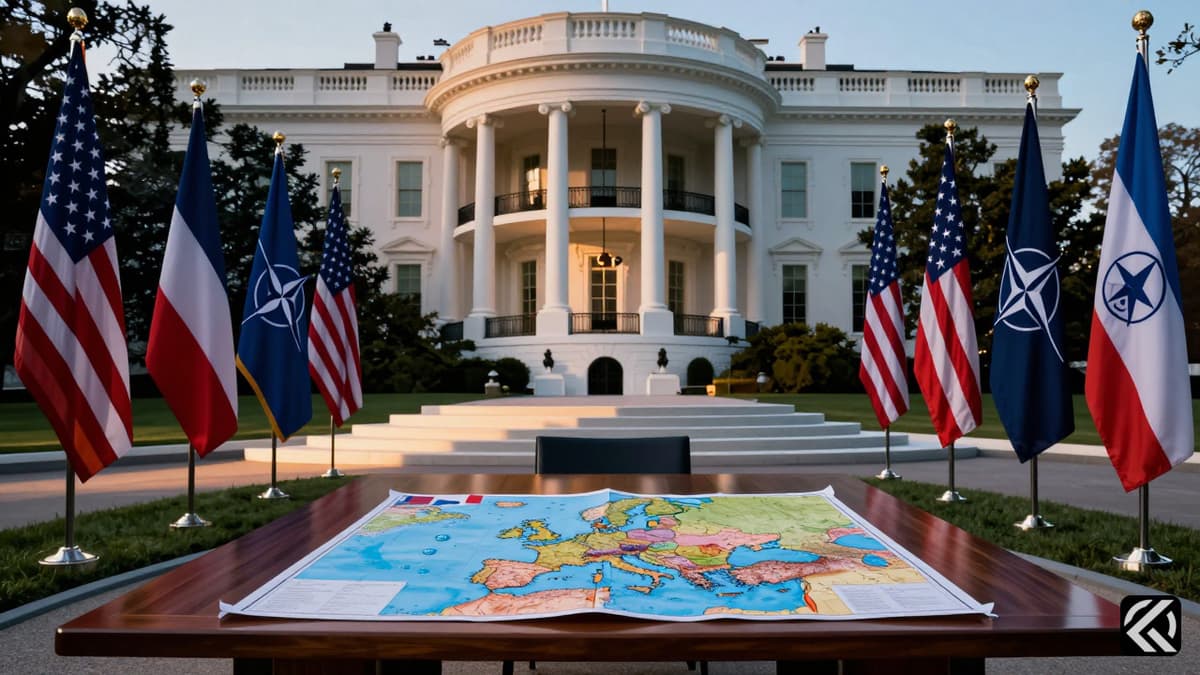
Tensions flare at the White House as Donald Trump attacks NATO for lacking support during the Iran conflict, sparking a fierce debate on alliance loyalty.
In a dramatic confrontation at the White House on Wednesday, President Donald Trump renewed his attacks on the North Atlantic Treaty Organization (NATO), declaring the alliance had failed the United States during the recent war with Iran. Following a private meeting that lasted over two hours, the President took to his Truth Social platform to state unequivocally that NATO was not there when the US needed them and warned they would not be there if the US required support again.
The meeting, which included Secretary General Mark Rutte, was characterized by the Dutch official as "very frank" and "very open," even as deep disagreements emerged between the American leader and his NATO counterpart. Trump had previously toyed with the idea of withdrawing from the trans-Atlantic military alliance after several member countries resisted his demands to reopen the Strait of Hormuz, a move aimed at easing rising global oil prices. Although the exact duration of the President's specific interaction with Rutte remains unknown, the atmosphere was charged with Trump's deep misgivings about member countries not providing sufficient aid before and during Operation Epic Fury.
White House Press Secretary Karoline Leavitt echoed the President's harsh sentiments, quoting him directly to say that NATO was "tested and they failed." Leavitt reported that Trump felt NATO countries had "turned their backs on the American people," who fund the defense of their nations, prompting the President to demand a "very frank and candid conversation" with the Secretary General. While the US president remains skeptical, Rutte attempted to correct the narrative during his News briefing with CNN, arguing that the large majority of European nations had actually been helpful with basing, logistics, and overflights.
The Secretary General's defense of the alliance relied heavily on the claim that European countries did not stand in the way of US operations. Rutte emphasized to the American president that most NATO members do not view the war in Iran as illegal and agree that degrading Iran's nuclear capabilities is crucial for global security. Despite this, the fundamental disconnect remains regarding the scale of support, with Trump maintaining that the alliance's contribution was inadequate during the conflict.
The timing of this friction is significant given the geopolitical landscape. The US Congress had previously voted at the end of 2023 to prohibit any US president from unilaterally withdrawing from NATO without a two-thirds Senate majority or an act of Congress, yet the political pressure from the executive branch remains intense. The expectation prior to the talks was that Rutte would cajole and convince Trump that remaining in the alliance served the best interests of both the US and its European partners. However, whether the Secretary General's warm relationship with Trump or his arguments regarding European logistical support will be enough to alleviate the President's concerns is still to be seen.
Rutte did attempt to find common ground by asking if the world was safer now than before the war, to which he responded "absolutely," crediting Trump's leadership in degrading Iran's nuclear threats. This acknowledgment of Trump's role in the conflict suggests a potential, albeit fragile, alignment on security outcomes, even if the political rhetoric regarding alliance support remains hostile. The US president's frustration appears rooted in the perception of abandonment during Operation Epic Fury, a sentiment that Leavitt reinforced by stating the alliance members had abandoned the American people.
As the administration navigates the aftermath of the Iran conflict, the relationship between the US and NATO faces a critical test. The President's statement that "NATO WASN'T THERE WHEN WE NEEDED THEM" signals a potential shift in US foreign policy priorities and could lead to increased scrutiny of member contributions. The Secretary General's efforts to highlight logistical contributions like overflights and basing indicate that the alliance is trying to prove its utility, yet the core issue of direct military support remains a point of contention.
The long-term implications of this News cycle suggest a period of uncertainty for the trans-Atlantic partnership. With the President holding deep misgivings about the alliance and the legal hurdles regarding withdrawal established by the 2023 Congressional vote, the US will likely continue to demand clearer commitments from member states. The coming weeks will determine if the "frank" dialogue initiated by Rutte can translate into a renewed sense of unity or if the President's demands for greater support will continue to strain the relationship. The outcome of these interactions will define the future of US-NATO cooperation in an increasingly volatile global environment.
Trump's criticism marks a significant turning point in US-NATO relations, with the President explicitly stating the alliance failed during the Iran war. While Secretary General Rutte defends the contributions of European nations regarding logistics and basing, the perception of abandonment remains a potent political tool for the President. Looking ahead, the alliance faces the challenge of reconciling Trump's demand for immediate, robust support with the realities of international cooperation. The established Congressional rules preventing unilateral withdrawal provide a legal buffer, but political pressure could force a restructuring of expectations regarding defense funding and operational participation. The coming months will test whether the "frank" conversations can bridge the gap between US demands and NATO's collective capabilities.
Jun 8, 2026 04:15 UTC
Trump Urges Netanyahu to Halt Iran Strike for Peace
Join 50,000+ readers getting the global briefing every morning.
No spam. Unsubscribe anytime.
Jun 8, 2026 02:28 UTC
Trump Walks Out of Meet the Press After Rejecting Evidence Demands
Jun 8, 2026 02:17 UTC
Magnitude 7.8 Quake Shakes Philippines, Urging Immediate Evacuations
Jun 8, 2026 00:51 UTC
Trump Claims Iran Nuclear Deal Imminent Despite Diplomatic Fractures
Jun 8, 2026 00:47 UTC
Iran Fires Missiles at Israel After Beirut Strike


