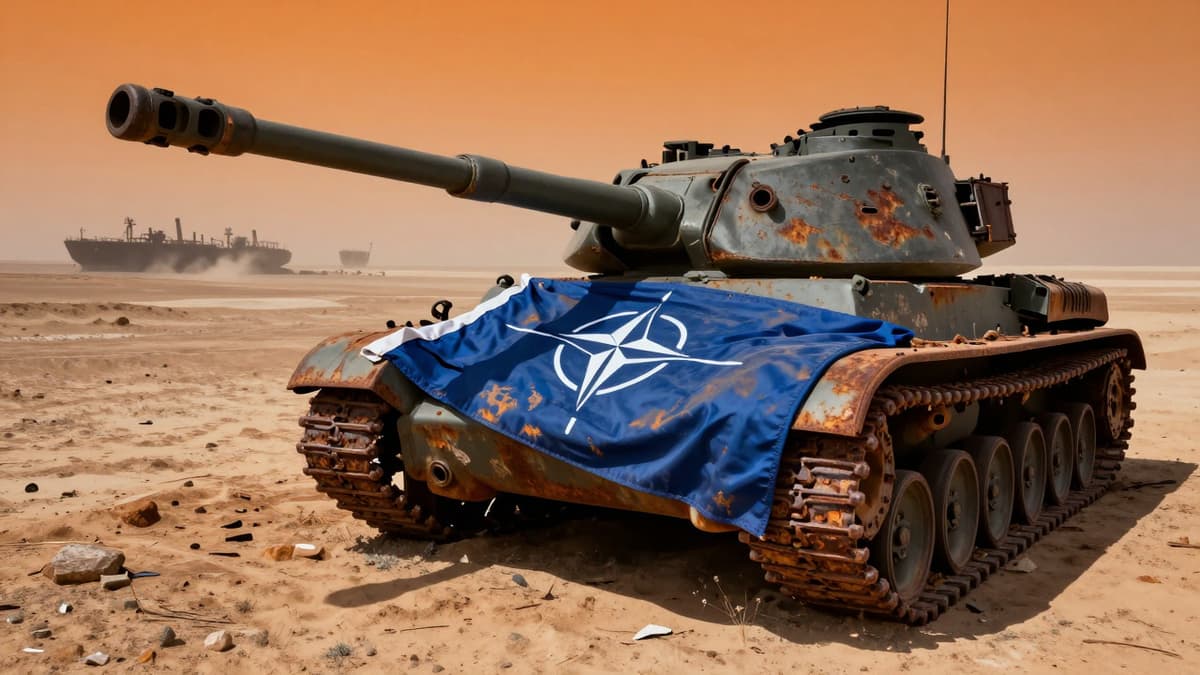
Following a tense diplomatic row over the Iran-Israel war, President Donald Trump has declared his intent to reconsider U.S. membership in the NATO alliance, calling it a "paper tiger" in a scathing interview.
President Donald Trump has announced he is considering exiting the North Atlantic Treaty Organization, labeling the security alliance a "paper tiger" following a diplomatic dispute over the ongoing Iran-Israel war. The U.S. President made these comments to the British daily The Telegraph, stating that the U.S. will no longer guarantee help for nations that refuse to defend their own interests. This potential withdrawal comes as global oil markets react to the conflict, with crude prices hitting $120 per barrel and gasoline soaring above $4 per gallon in the United States.
The tension escalated after key NATO partners, primarily the United Kingdom, France, and Spain, refused to join the military efforts to reopen the Strait of Hormuz, which has been shut since the Iran-Israel war began a month ago. Trump expressed disbelief that the alliance did not answer his call to join the conflict, noting that he did not insist heavily but expected automatic support. He criticized the lack of support from European nations, stating, "We've been there automatically... They weren't there for us." In a subsequent Truth Social post, Trump warned those countries that "the U.S.A. won't be there to help you anymore," urging them to "build up some delayed courage" and take action themselves.
The U.S. President's frustration was directed specifically at British Prime Minister Keir Starmer and the French government. Trump questioned the British navy's capabilities, claiming they are "too old" with non-functional aircraft carriers. He also attacked Starmer's energy policies, suggesting the Prime Minister only cares about "costly windmills that are driving your energy prices through the roof." Regarding France, Trump accused the country of being "VERY UNHELPFUL" by refusing to let military planes bound for Israel fly over French territory. He characterized the U.S. campaign as having essentially "decimated" Iran and insisted that the "hard part is done," leaving allies to manage their own oil supplies.
Trump's criticism of NATO stems from a long-standing on-and-off relationship with the alliance, where he has frequently accused member countries of piggybacking on U.S. security interests while spending less on defense. During his 2024 election campaign, he notoriously encouraged Russia to attack members that do not spend enough on defense, and earlier this year, he threatened to invade Greenland, a territory of the Danish NATO member. He told the Telegraph that he was "never swayed by NATO" and noted that Russian President Putin is fully aware of the alliance's weaknesses.
Responding to the U.S. President's harsh comments, Prime Minister Keir Starmer reaffirmed his strong support for the alliance, calling it "the single most effective military alliance the world has ever seen." Starmer emphasized that the alliance has kept the nation safe for decades and declared that Britain remains "fully committed to NATO." However, he also reiterated his stance on the specific conflict, stating, "whatever the noise," he would act in British national interests. He made it clear that this is "not our war" and that Britain would not get "dragged into it" despite the pressure.
On Tuesday, Trump posted on Truth Social that "The U.S.A. will REMEMBER" the nations that refused to participate, specifically hitting out at the U.K. and France for not joining the conflict to help reopen the Strait of Hormuz. He suggested that these nations, which are struggling to get jet fuel due to the closure, should buy fuel from the U.S. or "just TAKE IT" themselves. The President framed the situation as a test of reliability, noting that Ukraine was a test where the U.S. was present, but those allies were absent when needed. With gas and petroleum prices spiking in Europe and the U.S., the rift between Washington and its European allies appears to be widening significantly.
President Trump's remarks indicate a potential shift in American foreign policy that could fundamentally alter the strategic landscape of the Atlantic alliance. If the U.S. follows through on its threat to exit NATO after allies refuse to engage in the Iran-Israel war, the immediate impact could be a collapse of collective security guarantees in Europe. The President's specific critique of the British navy and French aviation policies suggests that future negotiations may focus heavily on operational capabilities rather than political solidarity. As global oil flows remain choked and prices continue to rise, the lack of a unified Western military response may force European nations to seek alternative security arrangements or develop their own independent defense capabilities, ending the era of automatic American protection.
Jun 8, 2026 02:17 UTC
Magnitude 7.8 Quake Shakes Philippines, Urging Immediate Evacuations
Join 50,000+ readers getting the global briefing every morning.
No spam. Unsubscribe anytime.
Jun 8, 2026 02:17 UTC
Magnitude 7.8 Quake Shakes Philippines, Urging Immediate Evacuations
Jun 8, 2026 00:51 UTC
Trump Claims Iran Nuclear Deal Imminent Despite Diplomatic Fractures
Jun 8, 2026 00:47 UTC
Iran Fires Missiles at Israel After Beirut Strike
Jun 7, 2026 22:38 UTC
Congress Party Claims Unity for INDIA Bloc Delhi Meeting


