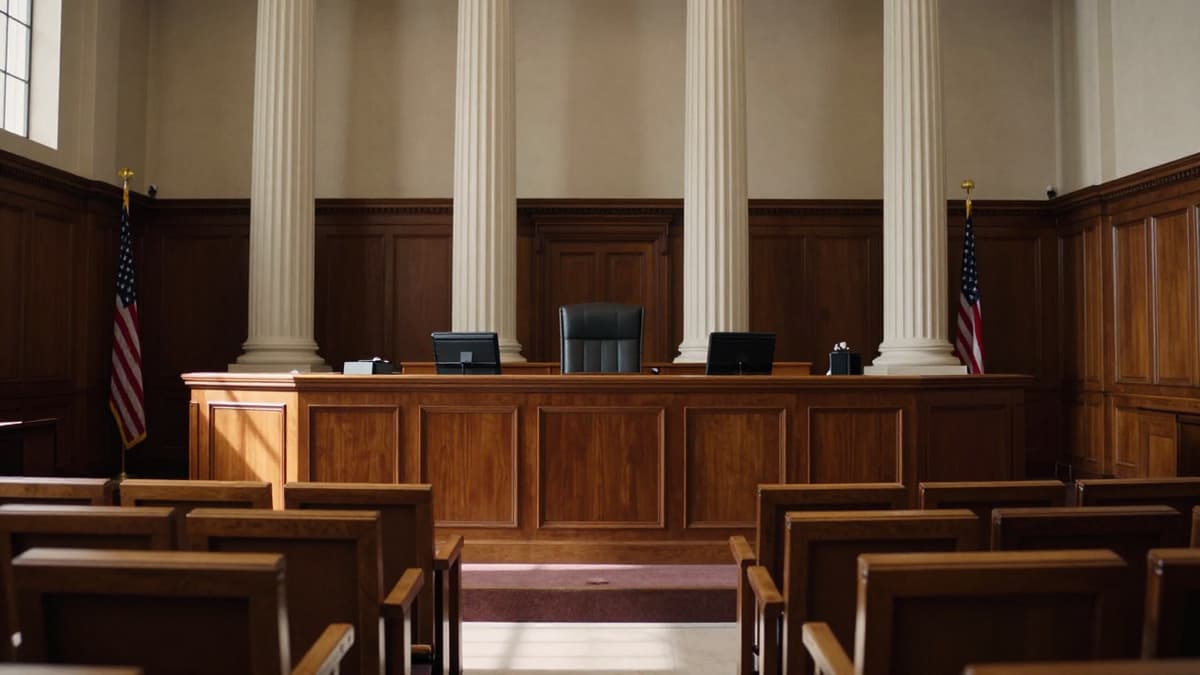
In a first for a sitting president, Donald Trump attended Supreme Court arguments challenging birthright citizenship, while justices probed the legal and practical implications of the move.
Donald Trump has made history by becoming the first sitting US president to attend oral arguments at the Supreme Court, a move that drew significant attention to the ongoing News regarding the constitutional right to citizenship for children born in the US. The President left the chamber after listening to the proceedings, returning to the White House, while arguments continue inside regarding whether the 14th Amendment protects birthright citizenship for all born on US soil or if exceptions should be expanded to include children of undocumented immigrants.
The hearing has been marked by intense scrutiny from the justices regarding the Trump administration's legal stance. Solicitor General Sauer, arguing for the administration, contends that the current US law granting "almost unrestricted" birthright citizenship is an "outlier" among modern nations, claiming that every nation in Europe operates under different rules. However, Justice Sonia Sotomayor challenged this by pointing out that the English rule historically differed from other European nations and citing the 1898 Supreme Court ruling in US v Wong Kim Ark, which established that children of legal immigrants are citizens under the 14th Amendment.
ACLU attorney Cecillia Wang emphasized that the rule of "anyone born here is a citizen" was enshrined in the 14th Amendment specifically to prevent government officials from altering it. She warned that overturning this principle could call into question the citizenship of millions of Americans, past, present, and future, and invalidate dozens of other US laws. Wang noted that historically, the only exceptions have been the children of foreign diplomats and the children of hostile invading armies, and even the exclusion of some Native Americans ended with the 1924 Indian Citizenship Act.
Outside the court, the political stakes were raised by Democratic California Senator Alex Padilla, who spoke to protesters. Padilla stated that the 14th Amendment should not be up for debate, asserting that "if you're born here, you are a citizen." He criticized the Trump administration, saying the President wants to "pick who gets to be an American and who doesn't," a move Padilla labeled as wrong.
Inside the courtroom, the justices expressed significant skepticism about the administration's position during the opening moments of the hearing. Chief Justice John Roberts questioned how the court could expand the few historical exclusions, such as children of foreign diplomats, to include a large group like children of undocumented immigrants, describing the administration's logic as unconvincing. Justice Elena Kagan directly challenged the administration's reliance on concepts like "allegiance" or "domicile," stating that the text of the 14th Amendment does not support the argument that undocumented immigrants lack the necessary allegiance to the US.
The debate also delved into the practical applications of the proposed changes. Justice Amy Coney Barrett pressed Sauer on how the rules would apply in cases where parents' identities or residency status are unclear, such as a US citizen traveling abroad to give birth. She questioned the administration's definition of "subject to the jurisdiction," which Sauer interprets as requiring an intent to stay lawfully, a standard Barrett argued was impossible to determine at the moment of birth for many individuals.
Justice Neil Gorsuch also raised critical questions regarding the status of Native Americans. When asked if Native Americans born in the US today are birthright citizens, Sauer initially expressed uncertainty, stating there is widespread agreement they are not, before hesitantly agreeing that under a test of parental domicile, they might be considered citizens. This exchange highlighted the complexity of applying the administration's new interpretation to historical precedents.
Sotomayor further asked if the administration was asking the court to overrule the 130-year-old Wong Kim Ark precedent. Sauer replied that they are not asking for a formal overrule but are attempting to limit the scope of the ruling. Sotomayor expressed skepticism about how this position could be sustained, noting that a prospective ruling might still allow future Congresses or presidents to use it to denaturalize people born in the US, similar to past treatment of Native Americans.
The Supreme Court is currently grappling with a fundamental shift in the interpretation of US citizenship laws that has stood for nearly a century. The Trump administration seeks to narrow the definition of "subject to the jurisdiction," potentially excluding children of undocumented immigrants, a move that contradicts nearly 130 years of legal consensus. If the court accepts the administration's argument that birthright citizenship is an outlier incompatible with modern international norms, it could fundamentally alter the demographic and legal landscape of the United States. The immediate impact involves the potential loss of citizenship for thousands of babies born to undocumented parents, while the long-term consequence could be the destabilization of established legal frameworks regarding nationality and allegiance. The outcome of this historic hearing will likely dictate whether the US maintains its unique approach to citizenship based on birth or aligns more closely with jus sanguinis traditions, affecting millions of Americans whose status has long been taken for granted.
Jun 8, 2026 02:17 UTC
Magnitude 7.8 Quake Shakes Philippines, Urging Immediate Evacuations
Join 50,000+ readers getting the global briefing every morning.
No spam. Unsubscribe anytime.
Jun 8, 2026 02:17 UTC
Magnitude 7.8 Quake Shakes Philippines, Urging Immediate Evacuations
Jun 8, 2026 00:51 UTC
Trump Claims Iran Nuclear Deal Imminent Despite Diplomatic Fractures
Jun 8, 2026 00:47 UTC
Iran Fires Missiles at Israel After Beirut Strike
Jun 7, 2026 22:38 UTC
Congress Party Claims Unity for INDIA Bloc Delhi Meeting