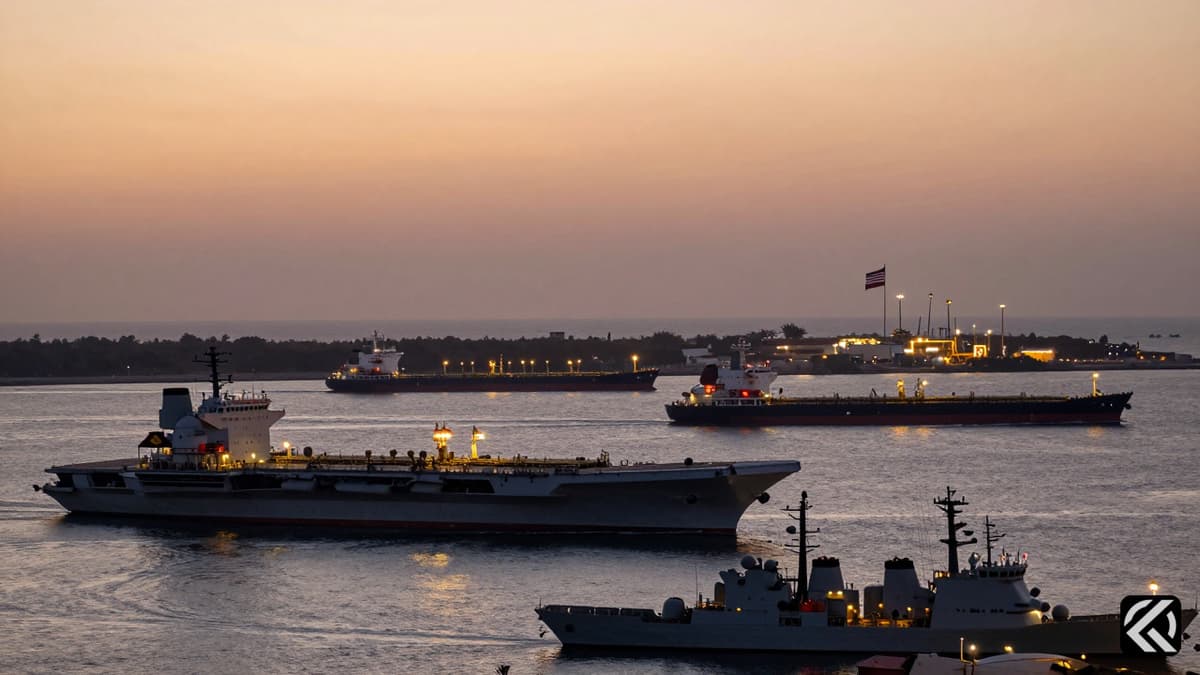
President Trump halts threats of civilization erasure to establish a fragile truce, yet US forces stay deployed while the Strait of Hormuz remains a critical point of contention.
U.S. President Donald Trump has announced a two-week pause in hostilities with Iran, marking a shift from his previous threats to erase the Iranian civilization to negotiating a diplomatic resolution. This fragile U.S.-Iran ceasefire comes after forty days of conflict where the U.S. and Israel failed to meet their initial objectives of annihilating Iran's navy or razing its missile industry. While Tehran has agreed to honor the truce, the path to lasting peace remains uncertain as US military assets continue to loom in the region.
The shift in strategy occurred on April 8, the fortieth day of the war, just hours after President Trump threatened severe consequences if Tehran did not accept his terms. Following the announcement, the U.S. President agreed to treat the Iranian proposal as a "workable basis" for future talks, a significant change from his demand on March 6 that there could be "no deal with Iran except UNCONDITIONAL SURRENDER." However, the President clarified that the pause on threatened strikes against civilian infrastructure is temporary. He explicitly stated on his Truth Social platform that all U.S. ships, aircraft, and military personnel, along with necessary weaponry, will remain deployed in and around Iran. These forces will stay until a "real agreement" is reached and fully complied with, signaling that the threat of lethal prosecution against the degraded enemy remains active.
Market reactions were immediate and volatile as investors digested the news. On Thursday, April 9, oil prices climbed to over $97 a barrel, driven by skepticism regarding the durability of the truce. Asian stocks also retreated, with Tokyo's Nikkei 225 dropping 0.9%, South Korea's Kospi falling 1.6%, and the Shanghai Composite index slipping 0.7%. The instability was compounded by reports that Iran had closed the Strait of Hormuz once again in response to deadly Israeli strikes in Lebanon. Ship owners and charterers in the region are currently seeking clarity on transit terms, as Iran continues to exercise de-facto control over the vital shipping waterway despite the ceasefire declaration.
Tensions on the ground have not subsided alongside the diplomatic overtures. Iran-backed militant group Hezbollah declared it had fired rockets at Israel in response to what it termed a violation of the ceasefire. This attack targeted the Israeli kibbutz of Manara near the border with Lebanon early Thursday, marking the group's first strike against Israel since the U.S. and Iran agreed to the pause. Hezbollah stated it retains the "right" to respond to Israeli actions, following a round of deadly strikes in Lebanon that the Lebanese Health Ministry reported killed 182 people and wounded 890 on Wednesday. The United Nations Secretary-General, Antonio Guterres, warned that ongoing Israeli military activity in Lebanon poses a "grave risk" to the fragile truce, calling for an immediate cessation of hostilities by all parties.
Diplomatic efforts are simultaneously advancing in Islamabad, where an Iranian delegation is set to arrive Thursday night for talks mediated by Pakistan. Reza Amiri Moghadam, Iran's ambassador to Pakistan, confirmed the arrival, noting that the delegation would engage in serious talks based on a 10-point proposal proposed by Iran. The ambassador acknowledged public skepticism regarding Israeli ceasefire violations intended to sabotage the initiative. Meanwhile, President Trump used the occasion of a closed-door meeting with NATO Secretary-General Mark Rutte to reiterate his grievances with the trans-Atlantic alliance. Following the private discussion, which was expected to address the alliance's lack of support during the crisis, Trump posted that NATO "WASN'T THERE WHEN WE NEEDED THEM," suggesting the U.S. might reconsider its commitment to the alliance.
The war, which began on February 28, was initially launched with five broad objectives: to raze Iran's missile industry, annihilate its navy, neutralize its proxies, prevent a nuclear weapon, and effect regime change. None of these goals have been achieved after forty days. Instead, the conflict has reinforced Iran's standing as a major regional power in West Asia. The President's biggest demand, the reopening of the Strait of Hormuz, was not part of the original set of objectives but has emerged as a critical condition. While the ceasefire offers a pause, the presence of U.S. forces and the continued military activity in Lebanon suggest that the conflict is far from over, with the region bracing for potential escalations that could shatter the current truce.
As diplomatic channels open in Islamabad and military postures harden in the Persian Gulf, the coming weeks will determine if the two-week pause evolves into a comprehensive peace or merely a brief intermission in a longer war. The continued deployment of U.S. forces and the volatility in the Strait of Hormuz suggest that any breakthrough will require immediate compliance from all parties, particularly Israel and Hezbollah, whose recent actions indicate that the truce remains precarious. If the "real agreement" Trump seeks remains elusive, the risk of renewed hostilities and further economic disruption looms large, potentially drawing the broader region into a deeper conflict.
Jun 8, 2026 00:51 UTC
Trump Claims Iran Nuclear Deal Imminent Despite Diplomatic Fractures
Jun 8, 2026 00:47 UTC
Iran Fires Missiles at Israel After Beirut Strike
Jun 7, 2026 22:00 UTC
US, Iran Peace Hops Fade 100 Days Into War
Jun 7, 2026 20:57 UTC
Iran Strikes Israel: IRGC Promises Week of Continuous Offensive
Jun 8, 2026 02:28 UTC
Trump Walks Out of Meet the Press After Rejecting Evidence Demands


