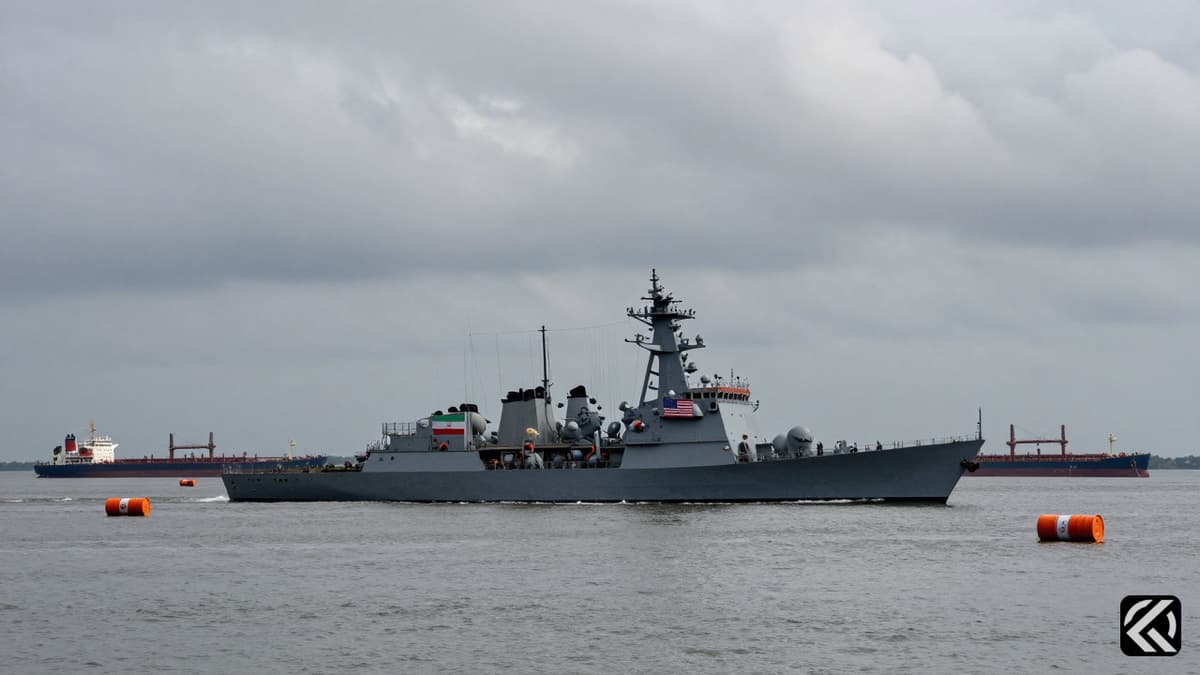
Tensions escalate as President Trump declares a naval blockade of the Strait of Hormuz today, following failed peace talks with Iran and a clash of rhetoric with Pope Leo XIV regarding global violence.
The U.S. President Donald Trump declared on Monday, April 13, 2026, that the American Navy will begin a blockade of the Strait of Hormuz, raising tensions after diplomatic efforts failed. This announcement follows the collapse of marathon peace talks between the United States and Iran in Pakistan, which had not produced a deal to end the ongoing war. The move jeopardizes a fragile two-week ceasefire and has immediately triggered a surge in global oil prices and financial market volatility.
In the wake of these developments, global markets reacted swiftly as fears of a maritime disruption took hold. Oil prices jumped above $100 a barrel on Monday, with Brent crude futures rising nearly 8% to $102.80 per barrel. The collapse of the Trump Iran negotiations has left the region on the brink of further escalation, with U.S. Central Command confirming that forces would begin implementing the blockade of all maritime traffic entering and exiting Iranian ports at 10 a.m. ET. Shipping data indicates that oil tankers are already steering clear of the strategic waterway, anticipating the start of the restriction.
President Trump addressed reporters at Joint Base Andrews in Maryland, stating he does not care if Iran returns to the negotiating table after the failed talks in Pakistan. He claimed that his previous remarks that the "civilisation will die" were the catalyst that brought Iran to the bargaining table initially, though he admitted they had since left the table. Despite the failure to secure a deal, Trump predicted that Iran would eventually return to give the United States "everything we want." He told reporters he was fine with the possibility of the other side not returning to negotiations.
The diplomatic fallout extended beyond the immediate conflict, involving friction with religious leadership as well. President Trump told reporters he is "not a big fan" of Pope Leo XIV, the global leader of Catholics, following the Pontiff's plea for an end to the violence. Trump criticized the Pope as a "very liberal person" who does not believe in stopping crime and accused him of "toying with a country that wants a nuclear weapon." The Pope had publicly implored world leaders to end the violence, stating, "Enough of the idolatry of self and money! Enough of the display of power! Enough of war!"
International responses to the blockade announcement were mixed, with regional partners clarifying their positions. Australia's Prime Minister Anthony Albanese called for the Strait of Hormuz to be opened and confirmed that the United States had not requested Australian assistance to participate in the blockade. Speaking to Nine Network television, Albanese emphasized that the U.S. action was taken unilaterally. "We've received no requests, and they've made this announcement overnight and they've done that in a unilateral way," he said. The Australian leader reiterated the desire for negotiations to resume and for freedom of navigation as required by international law.
The economic repercussions of the US Iran conflict were palpable across multiple sectors. South Korean shares fell on Monday, with the benchmark KOSPI down 62.26 points, or 1.06%, as the won weakened. The benchmark bond yield also rose as investors reacted to the lack of a deal over the weekend. In the United States, commodity markets saw significant movement, driven by the prospect of restricted fuel and fertilizer supplies. Chicago wheat futures rose, supported by higher oil prices, while corn and soybean futures also climbed. The most-active corn contract on the Chicago Board of Trade gained 1.8% to $5.81 a bushel, with soybeans rising to $11.82 a bushel.
President Trump's declaration of a naval blockade marks a critical turning point in the 2026 conflict, shifting the strategy from diplomatic engagement to direct maritime restriction. As the U.S. Navy prepares to enforce the shutdown of Iranian port traffic, the immediate future suggests a tightening of global supply chains and sustained volatility in energy markets. With the U.S. having stated that the blockade will continue unless demands are met, the likelihood of a rapid de-escalation appears low. The failure of the Pakistan talks indicates that diplomatic channels are currently exhausted, leaving military pressure as the primary lever. If Iran does not return to the bargaining table as predicted by the President, the economic sanctions and physical blockade may persist, potentially leading to a longer-term disruption in global oil flows and further destabilization of international relations.
Jun 8, 2026 00:51 UTC
Trump Claims Iran Nuclear Deal Imminent Despite Diplomatic Fractures
Jun 8, 2026 00:47 UTC
Iran Fires Missiles at Israel After Beirut Strike
Jun 7, 2026 22:00 UTC
US, Iran Peace Hops Fade 100 Days Into War
Jun 7, 2026 20:57 UTC
Iran Strikes Israel: IRGC Promises Week of Continuous Offensive
Jun 8, 2026 02:28 UTC
Trump Walks Out of Meet the Press After Rejecting Evidence Demands


