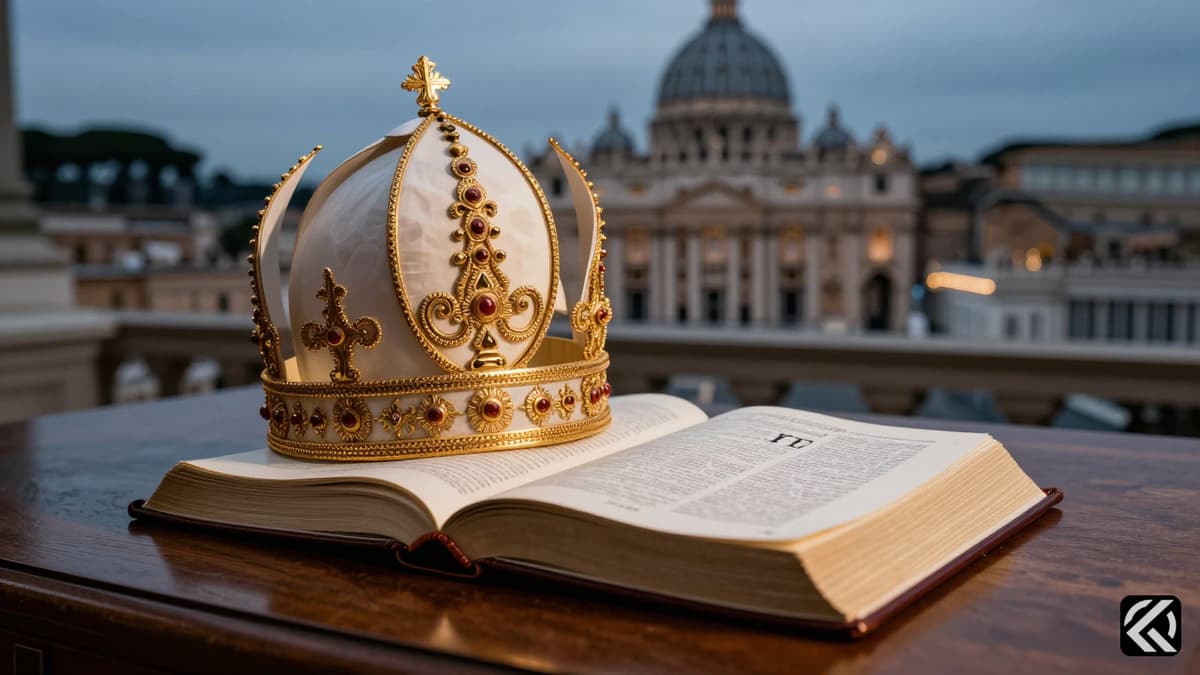
President Trump has made a significant factual error regarding the Vatican's stance, claiming Pope Leo XIV endorses Iran's nuclear capability despite explicit denials of nuclear arms.
President Donald Trump continued his criticism of Pope Leo XIV on Thursday, making a false claim regarding the pontiff's stance on nuclear weapons. During an exchange with CNN anchor Kaitlan Collins, Trump stated he was not fighting the Pope but insisted the Pope claimed Iran could possess a nuclear weapon. This assertion directly contradicts the reality that Pope Leo XIV has never made such a statement.
The false claim was immediately challenged by Collins, who pointed out to the President that the Pope has never said Iran could have a nuclear weapon. In reality, Pope Leo XIV, born Cardinal Robert Prevost, has consistently denounced nuclear arms and called for their elimination. While the Pope has spoken against the conflict involving the US, Israel, and Iran, arguing for diplomacy to prevent weapon development, this stance is fundamentally different from endorsing nuclear capabilities.
Trump's assertions regarding the nuclear weapons debate have escalated throughout the week. On Sunday night, the President wrote on social media that he did not want a Pope who thinks it is acceptable for Iran to have a nuclear weapon. Later that night, he told reporters he disliked a Pope who "is gonna say" such a thing. These earlier comments were vague, referring to opinions or future actions that could not be definitively debunked. However, Trump shifted his position on Thursday to claim the Pope had actually made a statement supporting Iran's possession of nuclear weapons.
Pope Leo has a long record of opposing nuclear arms. Elected in May 2025, he issued a statement the following month as tensions rose between Israel and Iran. He called for responsibility and reason, emphasizing that a safer world free from nuclear threats must be built through dialogue and justice. Days later, he expressed heartbreak over war in Ukraine, Iran, Israel, and Gaza, rejecting the temptation to use powerful weapons.
In July 2025, marking the 80th anniversary of the atomic bombings of Hiroshima and Nagasaki, Pope Leo condemned the horrors wrought by nuclear weapons. He argued that true peace requires laying down such arms and that nuclear deterrence is an illusion based on fear. In October 2025, Archbishop Gabriele Caccia, the Vatican's representative to the UN, reaffirmed that eliminating nuclear weapons is a moral imperative.
By January 2026, the Pope stated that nuclear deterrence relies on irrationality rather than law or justice. In February, he urged the US and Russia to extend the New START treaty to prevent an arms race. Most recently, in March 2026, the Pope called for effective disarmament and dialogue instead of violence.
It is crucial to understand that the Pope's calls for an end to the war in the Middle East and his advocacy for diplomacy are often misinterpreted. Critics of the conflict argue that diplomacy is the best method to prevent Iran from developing nuclear weapons, a sentiment aligned with the Vatican's position. However, asserting that diplomatic efforts are the only way to stop weapon development is not the same as stating that Iran is permitted to have those weapons.
Trump's claim that the Pope said "Iran can have a nuclear weapon" is factually incorrect. The Vatican has consistently maintained that the commitment to creating a safer world free from nuclear threats must be pursued. The Pope has never issued a statement granting permission or endorsement for Iran to possess nuclear capabilities. Instead, his teachings and public statements have focused on the dangers of nuclear proliferation and the urgent need for global disarmament.
The distinction lies in the method of achieving peace. While the Pope supports diplomatic solutions to prevent the spread of nuclear weapons, he has not conceded that Iran should possess them. Trump is free to argue that the Vatican's diplomatic approach is insufficient, but to claim the Pope explicitly supports the possession of nuclear weapons is to attribute words and positions to the Pontiff that have never been spoken or written.
The persistent false narrative regarding the Vatican's stance on nuclear weapons highlights a significant disconnect between the White House and the Holy See. As tensions remain high in the region involving the US, Israel, and Iran, the Pope's consistent calls for dialogue and disarmament stand in sharp contrast to the President's accusations. Looking ahead, this mischaracterization could further strain diplomatic relations and confuse the public understanding of the Vatican's actual policy. If the administration continues to misrepresent the Pope's positions, it may undermine efforts to foster the very dialogue the Holy See has championed as essential for global security. The path forward remains focused on the moral imperative of disarmament, a position that has been clear since the Pope's election in 2025.
Jun 8, 2026 02:17 UTC
Magnitude 7.8 Quake Shakes Philippines, Urging Immediate Evacuations
Join 50,000+ readers getting the global briefing every morning.
No spam. Unsubscribe anytime.
Jun 8, 2026 02:17 UTC
Magnitude 7.8 Quake Shakes Philippines, Urging Immediate Evacuations
Jun 8, 2026 00:51 UTC
Trump Claims Iran Nuclear Deal Imminent Despite Diplomatic Fractures
Jun 8, 2026 00:47 UTC
Iran Fires Missiles at Israel After Beirut Strike
Jun 7, 2026 22:38 UTC
Congress Party Claims Unity for INDIA Bloc Delhi Meeting


