Prime Minister Narendra Modi launched a sweeping pitch for women's empowerment in Bengal, promising financial aid and attacking opposition parties for stalling legislative quotas.
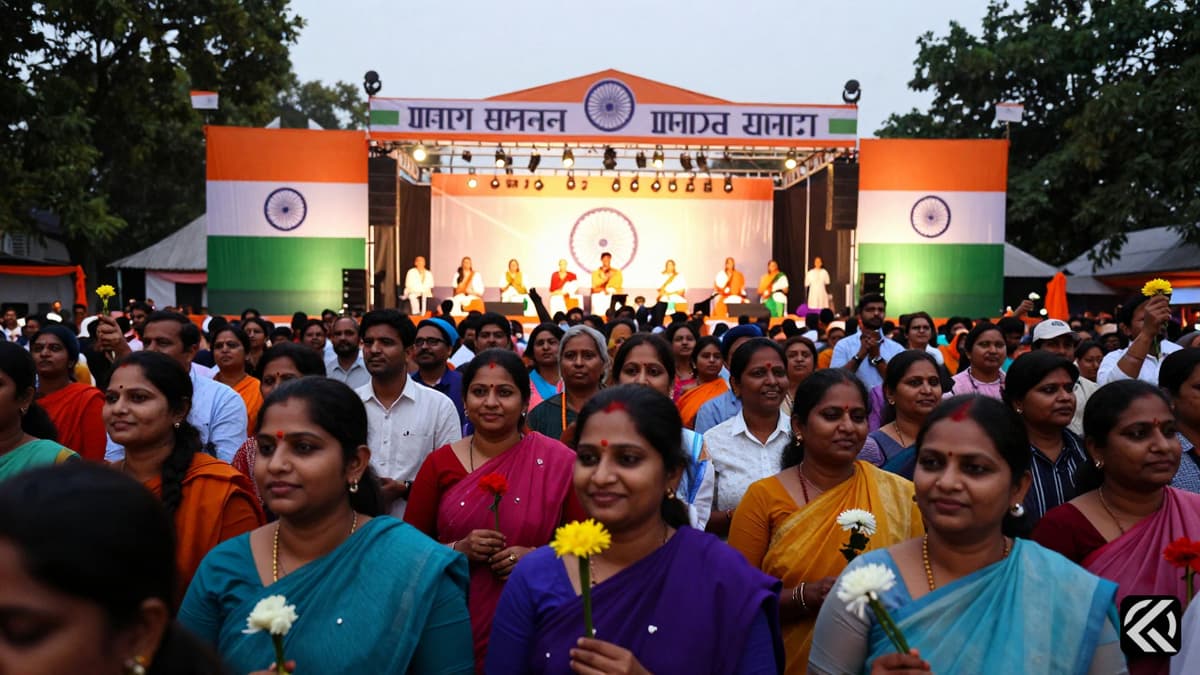
Prime Minister Narendra Modi intensified his electoral strategy in West Bengal on Sunday, focusing heavily on women-centric incentives and criticizing the ruling Trinamool Congress (TMC). During a significant address in Bankura, the Prime Minister pledged comprehensive financial and medical support while sharpening his attack on the opposition regarding the 33 per cent quota legislation.
The rally served as a platform to launch a series of welfare promises, including free treatment up to Rs 5 lakhs for women and free dialysis for families affected by kidney disease. Modi directly challenged the current state administration, alleging that the TMC had conspired with the Congress party to block the Women reservation bill, thereby preventing greater political representation for women. He argued that while the BJP ensures these rights, the current leadership actively works against the aspirations of Bengal's daughters to become MLAs and MPs.
At the heart of the PM Modi Bankura rally, the Prime Minister detailed a robust framework designed to uplift women economically and socially. He asserted that a BJP government would deliver free ration support to poor women and provide a yearly financial sum of Rs 36,000 to the sisters of Bengal. Specific allocations were outlined for various life stages and needs: Rs 21,000 for pregnant women, Rs 5,000 for the education of daughters following childbirth, and an additional Rs 9,000 annually for women involved in agriculture.
Modi further elaborated on the economic empowerment aspect of his platform, promising Rs 50,000 under the Mudra scheme to support self-employment initiatives. He emphasized that these measures are part of a "double-engine government" strategy intended to provide a "double mandate" specifically for the sisters of Bengal. The Prime Minister contrasted this proposed delivery system with the current situation, alleging that women in Bengal do not receive benefits comparable to those in states ruled by the BJP. He claimed the current government fails to prioritize the safety of sisters, the respect of mothers, or the general prosperity of women in the state.
During the event, the Prime Minister leveraged the crowd's energy to underscore a growing shift in public sentiment. He described the atmosphere as a mixture of enthusiasm and anger against what he termed the "ruthless government" in power. This sentiment, according to Modi, reflects a desire for change and a rejection of what he labeled as "Maha Jungle Raj" in Bengal. He cited the resistance to the reservation bill as a prime example of the opposition's alleged hostility toward women's political advancement.
A central theme of the speech was the legislative struggle over the 33 per cent women's reservation bill. Modi claimed that the current state government, in collusion with the Congress party, conspired to block the passage of this legislation. He argued that this obstruction prevents more Bengali women from securing seats in legislative assemblies and the parliament. "Modi ensured this… but TMC did not want more of Bengal's daughters to become MLAs and MPs," he stated, adding that opposition parties had "betrayed the sisters of Bengal yet again" by stalling the bill in Parliament.
The Prime Minister also used the podium to address the empowerment of marginalized communities, specifically tribal women and girls. He cited the election of President Droupadi Murmu as a testament to the BJP's commitment to these communities, contrasting it with the alleged opposition from rival parties who opposed her rise. Modi noted that Murmu now represents India on the global stage, reinforcing the party's dedication to inclusivity. He framed the upcoming election as a choice between continued stagnation under the current leadership and a future defined by safety, respect, and prosperity for all women.
The narrative presented by the Prime Minister was clear: the BJP stands for women's empowerment and safety as a core political identity, while the opposition is characterized by betrayal and a lack of support for women's rights. By outlining specific financial figures and legislative achievements, Modi sought to differentiate his party's record from the TMC's governance, framing the election as a pivotal moment for the destiny of women in Bengal.
The Prime Minister's announcements during the rally signal a potential paradigm shift in how welfare is delivered in West Bengal, should the BJP secure power. The detailed breakdown of financial aid, ranging from Rs 36,000 annually to specific health interventions like free dialysis, suggests a targeted approach to poverty alleviation and maternal health. If these promises translate into administrative action, the state could see a measurable increase in women's economic participation and health outcomes, particularly for those in rural and agricultural sectors who are eligible for the additional Rs 9,000 annual support.
Furthermore, the intense focus on the Women reservation bill indicates that political mobilization will remain a critical battleground. The Prime Minister's assertion that the opposition blocked the quota suggests that the issue of political representation for women will continue to be a flashpoint. If a change in government occurs, the legislative landscape could shift rapidly, potentially leading to the immediate implementation of the 33 per cent quota. This could result in a diverse legislative body that better reflects the demographics of the state, fundamentally altering the political discourse and policy priorities in Bengal for years to come. The rally's emphasis on the "anger" against the current administration suggests that voters are primed to evaluate governance through the lens of women's welfare and political inclusion.
Jun 8, 2026 02:17 UTC
Magnitude 7.8 Quake Shakes Philippines, Urging Immediate Evacuations
Jun 8, 2026 00:51 UTC
Trump Claims Iran Nuclear Deal Imminent Despite Diplomatic Fractures
Jun 8, 2026 00:47 UTC
Iran Fires Missiles at Israel After Beirut Strike
Jun 7, 2026 22:00 UTC
US, Iran Peace Hops Fade 100 Days Into War
Jun 8, 2026 04:15 UTC
Trump Urges Netanyahu to Halt Iran Strike for Peace