Section
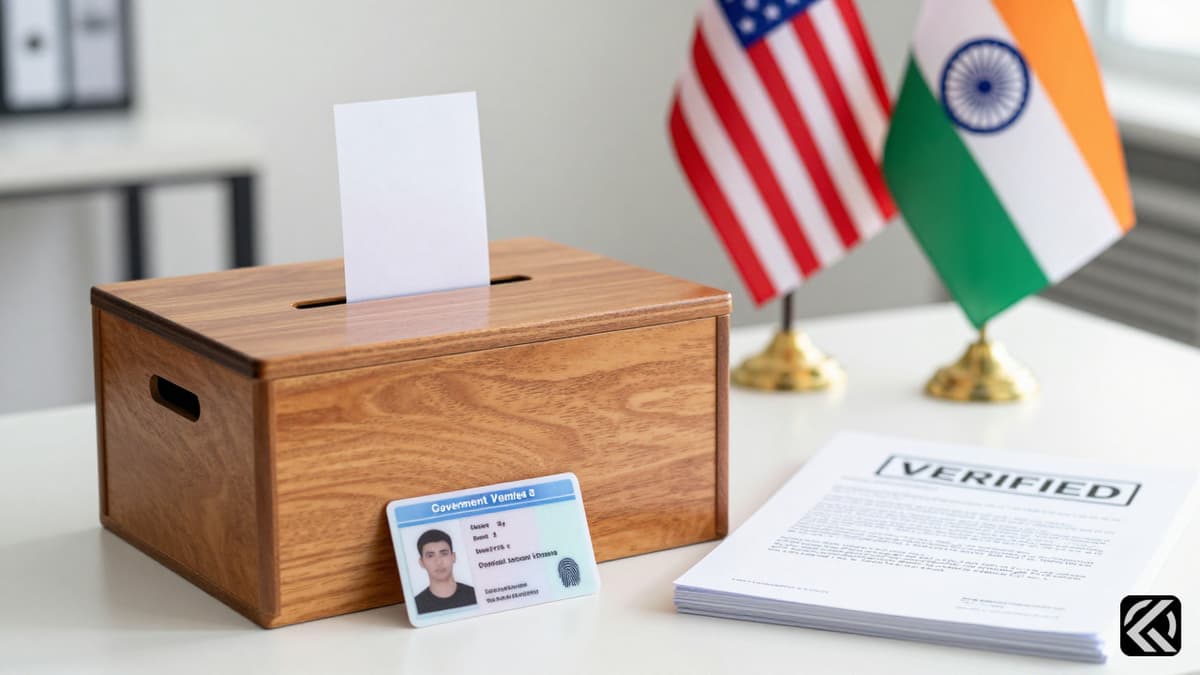
President Trump highlights India’s strict voter identification standards in a new push for the SAVE America Act, arguing that US elections lack comparable security measures.
US President Donald Trump on Tuesday publicly endorsed India’s electoral framework while intensifying his advocacy for the SAVE America Act. In a social media post on Truth Social, the President referenced a recent dialogue with Indian Chief Election Commissioner Gyanesh Kumar to argue for stricter voter identification laws in the United States. This move underscores a significant shift in rhetoric, using international examples to justify domestic legislative changes.
The immediate trigger for this renewed focus was Trump’s observation regarding the logistical and security differences between Indian and American voting processes. He highlighted that India’s last general election involved 646 million voters, with less than one percent casting ballots by mail. Crucially, Trump noted that every single voter in that massive exercise of democracy was required to possess a valid photo identity document. This statistic serves as the cornerstone of his argument that rigorous identification protocols are both feasible and necessary for maintaining election integrity on a large scale.
According to the White House, the proposed SAVE America Act aims to ensure that only US citizens are eligible to vote in federal elections. The administration has described the bill as a "common sense, bipartisan bill" designed to close perceived loopholes in the current system. Trump explicitly quoted Kumar, stating, "How can you have Elections in the US without a valid Photo ID?" This rhetorical question frames the domestic debate as a matter of basic logical consistency rather than partisan politics.
The White House has drawn a sharp contrast between the verification methods used in other nations and those currently employed in the United States. An official statement noted that countries like India and Brazil tie voter identification to biometric databases, ensuring a high level of security and accuracy. In contrast, the administration argues that the United States largely relies on "self-attestation for citizenship," a method they view as vulnerable to error or manipulation. By citing these international benchmarks, the administration seeks to normalize stricter identification requirements as a global standard rather than a unique American demand.
The legislation, which was originally introduced in Congress on January 29, proposes several specific mandates. First, it would require all voters to provide valid identification and proof of US citizenship when registering to vote in federal elections. Second, it seeks to limit the use of mail-in voting to specific circumstances only. These exceptions include illness, disability, military service, and travel. This restriction is a direct response to the low percentage of mail-in votes cited in the Indian example, aiming to reduce the volume of ballots that are not cast in person with immediate ID verification.
Furthermore, the White House emphasized the administrative duties that would fall to individual states under this new framework. The bill would require states to actively remove non-citizens from federal voter rolls. "If you want to register to vote in the United States, you have to be a citizen in the United States," the administration stated, reinforcing the principle that voting rights are inextricably linked to citizenship status. This directive implies a more rigorous audit of existing voter rolls, potentially leading to widespread purges of ineligible registrants to align with the new federal standards.
Trump has repeatedly backed the SAVE America Act, arguing that stricter voter-ID and citizenship requirements are necessary to strengthen election security. His latest comments do not introduce new statistical data but rather reframe the existing argument by invoking the authority of one of the world’s largest democracies. By pointing to the Chief Election Commissioner of India, Trump adds an international dimension to a domestic policy debate, suggesting that the US is falling behind global peers in terms of electoral verification.
The implications of this push are significant for the upcoming election cycle. If passed, the SAVE America Act would fundamentally alter the voter registration process across all 50 states. The requirement for proof of citizenship at the point of registration, coupled with the limitation of mail-in voting, would create new barriers for certain demographics who may lack immediate access to specific types of documentation. Supporters of the bill argue these barriers are essential for preventing fraud, while critics may view them as restrictive measures. However, based strictly on the source material, the administration’s position remains focused on the alignment of US practices with those of India and Brazil.
The White House continues to characterize the SAVE America Act as a vital step toward securing the nation's democratic processes. By leveraging the example of India’s 646 million voter election, they present a case for robust, mandatory identification systems. The comparison serves to legitimize the need for biometric or photo-ID-based verification, moving the conversation away from theoretical concerns toward practical, tested models of electoral security.
The administration’s comparative analysis suggests a future where US electoral laws mimic the rigid verification protocols seen in India and Brazil. If the SAVE America Act succeeds, it will mandate a shift from self-attestation to verified documentation for all federal voters. This change is expected to significantly reduce mail-in voting percentages, mirroring India’s sub-one percent figure. Long-term impacts include a more secure but potentially less accessible voting environment, with states tasked with aggressive removal of non-citizens from rolls.
Aug 17, 2026 14:29 UTC
USS Abraham Lincoln Crew Faces Mental Health Crisis During Extended Deployment
Aug 17, 2026 04:30 UTC
Trump Reduces Joint Military Exercises With South Korea
Aug 17, 2026 02:52 UTC
Kushner Meets Hamas in Egypt Over Rejected Gaza Ceasefire Plan
Aug 16, 2026 20:37 UTC
Kushner Mediates Gaza Ceasefire Amidst Escalating US-Iran Conflicts
Aug 18, 2026 00:16 UTC
Hemant Soren Cancels JSSC-CGL Amid Ongoing Agitation