Section
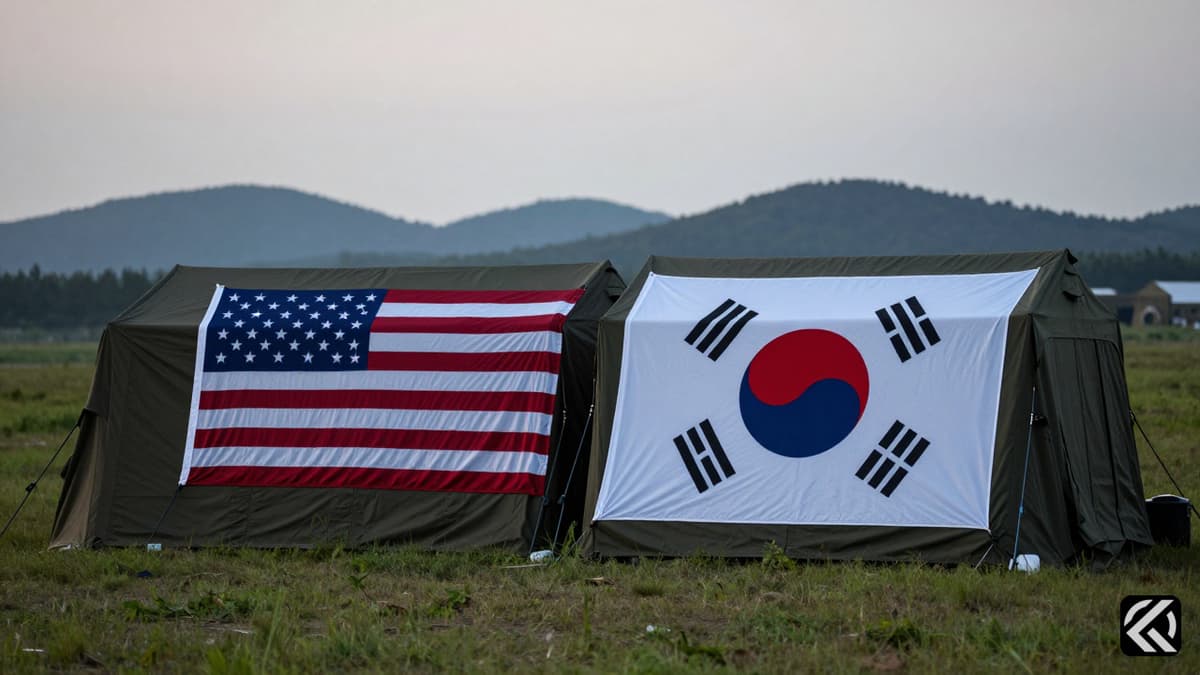
President Donald Trump has declared that the United States will "substantially reduce" joint military exercises with South Korea, a move he justified by citing his "very good relationship" with North Korean leader Kim Jong Un and the financial burden of the drills. Speaking on Truth Social, Trump argued that these exercises are "costly, with much of these costs paid for by the United States of America (as usual!)" and that they send a signal that is "totally inappropriate and hostile." However, the announcement comes with a caveat: the US and South Korea were scheduled to begin their annual military exercises on Monday, and Trump noted it was "too late to cancel" the current round of events.
Seoul has firmly rejected the implication that the drills would be halted. Officials stated that the drills with the US would proceed "as scheduled," indicating a divergence in diplomatic messaging between the two allies. Pyongyang has not yet commented on the announcement. This tension arises as North Korea accelerates its nuclear and missile programs, including ballistic missile tests banned by the United Nations this month. Additionally, military leaders highlighted North Korea's deployment of troops to support Russia’s war against Ukraine, a threat that US military spokesperson Ryan Donald said is already accounted for in their training protocols.
The rationale behind Trump’s decision appears multifaceted, blending diplomatic leverage with grievance over allied cooperation. On his social media platform, Trump posted an old photograph of himself and Kim Jong Un from 2019, describing them as great friends "despite the unfriendly look on this particular picture." This gesture aligns with his history of suspending exercises during denuclearization negotiations; he halted them entirely in 2018, claiming the drills were "provocative" and stopping the "war games" would save the US "tremendous amount of money." The exercises had also been scaled back in 2020 due to the pandemic.
President Trump reveals plans to cut joint military drills with Seoul, citing financial burdens and diplomatic ties with Pyongyang, while Seoul confirms operations continue.
Trump further elucidated his position by pointing to South Korea’s reluctance to support US objectives in the Middle East. He revealed that he had asked the President of South Korea to join the US in the "denuclearisation" of Iran, to which Seoul replied, "No thanks!" He similarly expressed displeasure with other allies, including Japan, France, and the UK, for their hesitance to engage in hostilities with Iran. This suggests that Trump views military cooperation as conditional on broader geopolitical alignment, particularly regarding regional conflicts outside the Korean peninsula.
For Seoul, Trump’s announcement presents a complex diplomatic dilemma. On one hand, the South Korean government has long requested that Trump engage directly with Pyongyang. The public indication of a warm relationship between Trump and Kim raises hopes in Seoul that the US president might successfully bring the North Korean leader back to the negotiating table. On the other hand, the public rebuke regarding Iran highlights a potential rift in alliance expectations, with Trump hinting he is unhappy with Seoul’s unwillingness to make direct military or logistical contributions to US operations abroad.
The military scope of the upcoming exercises remains significant. The 11-day event is expected to be similar in scale to previous years, involving approximately 18,000 South Korean soldiers. With about 28,500 American military personnel already stationed in South Korea, the presence of US forces is deeply entrenched. Recent tensions were exacerbated just days before Trump’s announcement, when South Korea, the US, and Japan detected a second North Korean missile test in rapid succession. Pyongyang’s foreign ministry has previously condemned such joint drills as "a rehearsal for an aggressive war."
Despite the rhetoric, the immediate future of the alliance remains in flux. The current administration’s approach marks a departure from standard NATO-style alliance dynamics, where military cooperation is often treated as a fixed commitment regardless of political disagreements. Trump’s past behavior suggests that while the infrastructure of the alliance remains, its operational intensity is subject to his personal diplomatic assessments.
Trump’s announcement underscores a transactional approach to alliance management, where military cooperation is explicitly linked to allied support in other global conflicts. By reducing the scope of future joint military drills while maintaining a current operational schedule, Trump aims to pressure Seoul and Pyongyang simultaneously. If South Korea continues to refuse participation in US-led initiatives like the Iran denuclearization, further reductions in military cooperation could become permanent, altering the security architecture of East Asia. Conversely, if Trump’s outreach to Kim Jong Un yields results, the long-term impact could be a significant de-escalation on the Korean Peninsula, albeit at the cost of traditional deterrence strategies. The immediate aftermath will likely see heightened diplomatic activity as Seoul navigates the delicate balance between maintaining its security guarantee from Washington and asserting its independent foreign policy.
Aug 17, 2026 14:29 UTC
USS Abraham Lincoln Crew Faces Mental Health Crisis During Extended Deployment
Aug 17, 2026 04:30 UTC
Trump Reduces Joint Military Exercises With South Korea
Aug 17, 2026 02:52 UTC
Kushner Meets Hamas in Egypt Over Rejected Gaza Ceasefire Plan
Aug 16, 2026 20:37 UTC
Kushner Mediates Gaza Ceasefire Amidst Escalating US-Iran Conflicts
Aug 18, 2026 00:00 UTC
Trump’s False Claims on South Korea Defense Payments Disputed