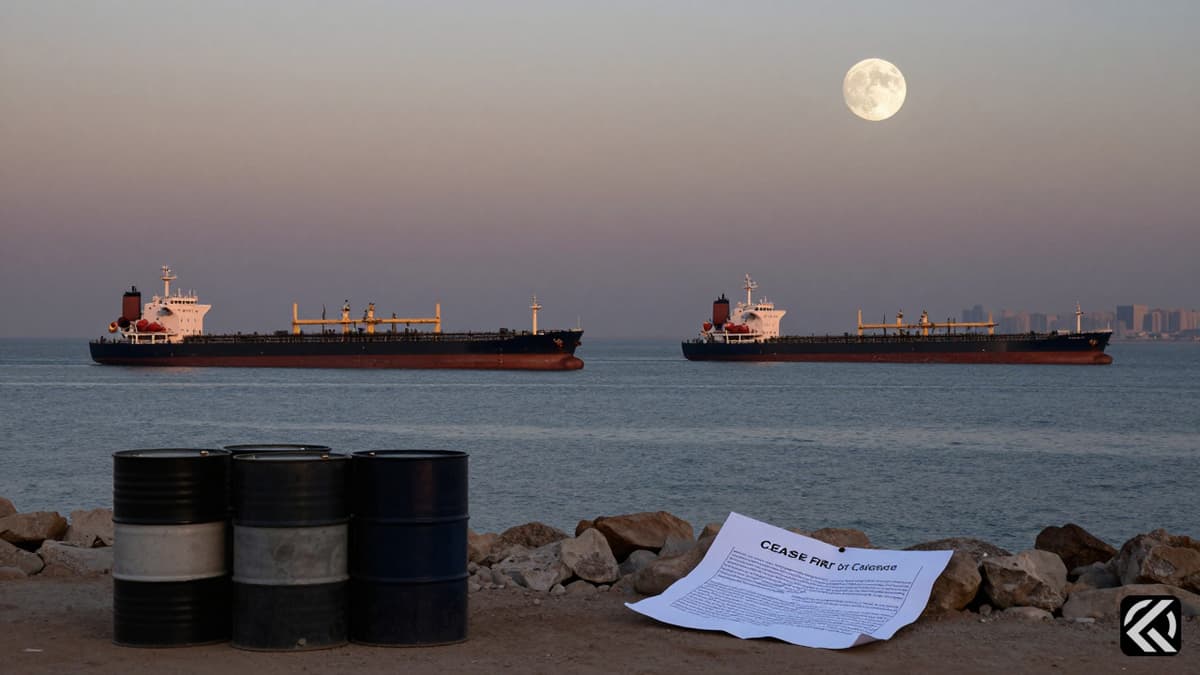
Tensions flared as a two-week truce was announced, yet skepticism persists in Tehran. Markets surged while missile alarms blared across the Gulf.
President Donald Trump has agreed to a two-week Iran ceasefire following a diplomatic breakthrough, announced roughly 6:30 p.m. ET on Tuesday. The agreement aims to pause hostilities immediately, though the precise start time for the cessation of fire remains undefined by the White House. This development triggers a complex mix of market euphoria and ongoing military alerts across the Middle East.
The immediate aftermath of the announcement saw volatile reactions on the ground and in financial markets. In Tehran, Iranians gathered in the streets during pre-dawn darkness, though many voiced deep skepticism regarding the pact's longevity. Some citizens burned American and Israeli flags, actions characteristic of pro-regime rallies, while others waved national flags and displayed portraits of Supreme Leader Mojtaba Khamenei and his late father, former leader Ayatollah Ali Khamenei. On the diplomatic front, Iran's Supreme National Security Council had previously issued a statement claiming a victory and a forced US acceptance of a 10-point plan, a claim President Trump later debunked as a "FRAUD" linked to a fake Nigerian news site.
The financial world reacted swiftly to the news of a potential de-escalation. Asian equity markets, which opened first, surged significantly. Japan's Nikkei 225 index jumped 4.9%, South Korea's Kospi gained 5.7%, and Hong Kong's Hang Seng index rose 2.8%. Simultaneously, energy markets saw a sharp correction; US West Texas Intermediate crude futures plunged more than 13% to under $98 a barrel, and Brent crude fell 12.78% to $95.31. These drops, while significant, still leave prices well above the $67.02 settlement from February 27 before the war began.
The primary driver of this volatility is the potential reopening of the Strait of Hormuz, a critical chokepoint where 20% of the world's oil traffic normally travels. Investors are waiting to confirm if Iran will lift its effective blockade of the strait. Despite the agreement, uncertainty persists regarding the full scope of the reopening and whether the proposed talks will result in a durable end to the conflict. Analysts note that questions remain about whether the US and Iran will follow through on a path to a permanent resolution.
Diplomacy has played a central role in reaching this temporary halt in hostilities. Pakistan has emerged as a major mediator, with Prime Minister Shehbaz Sharif presenting the ceasefire plan to President Trump on Tuesday. Both nations have now agreed to the terms. Following the agreement, Sharif invited delegations from the US and Iran to Islamabad for further talks, with negotiations likely to occur in person on Friday.
Pakistan is viewed as an ideal venue for these discussions due to its shared border and cultural ties with Iran, its large Shia Muslim population, and the absence of US military bases or prior targeting by Iranian missiles. Additionally, Islamabad has re-emerged as a key US partner under Trump's second term, driven by interest in the country's vast deposits of rare earths and critical minerals. The US President has also cultivated a close rapport with Pakistan's military chief, Asim Munir.
While the ceasefire deal was announced, political friction in Washington persists. House Minority Leader Hakeem Jeffries renewed his call for Congress to reconvene and vote on a war powers resolution to end the conflict permanently, labeling the two-week deal as "insufficient." Jeffries stated that Democrats plan to introduce the resolution if a vote does not occur that week. Senator Lindsey Graham, a strong advocate for military action, emphasized that any proposal to end the war, including a potential 10-point Iranian plan, would require congressional review similar to the Obama JCPOA.
On the ground, the situation remained tense despite the agreement. Sirens sounded across the Gulf and in Israel as several countries reported incoming missiles early Wednesday. Both Kuwait and the UAE worked to intercept drone and missile threats, while Abu Dhabi responded to a fire at the Habshan gas processing facility. Qatar successfully intercepted a missile attack, and Bahrain issued safety warnings. Israel's military identified several rounds of missiles launched from Iran and deployed emergency teams to impact sites in central Israel. Iran's Supreme Leader, Mojtaba Khamenei, had ordered all military branches to stop firing around 8:30 p.m. ET, but the security situation in the region remains volatile.
The fragile Pakistan mediation efforts highlight a shifting geopolitical landscape where non-Western powers are becoming central to resolving Middle Eastern conflicts. The immediate impact includes a stabilization of oil markets, but the long-term success of the truce depends entirely on the upcoming talks in Islamabad. If these negotiations lead to the permanent lifting of the Strait of Hormuz blockade and the removal of Iran's nuclear enrichment capabilities as demanded by Senator Graham, a new era of regional stability could emerge. However, given the history of broken negotiations and the persistent skepticism voiced by Iranian citizens, the international community must remain vigilant. The coming weeks will determine whether this two-week pause evolves into a permanent peace or merely another interlude in a prolonged cycle of regional hostility.
Jun 8, 2026 02:17 UTC
Magnitude 7.8 Quake Shakes Philippines, Urging Immediate Evacuations
Jun 8, 2026 00:51 UTC
Trump Claims Iran Nuclear Deal Imminent Despite Diplomatic Fractures
Jun 8, 2026 00:47 UTC
Iran Fires Missiles at Israel After Beirut Strike
Jun 7, 2026 22:00 UTC
US, Iran Peace Hops Fade 100 Days Into War
Jun 8, 2026 04:15 UTC
Trump Urges Netanyahu to Halt Iran Strike for Peace


