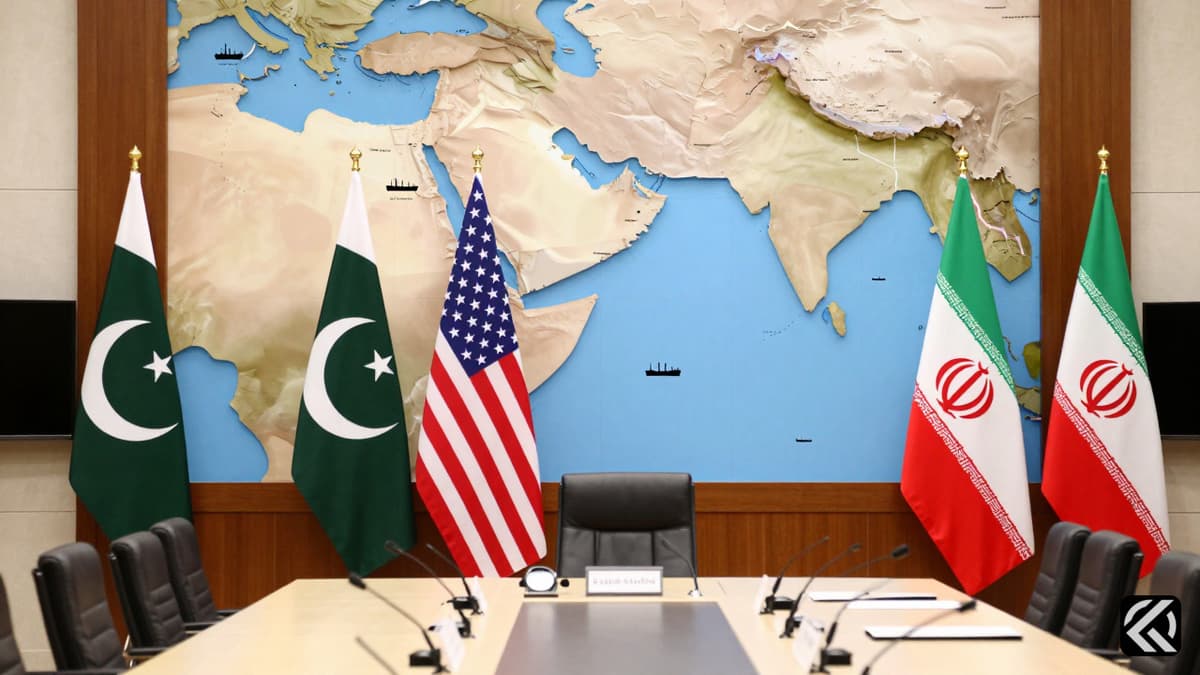
Pakistan steps into a pivotal diplomatic role as Islamabad prepares to host high-stakes US-Iran peace talks following a brokered two-week ceasefire.
The high-stakes diplomacy initiated by Pakistan has culminated in a two-week ceasefire between the US and Iran, with leaders in Islamabad now preparing to host the subsequent peace talks. A two-day holiday was declared in the capital ahead of the summit, scheduled to begin on Saturday, though the final confirmation of the event remains pending.
While the city has deployed approximately 10,000 police officers and security forces to ensure safety, making the streets notably quieter, the stakes extend far beyond local security. Global markets are watching closely, hoping for the reopening of the Strait of Hormuz, a critical waterway where roughly 20% of the world's oil supply once flowed before the outbreak of hostilities. For Pakistan, the outcome carries even greater weight; a collapse in negotiations could drag the nation into a conflict with its neighbor, Iran.
Expert Abdul Basit of Nanyang Technological University warns of a "nightmare scenario" if talks fail, particularly given Pakistan's mutual defense pact with Saudi Arabia, which Islamabad has pledged to honor. This alignment could see three of Pakistan's borders become active conflict zones, complicating an already fragile situation where the nation is already battling full-fledged insurgencies in two of its four provinces. Yet, despite the severe risks, pride and excitement are dominating social media, with viral memes celebrating Pakistan's ability to avert a potential catastrophe that other nations failed to prevent.
The success of this diplomatic breakthrough is vital for a country grappling with years of political unrest, a fragile economy that teetered on the brink of debt default just two years ago, and intense rivalry with India. The feat was largely driven by military chief Asim Munir, whom US President Donald Trump has dubbed his "favourite field marshal." Munir, arguably the most powerful figure in the country where the army holds a predominant political role, began cultivating rapport with the US president early in Trump's second term.
According to former ambassador Maleeha Lodhi, Munir secured two early wins for the US president. First, acting on CIA intelligence, he handed over the alleged mastermind behind the 2021 Kabul airport bombing, an attack that killed at least 170 Afghans and 13 US service members. Trump subsequently highlighted this achievement in his first address to Congress. The second win involved Pakistan conveying its pivotal role in preventing a wider war with India, a contribution that led Pakistan to be one of the few nations to nominate Trump for the Nobel Peace Prize.
Beyond security cooperation, Pakistan has strengthened ties by promising access to critical minerals, a US national-security interest. In September 2025, the Frontier Works Organisation, a major miner operating under the military, signed a $500 million investment deal with a US company. Additionally, an agreement signed in January with an affiliate of World Liberty Financials, a crypto venture co-founded by Trump's family, aims to integrate its stablecoin into Pakistan's digital-payment system. These moves have further solidified the country's relationship with the Trump circle.
Despite these close ties, Pakistan maintained a balanced approach, officially condemning the initial US-Israeli attacks on Iran. However, when Iran targeted Saudi oil fields, a military ally, Islamabad issued a strongly worded statement against Tehran. On April 7, Pakistan abstained from a UN Security Council resolution regarding the Strait of Hormuz, a move senator Mushahid Hussain Syed described as "one-sided" because it did not account for the initial US and Israeli attacks.
This principled stance helped build trust with Iran and other Gulf nations. Prime Minister Shehbaz Sharif played a crucial role, speaking with over a dozen world leaders across Washington, Moscow, Beijing, and Europe regarding the crisis. On the day of the ceasefire announcement, Sharif held a "warm and substantive conversation" with Iranian President Masoud Pezeshkian, who reaffirmed Iran's participation in the upcoming negotiations and appreciated Pakistan's efforts.
Former ambassador Asif Durrani notes that Sharif leveraged decades of cooperation between the two neighbors, who share a 920km border and common concerns over militants and the instability in Afghanistan. Furthermore, religious ties have fostered deep connections, with Pakistan's large Shia population traveling annually for pilgrimages to Iran, the world's largest Shia country.
As Saturday approaches, uncertainty remains regarding whether the US and Iran will attend the promised peace talks. The ceasefire is under strain, and officials in Pakistan are concerned about the responsibility resting on President Trump to restrain Israel. While Pakistan has acted as a broker, taking the horse to water, the final decision to drink remains with the warring parties.
The outcome of these upcoming negotiations will likely define the immediate geopolitical landscape of South Asia and the Persian Gulf. If the talks succeed in securing a lasting resolution, it could stabilize the Strait of Hormuz, ensuring the uninterrupted flow of global oil supplies and alleviating economic pressures on Pakistan. Conversely, a failure could trigger a severe escalation, forcing Pakistan to confront potential multi-front conflicts involving India, Afghanistan, and Iran while managing internal insurgencies. The nation's economy, already fragile, faces the prospect of further instability if the diplomatic bridge built by its military and political leaders collapses. Ultimately, the success of this initiative depends less on Pakistan's mediation capabilities and more on the willingness of the primary adversaries to honor the ceasefire and engage in genuine dialogue.
Jun 8, 2026 00:51 UTC
Trump Claims Iran Nuclear Deal Imminent Despite Diplomatic Fractures
Jun 8, 2026 00:47 UTC
Iran Fires Missiles at Israel After Beirut Strike
Jun 7, 2026 22:00 UTC
US, Iran Peace Hops Fade 100 Days Into War
Jun 7, 2026 20:57 UTC
Iran Strikes Israel: IRGC Promises Week of Continuous Offensive
Jun 8, 2026 02:28 UTC
Trump Walks Out of Meet the Press After Rejecting Evidence Demands


