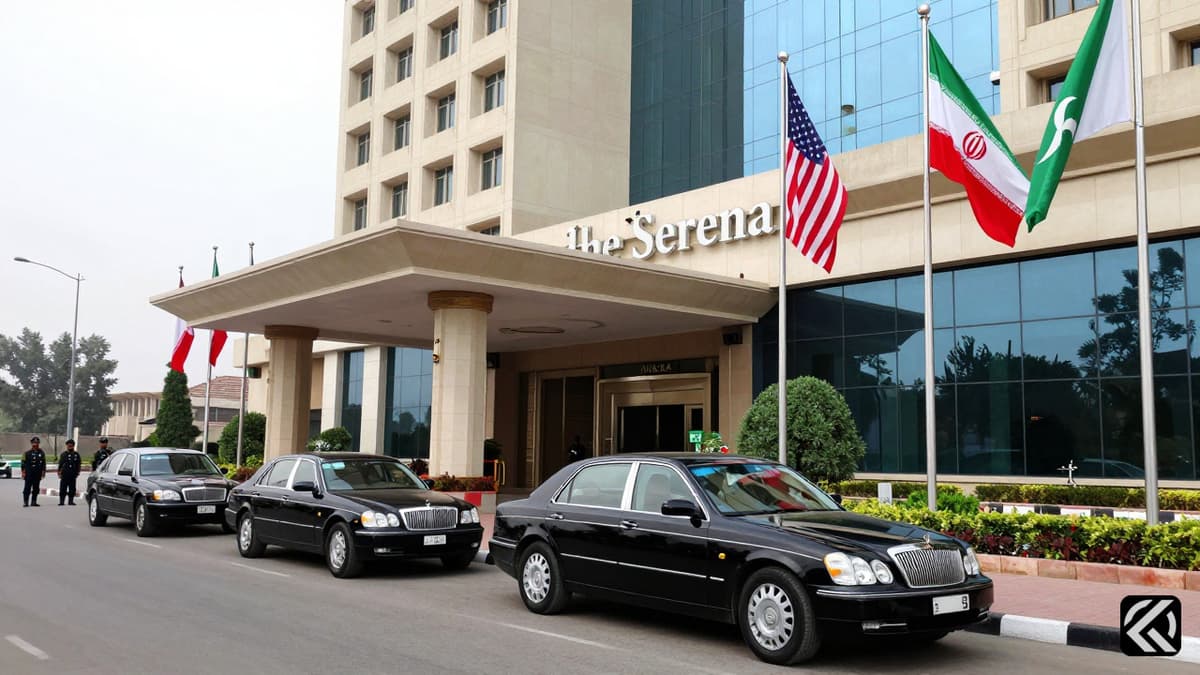
Amidst deep divisions, Pakistan hosts high-level US and Iranian delegations in Islamabad, aiming to secure a fragile agreement to continue peace negotiations following a recent ceasefire.
With key differences between Washington and Tehran seemingly intact, Pakistan has initiated a high-level diplomatic mission in Islamabad to facilitate negotiations between the two warring nations. Set to commence on Saturday, the summit aims for a realistic outcome: securing an agreement to continue dialogue despite the deep divisions that have characterized the relationship since the conflict began.
The high-level negotiations follow a US-mediated two-week ceasefire agreed upon days earlier, serving as a global attempt to halt hostilities initiated by US and Israeli airstrikes on February 28. These airstrikes resulted in the death of Iranian Supreme Leader Ayatollah Ali Khamenei, sparking a war that has since expanded the scope of regional instability.
US Vice President JD Vance left Washington on Friday to lead the American delegation, which includes President Donald Trump’s chief negotiator Steve Witkoff and his son-in-law, Jared Kushner. While Tehran has not formally confirmed its roster, Foreign Minister Abbas Araghchi and Parliament Speaker Mohammad Bagher Ghalibaf are expected to lead the Iranian team. The talks will take place exactly six weeks after the initial outbreak of hostilities, a critical window where a Pakistan mediated talks framework is being tested to see if it can bridge the widening gap between the two powers.
Experts and sources close to the mediation effort indicate that a major breakthrough on Saturday is unlikely. However, by establishing a modest ceiling-an agreement to continue deeper negotiations aimed at a lasting peace deal-Pakistan hopes to solidify the truce that has already offered a collective sigh of relief globally. "Pakistan has succeeded in getting them together. We got them to sit at a table. Now it is for the parties to decide whether they are willing to make the sacrifices necessary to reach an eventual solution," stated Zamir Akram, Pakistan's former ambassador to the United Nations.
The 'Proximity Format'
The logistical arrangement for these talks highlights the delicate nature of the diplomacy. The US and Iranian delegations will land at the Nur Khan airbase outside Islamabad before proceeding to the Serena Hotel, where they will reside and where the negotiations will occur. Despite sharing the same venue, the two teams will not meet face-to-face. Instead, they will occupy two separate rooms, with Pakistani officials shuttling messages between them.
This diplomatic strategy is known as proximity talks, a method where parties communicate through a third party rather than direct engagement. Pakistan has extensive historical experience with this technique. In 1988, Islamabad participated in the Geneva Accords negotiations regarding the Soviet withdrawal from Afghanistan, where UN-mediated indirect talks produced a landmark agreement. Akram, who represented Pakistan at the UN in Geneva from 2008 to 2015, noted that this history is highly relevant. "Proximity talks have been used before. Pakistan itself participated in one in Geneva in 1988 on the Afghan issue," Akram told Al Jazeera. He emphasized that the mere presence of the parties at the hotel is a metric of trust, adding that a solution will not be reached in a couple of days.
Building Diplomatic Momentum
In the 48 hours following the ceasefire announcement on April 7, a wave of international support rallied behind Islamabad. UN Secretary-General Antonio Guterres welcomed the truce and lauded Pakistan's role. Leaders from Kazakhstan, Romania, and the United Kingdom also issued statements endorsing the mediation.
Prime Minister Shehbaz Sharif engaged in extensive diplomatic outreach, speaking with eight world leaders, including the Emir of Qatar, the presidents of France and Turkiye, the prime ministers of Italy and Lebanon, the King of Bahrain, and the chancellors of Germany and Austria. Foreign Minister Ishaq Dar, who also serves as deputy prime minister, held an in-person meeting with China's ambassador and conversed with more than a dozen counterparts. In total, Pakistan's leadership made or received over 25 diplomatic contacts in roughly two days.
Salma Malik, a professor of strategic studies at Quaid-i-Azam University, noted that this scale of engagement reflects global confidence in Pakistan. "The two main parties showed confidence in Pakistan to act as a neutral agent, that is the first and most critical litmus test for any mediating country, and Pakistan passed it," she stated.
The most immediate threat to the success of the Saturday summit lies outside the negotiating room: the ongoing Israeli bombardment of Lebanon. Iranian President Masoud Pezeshkian warned Prime Minister Sharif that continued attacks would render the negotiations meaningless. Hours after the ceasefire was announced, Israel launched its most widespread bombardment of Lebanon since the conflict's inception, killing over 300 people in Beirut and southern Lebanon in a single day.
Foreign Minister Abbas Araghchi has stated that Tehran could abandon the ceasefire entirely if these strikes continue. While Sharif strongly condemned Israel's actions during a call with Lebanese Prime Minister Nawaf Salam on April 9 and maintains that the truce extends to Lebanon, the US holds a different view. Vice President Vance and President Trump have indicated that Lebanon falls outside the ceasefire's terms.
Seema Baloch, a former Pakistani envoy, highlighted that the issue ultimately rests with Washington. "Lebanon is key and Israel will use it to play the spoiler role," Baloch said. "It is now the US decision whether it will allow Israel, which is not seated at the Iran US ceasefire negotiations to play that role." While Israeli Prime Minister Benjamin Netanyahu has expressed readiness to begin direct negotiations with Lebanon, he clarified that no ceasefire exists there and strikes on Hezbollah will continue.
Despite these stumbling blocks, experts remain cautious but hopeful. The US is expected to push for restrictions on Iran's nuclear program, including limits on enrichment, while Tehran demands full sanctions relief and compensation for wartime damage. The Strait of Hormuz, a critical conduit for global oil and gas, remains a pressure point. Analysts suggest that an extension of the ceasefire deadline or movement on the Strait could serve as the first sign of meaningful progress, provided both sides agree to the necessity of continuing the dialogue.
The outcome of these Pakistan mediated talks will likely determine the longevity of the current Iran US ceasefire and the stability of the broader Middle East. If the US allows Israel to continue its campaign in Lebanon, the truce may fracture, but a unified American stance on de-escalation could force a broader resolution. The failure to address the core issues of nuclear enrichment and the Strait of Hormuz would likely result in a temporary pause rather than a lasting peace. As the parties engage in proximity talks, the international community watches closely to see if the diplomatic momentum built by Sharif's outreach can overcome the deep-seated hostilities and geopolitical fractures that have driven this conflict for weeks. The success or failure of this round will set the tone for future negotiations in the region, potentially dictating the security landscape for years to come.
Jun 8, 2026 00:51 UTC
Trump Claims Iran Nuclear Deal Imminent Despite Diplomatic Fractures
Jun 8, 2026 00:47 UTC
Iran Fires Missiles at Israel After Beirut Strike
Jun 7, 2026 22:00 UTC
US, Iran Peace Hops Fade 100 Days Into War
Jun 7, 2026 20:57 UTC
Iran Strikes Israel: IRGC Promises Week of Continuous Offensive
Jun 8, 2026 02:28 UTC
Trump Walks Out of Meet the Press After Rejecting Evidence Demands


