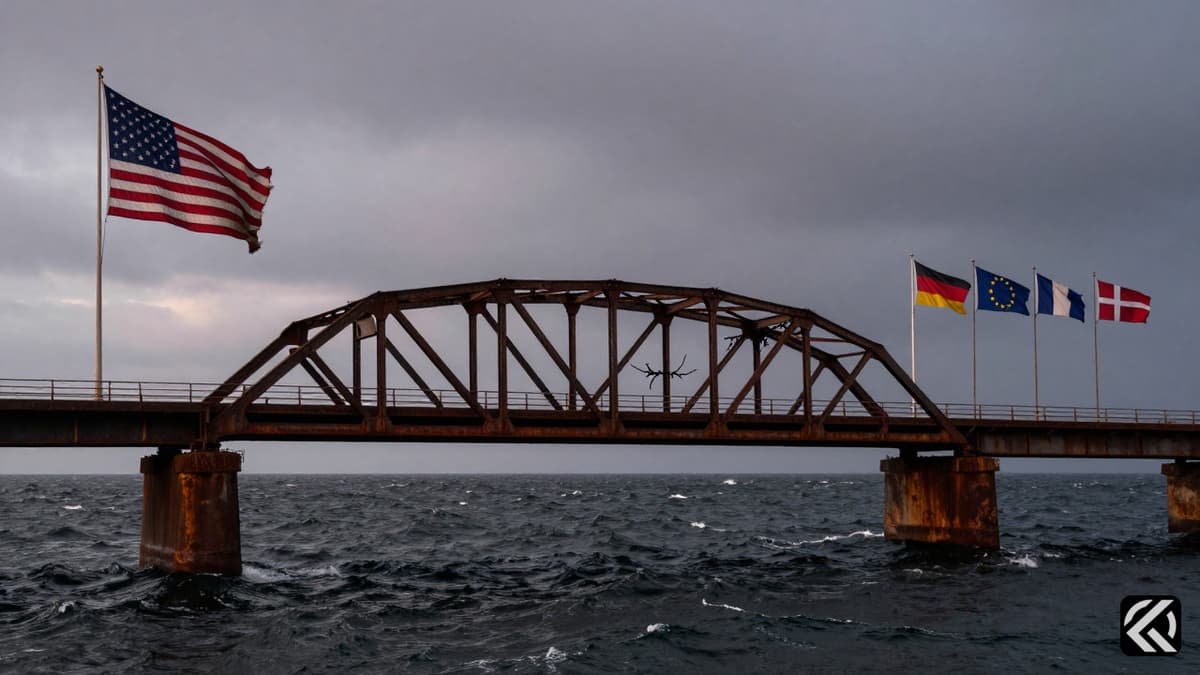
Amidst tensions over the Iran war and potential US withdrawal, experts warn the transatlantic alliance faces its biggest crisis yet regarding its future survival and credibility.
Donald Trump's long-standing disdain for NATO allies has reached a critical point, fueled by disputes over defence spending and the recent refusal of European nations to join his war on Iran. Analysts now warn that the alliance is facing its most significant NATO fracture since its inception, with Trump recently describing the lack of allied support as a permanent stain on the organization.
The tension escalated sharply this week when Trump condemned the allies' stance, prompting German Chancellor Friedrich Merz to label the conflict a "trans-Atlantic stress test." While a formal US withdrawal requires a two-thirds Senate majority or an act of Congress-both unlikely scenarios-Trump retains the power to undermine the alliance without leaving it. He can move approximately 84,000 troops out of Europe, close military bases, or halt coordination, actions that would severely damage the security architecture the US has undergirded since NATO's founding.
Jim Townsend, a former Deputy Assistant Secretary of Defense for Europe and NATO, stated unequivocally that "there will be no return to business as usual" in the alliance. He emphasized that the transatlantic partnership is "closer to a break than we have ever been," driven by the current administration and likely persisting into the future.
The core of the crisis involves deepening Article 5 scepticism among European nations regarding Washington's willingness to fulfill collective defence obligations. Although the treaty mandates collective defence, it does not force an automatic military response, leading to fears that the US would not intervene if allies were attacked. Trump has reportedly considered relocating US bases from countries deemed unhelpful during the Iran conflict to more supportive nations, further eroding the credibility of the alliance.
Stefano Stefanini, a former Italian ambassador to NATO, argued that Trump does not need to officially withdraw to destroy the alliance; the mere suggestion of withdrawal has already eroded its status as an effective entity. However, European allies are attempting to mitigate these risks by accelerating their own defence capabilities. Between 2020 and 2025, member states increased defence expenditure by more than 62 percent, a direct response to the perceived weakening of European defence industries revealed by Russia's invasion of Ukraine.
Despite these financial injections, significant gaps remain in US-European defence cooperation regarding the ability to strike deep into enemy territory, intelligence gathering, surveillance, reconnaissance, and space-based capabilities. The International Institute for Security Studies (IISS) reports that filling these gaps will take a decade or more and require roughly $1 trillion. European defence industries currently struggle to ramp up production, and many national armies are failing to meet recruitment and retention targets.
Minna Alander, an analyst at the Stockholm Centre for Eastern European Studies, suggests that a European-centric NATO is still possible. She posits that European members have a strong incentive to maintain the structure as a vehicle for military cooperation, even if it evolves into a radically different form following a potential US withdrawal.
The timeline for potential conflict is tight. General Carsten Breuer, Germany's chief of defence, estimates that Russia may reconstitute its forces sufficiently to attack NATO territory by 2029, though other analysts warn of threats as early as 2027. Breuer has ordered the German military to be fully equipped by 2029 to meet this deadline.
Historical context reveals that the debate often mischaracterizes NATO as solely a US favour to Europe. Born during the Cold War against the Soviet Union, the alliance was used by the US to attract as many countries as possible, treating non-members as potential allies of the enemy. Following the September 11, 2001, attacks, NATO invoked Article 5 for the first time, sending troops to Afghanistan where thousands died, including 500 from the UK and dozens from France, Denmark, and Italy.
During the Iran war, European bases served as beneficial staging sites for the US military, even as countries publicly distanced themselves from the conflict. Stefanini notes that Trump comfortably overlooks these strategic benefits to the US. He asserts that while Europe bears responsibility for not investing enough in defence, the notion that NATO serves only European strategic interests is false. The alliance has always served US interests, and without European investment in their own security, the dependence remains a critical vulnerability in the transatlantic relationship.
The future of the alliance depends on whether European nations can bridge the $1 trillion gap and overcome production hurdles before 2027 or 2029. If they fail, the NATO fracture could become permanent, leaving the trans-Atlantic region vulnerable to Russian aggression without a unified defence front. However, if the alliance can transform into a European-led structure with robust independent capabilities, it may survive the withdrawal of the US. The window for this transformation is narrow, and the political will to fund it remains the primary variable determining the survival of the trans-Atlantic security architecture.
Jun 8, 2026 02:17 UTC
Magnitude 7.8 Quake Shakes Philippines, Urging Immediate Evacuations
Join 50,000+ readers getting the global briefing every morning.
No spam. Unsubscribe anytime.
Jun 8, 2026 02:17 UTC
Magnitude 7.8 Quake Shakes Philippines, Urging Immediate Evacuations
Jun 8, 2026 00:51 UTC
Trump Claims Iran Nuclear Deal Imminent Despite Diplomatic Fractures
Jun 8, 2026 00:47 UTC
Iran Fires Missiles at Israel After Beirut Strike
Jun 7, 2026 22:38 UTC
Congress Party Claims Unity for INDIA Bloc Delhi Meeting


