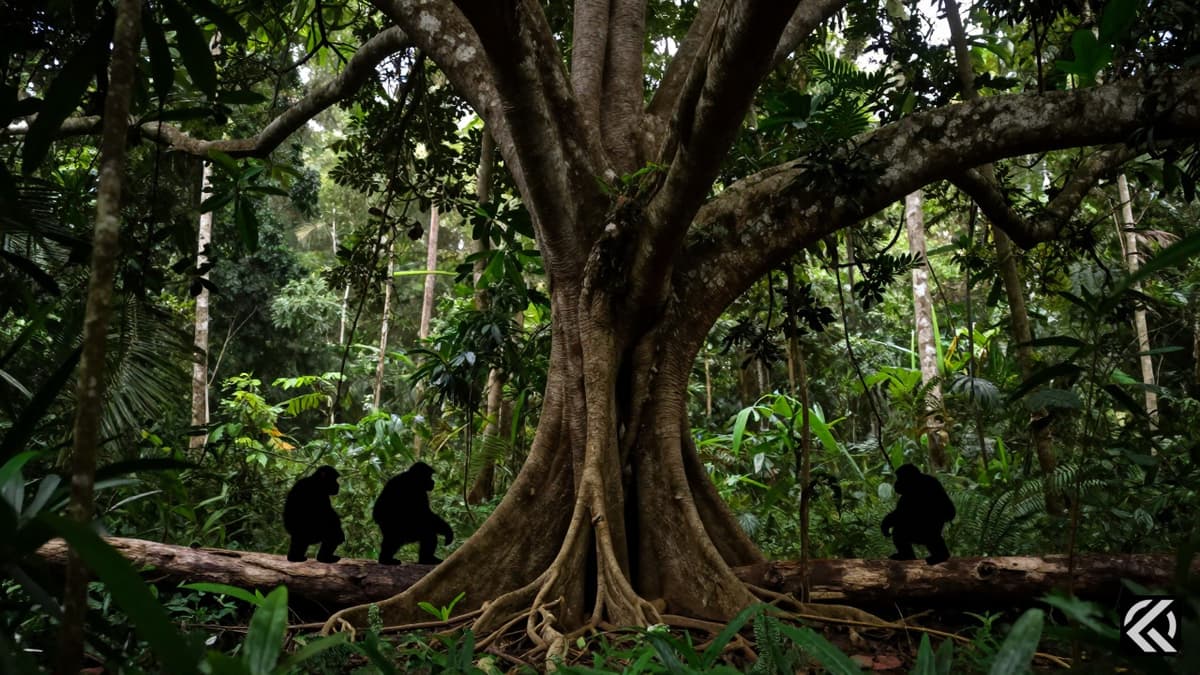
Eight years of deadly violence have fractured Uganda's largest chimpanzee group, transforming a once harmonious community into two warring factions locked in a brutal civil war.
The world's largest known group of wild chimpanzees has fractured, locking in a vicious civil war for eight years. Located within Uganda's Kibale National Park, the once close-knit community of Ngogo chimpanzees has descended into lethal hostilities. Since 2018 alone, scientists have recorded 24 killings, a shocking statistic that includes the deaths of 17 infants. The intensity and duration of this violence have prompted researchers to publish their findings in the journal Science, suggesting that the events may offer critical insights into how early human conflict developed.
Lead author Aaron Sandel, an anthropologist from the University of Texas and co-director of the Ngogo Chimpanzee Project, noted the stark contrast between the past and present. He described the subjects as chimps that previously held hands, now trying to kill each other. While the exact cause of the split remains unclear, Sandel explained that chimpanzees are naturally territorial and usually have hostile interactions with outsiders. However, the Ngogo group, consisting of nearly 200 individuals, lived in harmony for decades, divided only into Western and Central sets that operated as a cohesive unit.
The polarization began in June 2015, when Western chimpanzees fled and were chased by the Central group. Unlike usual arguments that involved screaming followed by grooming and cooperation, this dispute led to a six-week avoidance period. Interactions became less frequent and significantly more aggressive. By 2018, two distinct groups had emerged, and Western members began attacking Central chimpanzees. In 24 targeted attacks, at least seven adult males and 17 infants from the Central group were killed, though researchers suspect the actual death toll is even higher.
Researchers have identified three likely catalysts that precipitated the fission of this massive community. The first event occurred in 2014 with the unexplained deaths of five adult males and one adult female. This loss disrupted social networks and weakened the ties across the subgroups. The following year, a change in the alpha male coincided with the first period of separation, a shift in dominance hierarchy that likely increased aggression and avoidance behaviors.
The third and most devastating factor arrived in 2017 with a respiratory epidemic that claimed the lives of 25 chimpanzees, including four adult males and 10 adult females. This tragedy occurred just a year before the final separation. One of the males lost during the epidemic was described as "among the last individuals to connect the groups," suggesting his death was a pivotal moment in the group's dissolution. Sandel and his colleagues argue that these factors, combined with group size, resource competition, and male-male competition for reproduction, drove the violence.
The implications of this study extend beyond primatology. Sandel stated that the findings encourage a reevaluation of human conflict. "In the case of the Ngogo fission, individuals who lived, fed, groomed and patrolled together for years became targets of lethal attacks on the basis of their new group membership," the paper reads. The researchers argue that because chimpanzees are one of the species most genetically close to humans, their ability to wage war without constructs like religion, ethnicity, or political beliefs suggests that relational dynamics may play a larger role in human conflict than often assumed.
James Brooks, a researcher at the German Primate Center, commented on the study, calling it a "reminder of the danger that group divisions can present to human societies." He emphasized that while humans must learn from the group-based behavior of other species in war and peace, their evolutionary past does not strictly determine their future. This ongoing News underscores the fragility of social bonds and the potential for violence when those bonds are severed by environmental or social stressors. The study serves as a somber reminder that even in species with high social intelligence, the line between cooperation and lethal conflict can vanish quickly under the right, or wrong, conditions.
The Ngogo chimpanzee community's descent into violence serves as a critical case study for understanding the origins of warfare. As researchers continue to monitor the situation in Uganda, the pattern of lethal aggression following social disruption offers a unique window into pre-human behavioral evolution. If current trends continue, this fission may permanently alter the social structure of the Kibale National Park, potentially creating two isolated populations that never reconcile. The long-term impact will likely reshape how scientists and anthropologists view the relationship between group cohesion and the inevitability of conflict in primate societies.
Jun 8, 2026 02:17 UTC
Magnitude 7.8 Quake Shakes Philippines, Urging Immediate Evacuations
Join 50,000+ readers getting the global briefing every morning.
No spam. Unsubscribe anytime.
Jun 8, 2026 02:17 UTC
Magnitude 7.8 Quake Shakes Philippines, Urging Immediate Evacuations
Jun 8, 2026 00:51 UTC
Trump Claims Iran Nuclear Deal Imminent Despite Diplomatic Fractures
Jun 8, 2026 00:47 UTC
Iran Fires Missiles at Israel After Beirut Strike
Jun 7, 2026 22:38 UTC
Congress Party Claims Unity for INDIA Bloc Delhi Meeting


