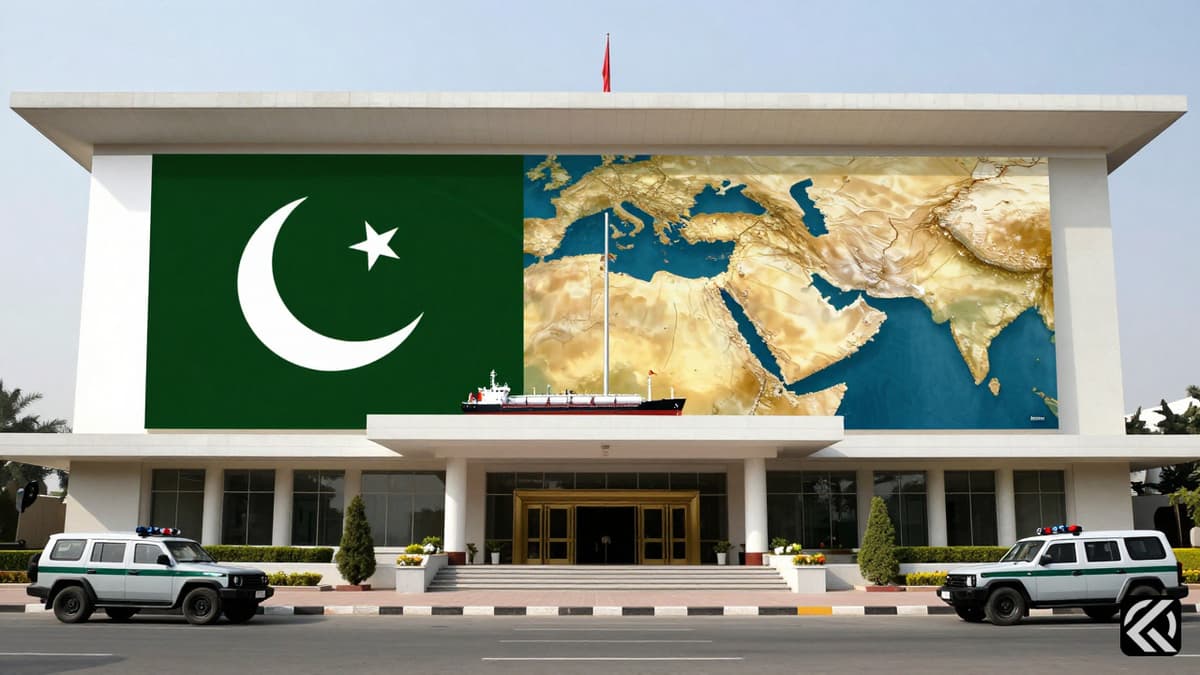
Amidst heightened security in Islamabad, Pakistan positions itself as the crucial mediator for US-Iran peace talks, leveraging military ties and diplomatic finesse to avert a broader catastrophe.
The high-stakes diplomacy that led to Pakistan hosting US-Iran peace talks is now unfolding in the capital. As the nation celebrates a successful two-week ceasefire, leaders are preparing to officially host the negotiations. A two-day holiday was declared in Islamabad ahead of the talks, which are scheduled to begin on Saturday.
While it remains unconfirmed whether the talks will proceed, the city has fully readied itself for the event. The streets have become noticeably quieter as approximately 10,000 police officers and security forces are deployed to ensure safety. The stakes for the world are undeniably high; nations globally are eager to see an end to the fighting and the reopening of the Strait of Hormuz, where about 20% of the global oil supply flowed before the conflict began.
For Pakistan, the stakes are equally critical. Experts warn that a collapse of negotiations could drag the country into a nightmare scenario, potentially involving a fight with its neighbor, Iran. Abdul Basit, a South Asia expert at Nanyang Technological University, notes that Pakistan signed a mutual defense pact with Saudi Arabia last year. Islamabad has since made it clear that it will honor its commitment to the Saudis, a move that could result in three of Pakistan's borders becoming hot simultaneously. This includes existing tensions with Afghanistan and India, alongside two full-fledged insurgencies currently plaguing two of the country's four provinces. Pakistan cannot afford such a multi-front crisis.
Despite these risks, pride and excitement are dominating Pakistani social media, with various memes going viral celebrating the nation's role. Basit describes the situation as a victory, noting that no other country in the world was able to broker the ceasefire while Pakistan was on the verge of a possible catastrophe. This success is vital for a nation that has endured years of political unrest, a fragile economy that teetered on the brink of debt default just two years ago, and intense rivalry with India.
How did Pakistan pull off this diplomatic feat? The nation finds itself in a unique position, trusted by the US, Iran, and Gulf countries alike. The reconciliation process is being led by Pakistan's military chief, Pakistan military chief Asim Munir, whom US President Donald Trump has dubbed his "favourite field marshal." This designation comes from Mushahid Hussain Syed, a senator from the ruling Pakistan Muslim League. Munir is arguably the most powerful man in a country where the army has long played a predominant role in politics.
Soon after the start of Trump's second term, Munir began building rapport with the US president, securing two early wins according to Maleeha Lodhi, a former Pakistan ambassador to the US and UN. Acting on CIA intelligence, the field marshal handed over the alleged mastermind behind the 2021 Kabul airport bombing, a suicide attack that killed at least 170 Afghans and 13 US service members. Trump was so grateful that he mentioned this achievement in his first address to Congress.
Lodhi adds that the second win was the way Pakistan conveyed to Trump that he played a pivotal role in preventing a wider war with India. Pakistan is one of the few countries that have nominated Trump for the Nobel Peace Prize, a title he has long coveted. The President, who was not deriving much joy from the tariff wars imposed on almost every country, really needed what he received from Pakistan.
Beyond military cooperation, Pakistan has promised access to its critical minerals, a move the US views as a national-security interest. In September 2025, Pakistan's Frontier Works Organisation, the country's major miner of critical minerals operating under the military, signed a $500 million investment deal with a US company. The ceremony took place at the Prime Minister House, with Munir in attendance. Furthermore, in January, Pakistan signed an agreement with an affiliate of World Liberty Financials, the cryptocurrency venture co-founded by Trump and his family, which will potentially integrate its stablecoin into the country's digital-payment system.
However, these close ties did not prevent Pakistan from officially condemning the first US-Israeli attacks in Iran. Yet, when Iran bombed the oil fields of Saudi Arabia, a military ally, Pakistan issued a strongly worded statement against Iran. On April 7, Pakistan abstained from a UN Security Council resolution urging states to coordinate efforts to reopen the Strait of Hormuz. Syed called this stance "one-sided" because the solution did not mention that the US and Israel attacked first.
This "principled stance" and "balanced approach" have helped enhance the trust of Iran and other Gulf countries. Prime Minister Shehbaz Sharif played a crucial role in the negotiations, with former Foreign Secretary Aizaz Chaudhry noting that Sharif and his deputy, Foreign Minister Ishaq Dar, spoke with more than a dozen world leaders over the past five weeks. On the day the ceasefire was announced, Sharif reported a "warm and substantive conversation" with Iran's President Masoud Pezeshkian, who reaffirmed Iran's participation and expressed appreciation for Pakistan's efforts.
Sharif appears to have leveraged Pakistan's long-standing relationship with Iran. The two countries share a 920km border and have been cooperating for decades. They also share concerns regarding militants and the unstable situation in Afghanistan. Former Pakistan ambassador to Iran Asif Durrani notes that for the past five decades, both nations have faced instability in the form of refugees. Religion has also played a role, with Pakistan hosting one of the world's largest Shia populations, allowing thousands of Pakistanis to travel to Iran for pilgrimage annually.
As Saturday approaches, uncertainty remains regarding whether the promised peace talks will materialize. The ceasefire is under growing strain, and it is unclear if the two sides will actually turn up. Concerns exist among Pakistani officials, with the responsibility resting on Trump to restrain Israel. Durrani emphasizes that while Pakistan has played its part as a broker, mediator, or facilitator, it can only take the horse to water, not make it drink. The success of the initiative ultimately depends on the parties making use of the opportunity provided by Pakistan to secure the future of the region.
Jun 8, 2026 02:17 UTC
Magnitude 7.8 Quake Shakes Philippines, Urging Immediate Evacuations
Join 50,000+ readers getting the global briefing every morning.
No spam. Unsubscribe anytime.
Jun 8, 2026 02:17 UTC
Magnitude 7.8 Quake Shakes Philippines, Urging Immediate Evacuations
Jun 8, 2026 00:51 UTC
Trump Claims Iran Nuclear Deal Imminent Despite Diplomatic Fractures
Jun 8, 2026 00:47 UTC
Iran Fires Missiles at Israel After Beirut Strike
Jun 7, 2026 22:38 UTC
Congress Party Claims Unity for INDIA Bloc Delhi Meeting


