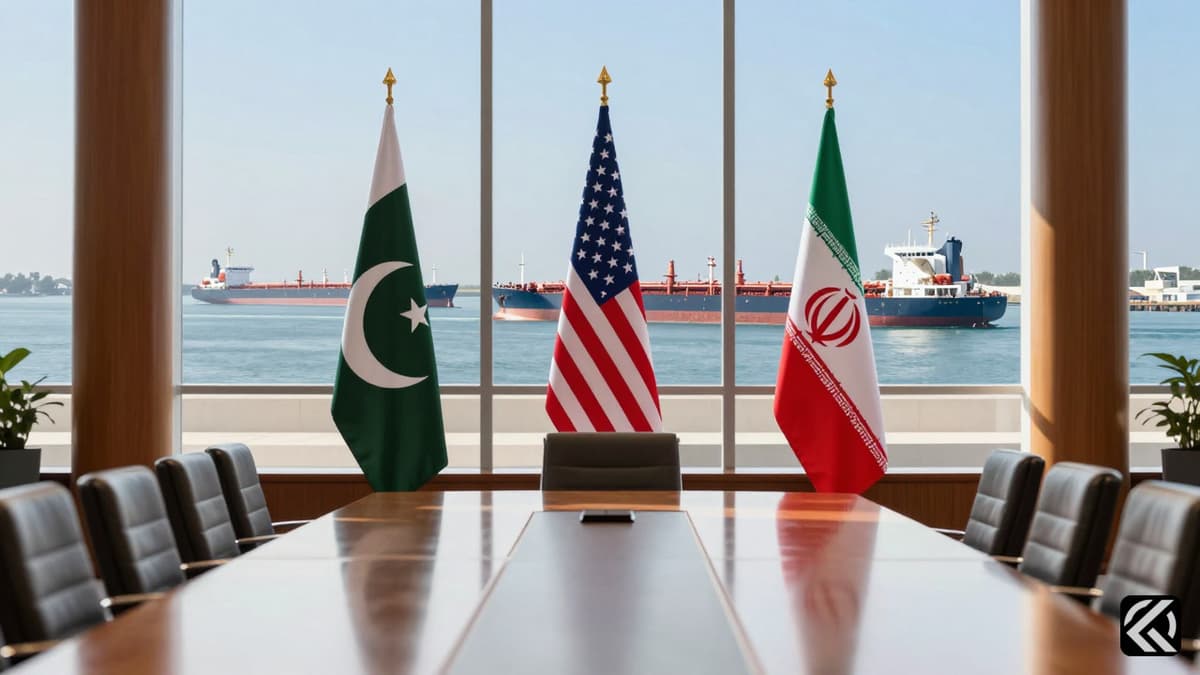
Amidst high stakes and global oil concerns, Pakistan emerges as the unlikely broker of peace between the US and Iran, deploying massive security for imminent talks.
The high-stakes diplomacy leading to Pakistan hosting US-Iran peace talks has prompted a unique response in Islamabad. A two-day holiday was declared in the capital ahead of the talks, which are scheduled to begin on Saturday. While the final confirmation of the event's occurrence remains pending, the city has mobilized extensive security, quieting streets with the deployment of roughly 10,000 police officers and security forces.
This diplomatic effort, which secured a two-week ceasefire between the US and Iran, addresses a critical global concern. Countries worldwide are eager to see an end to the fighting and the reopening of the Strait of Hormuz, the vital artery where about 20% of the global oil supply previously flowed. For Pakistan, the stakes are equally profound, as the South Asian nation faces a potential "nightmare scenario" if negotiations fail. Experts warn that a collapse could drag Pakistan into fighting its neighbor, Iran, especially given Islamabad's mutual defense pact with Saudi Arabia.
How did Pakistan pull off this feat? The answer lies in a unique positioning where the nation is trusted by the US, Iran, and Gulf countries simultaneously. The reconciliation process is led by Pakistan's military chief, Asim Munir. According to Senator Mushahid Hussain Syed, Munir is referred to by US President Donald Trump as his "favourite field marshal." Munir, arguably the most powerful man in Pakistan where the army plays a predominant role, began building rapport with the US president soon after the start of Trump's second term.
This relationship yielded two early wins that solidified the path to the Pakistan US-Iran peace talks. Acting on CIA intelligence, Munir handed over the alleged mastermind behind the 2021 Kabul airport bombing, a tragic attack that killed at least 170 Afghans and 13 US service members. Trump expressed immense gratitude, mentioning the achievement in his first address to Congress. Furthermore, Pakistan conveyed to Trump that he had played a pivotal role in preventing a wider war with India. This contribution was so significant that Pakistan has nominated Trump for the Nobel Peace Prize, which he has long coveted. The US president, who was reportedly not finding joy in his global tariff wars, received this diplomatic success from Pakistan as a crucial win.
Beyond military and political cooperation, Pakistan has solidified ties through economic interests. The nation has promised access to critical minerals, a priority for US national security. In September 2025, Pakistan's Frontier Works Organisation, a major miner operating under the military, signed a $500 million investment deal with a US company at the Prime Minister House, with Munir in attendance. Additionally, in January, Pakistan signed an agreement with an affiliate of World Liberty Financials, a cryptocurrency venture co-founded by Trump and his family, to potentially integrate a stablecoin into the country's digital-payment system. These moves have bolstered ties with Trump's circle.
Despite these close ties, Pakistan maintained a "principled stance." The nation officially condemned the first US-Israeli attacks in Iran. However, when Iran retaliated by bombing Saudi oil fields, a military ally, Pakistan issued a strongly worded statement against Tehran. On April 7, Pakistan abstained from a UN Security Council resolution urging states to reopen the Strait of Hormuz, a move Senator Syed called "one-sided" as it failed to mention the US and Israeli attacks first. This balanced approach has enhanced the trust of Iran and other Gulf nations.
Prime Minister Shehbaz Sharif played a crucial role, alongside Foreign Minister Ishaq Dar, by speaking with more than a dozen world leaders in Washington, Moscow, Beijing, European capitals, Turkey, Egypt, and GCC states. On the day the ceasefire was announced, Sharif reported a "warm and substantive conversation" with Iranian President Masoud Pezeshkian, who reaffirmed Iran's participation and appreciated Pakistan's efforts. This leverage is built on a 920km shared border and decades of cooperation regarding militants and Afghan instability. Furthermore, religious connections play a role, with Pakistan's large Shia population frequently traveling to Iran for pilgrimage, fostering a unique trust.
Yet, as the date for the talks approaches, uncertainty remains. The ceasefire is under growing strain, and it is unclear if the parties will actually turn up. There is a concern among Pakistani officials that the responsibility to restrain Israel ultimately rests on Trump. Former ambassador Asif Durrani notes that Pakistan has played its part as a broker, but like a horse taken to water, the parties must choose to drink.
Diplomatic Risks and Economic Pressures
While Pakistan has successfully brokered a ceasefire, the sustainability of the upcoming Donald Trump Asim Munir partnership remains the linchpin for lasting peace. The nation has already "played its part" in facilitating dialogue, but the success of the Strait of Hormuz reopening hinges entirely on the willingness of the US and Iran to engage. If the talks collapse, the economic repercussions for Pakistan, already recovering from a debt default two years prior, could be severe. The potential for a "three borders" hotspot, involving Iran, India, and Afghanistan, alongside ongoing insurgencies in two provinces, suggests that the cost of failure is national stability. However, the current surge of pride and social media activity indicates a populace ready to support this high-wire act, hoping that the diplomatic breakthrough will translate into long-term regional security and economic recovery.
Jun 8, 2026 02:17 UTC
Magnitude 7.8 Quake Shakes Philippines, Urging Immediate Evacuations
Join 50,000+ readers getting the global briefing every morning.
No spam. Unsubscribe anytime.
Jun 8, 2026 02:17 UTC
Magnitude 7.8 Quake Shakes Philippines, Urging Immediate Evacuations
Jun 8, 2026 00:51 UTC
Trump Claims Iran Nuclear Deal Imminent Despite Diplomatic Fractures
Jun 8, 2026 00:47 UTC
Iran Fires Missiles at Israel After Beirut Strike
Jun 7, 2026 22:38 UTC
Congress Party Claims Unity for INDIA Bloc Delhi Meeting


