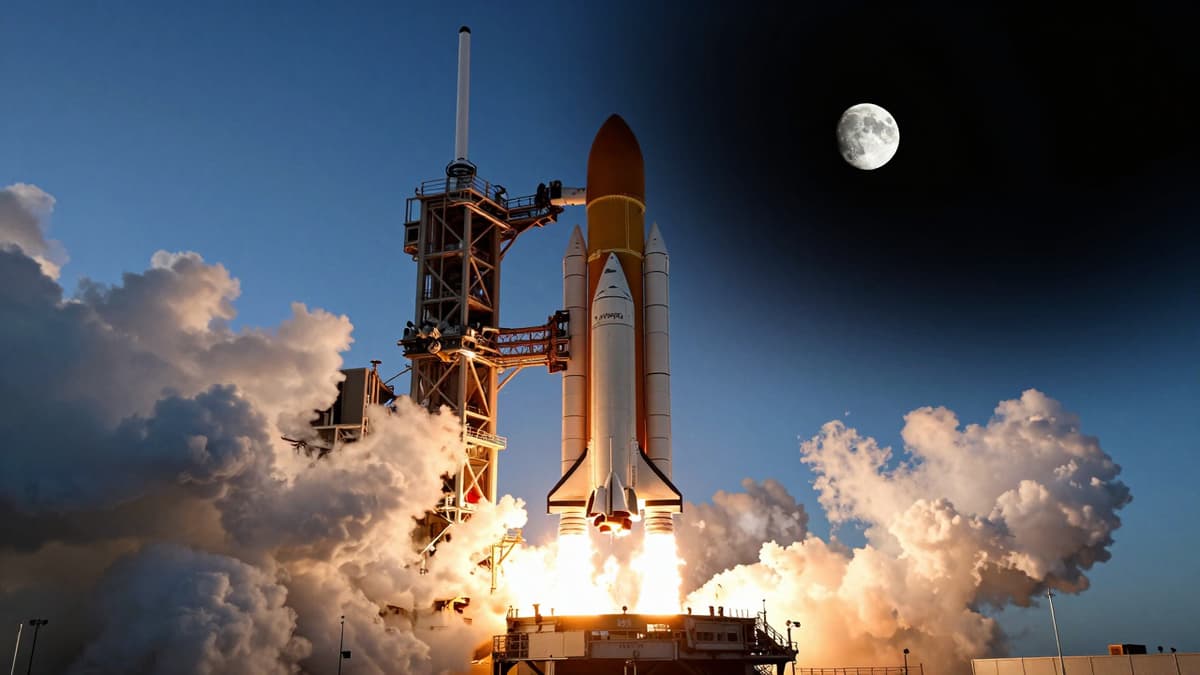
After overcoming technical delays, the historic Artemis II mission has launched from Florida, marking a pivotal moment for the United States as it prepares to return humans to the lunar surface.
The historic Artemis II space mission has successfully blasted off from the US state of Florida, launching four astronauts on a journey around the moon that marks the first time humans have traveled beyond low-Earth orbit in more than 50 years.
This launch, which occurred on a Wednesday, serves as a major milestone in NASA's strategic plan to return humans to the lunar surface and eventually pave the way for crewed missions to Mars. The 32-storey rocket rose from NASA's Kennedy Space Center in Cape Canaveral, drawing tens of thousands of spectators to witness the liftoff.
Tensions were exceptionally high in the hours leading up to the launch as hydrogen fuel began flowing into the rocket, a critical phase that had previously caused a dangerous leak during a countdown test earlier this year, forcing a lengthy delay. To the relief of the entire team, no significant hydrogen leaks were detected this time. The launch team successfully loaded more than 700,000 gallons (2.6 million litres) of fuel into the Space Launch System rocket on the pad, a smooth operation that set the stage for the crew to board.
However, NASA faced additional challenges. The agency had to resolve several technical issues ahead of liftoff to ensure a successful departure. One specific concern involved commands failing to get through to the rocket's flight-termination system, a safety mechanism designed to send a self-destruct signal if the rocket veers off course and threatens populated areas. According to NASA, this issue was quickly resolved without delaying the launch.
Furthermore, engineers troubleshot a battery in the launch-abort system after its temperature readings fell outside the expected range. The problem was fixed and did not prevent the launch from proceeding, allowing the mission to move forward with the crew on board.
The Artemis II crew consists of NASA astronauts Reid Wiseman, Victor Glover, and Christina Koch, along with Canadian Space Agency astronaut Jeremy Hansen. They are set for a nearly 10-day journey around the moon and back, taking them farther into space than humans have travelled in decades.
On this historic mission, launch director Charlie Blackwell-Thompson addressed the crew: "On this historic mission, you take with you the heart of this Artemis team, the daring spirit of the American people and our partners across the globe, and the hopes and dreams of a new generation. Good luck, Godspeed Artemis II. Let's go."
Five minutes into the flight, Wiseman, who serves as the commander, saw the team's target from the capsule. "We have a beautiful moonrise, we're headed right at it," he said.
The astronauts will spend the first one to two days in high Earth orbit carrying out extensive systems checks. These tests include verifying Orion's life-support, propulsion, navigation, and communications systems to ensure the spacecraft is ready for deep space. Once these checks are complete, the Orion capsule will perform a critical engine burn known as translunar injection, sending the spacecraft out of Earth's orbit and onto a trajectory toward the moon.
The journey will take several days, during which the crew will continue monitoring spacecraft systems as they travel farther from Earth. Artemis II will then fly behind the moon on a free-return trajectory, a path that naturally swings the spacecraft back towards Earth using the gravity of both the moon and Earth, requiring minimal fuel. During this phase, the spacecraft will reach its greatest distance from Earth.
After the lunar flyby, the crew will spend several days travelling back to Earth while carrying out additional deep-space tests on power systems, thermal controls, and crew operations. As the capsule approaches Earth, it will re-enter the atmosphere at speeds of about 40,233km per hour (25,000 miles per hour) before splashing down in the Pacific Ocean, where recovery teams will retrieve the crew.
With half the world's population not yet born when NASA's Apollo astronauts last walked on the moon, Artemis II is being presented as a new generation's moon mission. NASA science mission chief Nicky Fox highlighted this generational shift earlier in the week, stating, "There are a lot of people who don't remember Apollo. There are generations who weren't alive when Apollo launched. This is their Apollo." The successful launch and the upcoming lunar flyby represent a definitive step in reclaiming American leadership in space exploration while introducing the wonders of the cosmos to a new demographic of space enthusiasts and future engineers.
The successful completion of the Artemis II launch and its subsequent operational phases indicates that the technical hurdles regarding the Space Launch System and the Orion capsule are being systematically resolved. Based on the source material indicating the mission is a major step toward returning to the moon and sending astronauts to Mars, the long-term impact suggests a sustained shift in human spaceflight capabilities. If the deep-space tests on power systems and thermal controls during the return journey yield positive results, the trajectory is set for subsequent missions to the lunar surface, fulfilling the agency's plan to establish a long-term human presence beyond low-Earth orbit within the coming decades.
Jun 8, 2026 04:15 UTC
Trump Urges Netanyahu to Halt Iran Strike for Peace
Join 50,000+ readers getting the global briefing every morning.
No spam. Unsubscribe anytime.
Jun 8, 2026 02:28 UTC
Trump Walks Out of Meet the Press After Rejecting Evidence Demands
Jun 8, 2026 02:17 UTC
Magnitude 7.8 Quake Shakes Philippines, Urging Immediate Evacuations
Jun 8, 2026 00:51 UTC
Trump Claims Iran Nuclear Deal Imminent Despite Diplomatic Fractures
Jun 8, 2026 00:47 UTC
Iran Fires Missiles at Israel After Beirut Strike


