A federal judge has issued a temporary halt on the controversial White House ballroom project, ruling that the President lacked the constitutional authority to proceed without Congress.
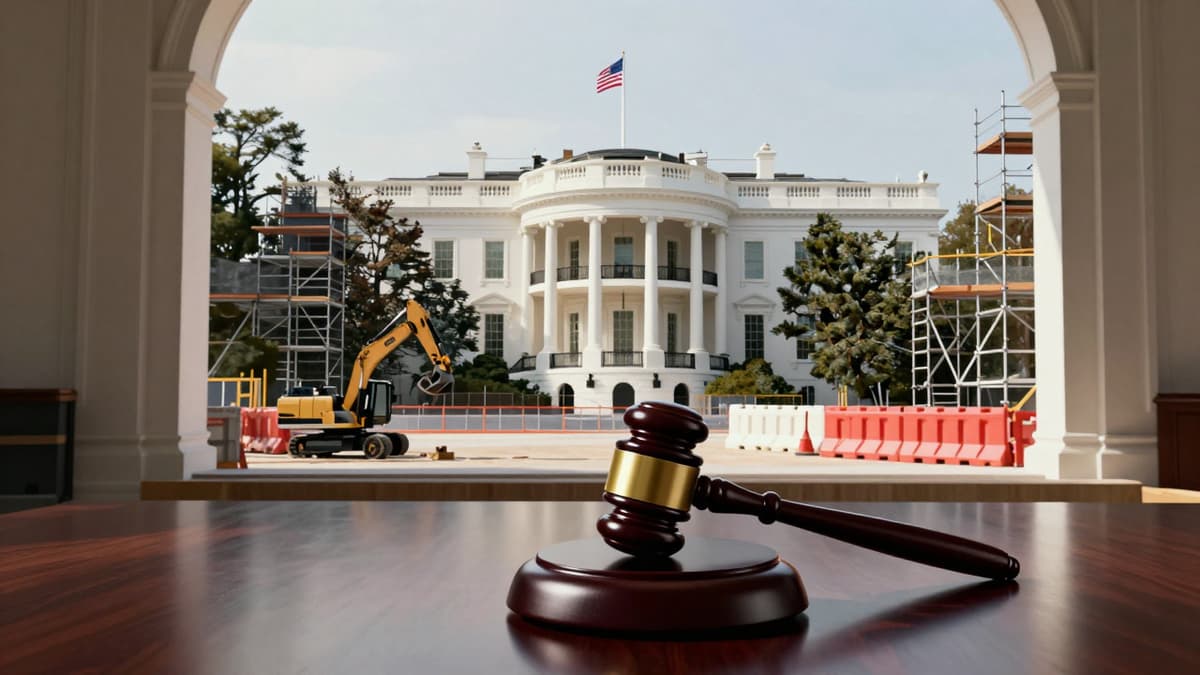
A US judge has temporarily prevented President Donald Trump's White House ballroom construction project from continuing, ruling that proper procedures were not followed before the project began. The decision halts work after the White House was sued by the National Trust for Historic Preservation for alleged legal violations regarding environmental assessments and property authorization.
The ruling comes after a detailed legal battle where the preservation group argued that the administration broke the law by beginning construction without filing plans with the National Capital Planning Commission. The group further alleged that the White House failed to seek an environmental assessment and declined to seek necessary authorisation from Congress, violating the US Constitution which reserves the right to dispose of federal property to Congress. In a strongly worded 35-page ruling published on Tuesday, Judge Richard Leon concluded that no statute grants the President the authority he claims, noting that construction must stop until Congress blesses the project through statutory authorization.
Judge Leon, who was appointed by a Republican president, emphasized the constitutional distinction regarding the White House. "The President of the United States is the steward of the White House for future generations of First Families. He is not, however, the owner!" Leon wrote, using a significant number of exclamation points to drive home his argument. He stated that the National Trust is likely to succeed on the merits because no law comes close to giving the President the claimed authority. Consequently, the judge ordered that "unless and until Congress blesses this project through statutory authorization, construction has to stop."
The context of the construction involves the demolition of the East Wing, which was constructed in 1902, to make way for the new multi-million dollar ballroom. Since the demolition in October, the proposed blueprint has seen significant expansion. Originally planned as a ballroom with a capacity of 500 people, the design has grown to a space capable of fitting 1,350 guests. The White House administration previously argued that their plan was more economical than renovating the East Wing, citing that many presidents have made similar changes to the property.
The financial details of the project remain a point of contention. The White House states the project is expected to cost $400m (£302m) and is being funded entirely by private donors. Trump and his administration have maintained that the building is "under budget" and "ahead of schedule." Trump quickly criticized the ruling on his social media site, Truth Social, asserting that the project is proceeding well and "will be the finest Building of its kind anywhere in the World." He noted that the National Trust is suing him for a ballroom that is being built at "no cost to the Taxpayer."
The legal implications of this ruling extend beyond the immediate construction site. Judge Leon's conclusion suggests that if the President and his team can secure approval from Congress, "the American people will benefit from the branches of Government exercising their constitutionally prescribed roles." This highlights the separation of powers at the heart of the dispute, reinforcing the idea that executive authority over federal property is not absolute without legislative backing. The judge's decision places the onus on Congress to provide the necessary statutory authorization before the project can resume.
This judicial intervention highlights the friction between executive initiative and constitutional constraints regarding federal property. The ruling underscores that even for high-profile projects, the executive branch cannot bypass legislative requirements for property disposition. If the administration seeks to resume the Trump White House Ballroom construction, the path forward strictly requires legislative action. The future of the project now depends on whether Congress chooses to provide the statutory authorization demanded by the court. Without such action, the legal standing of the project remains halted, and the separation of powers will be tested as the administration weighs its response to the court's demand for congressional blessing.
Jun 8, 2026 02:17 UTC
Magnitude 7.8 Quake Shakes Philippines, Urging Immediate Evacuations
Jun 8, 2026 00:51 UTC
Trump Claims Iran Nuclear Deal Imminent Despite Diplomatic Fractures
Jun 8, 2026 00:47 UTC
Iran Fires Missiles at Israel After Beirut Strike
Jun 7, 2026 22:00 UTC
US, Iran Peace Hops Fade 100 Days Into War
Jun 8, 2026 04:15 UTC
Trump Urges Netanyahu to Halt Iran Strike for Peace