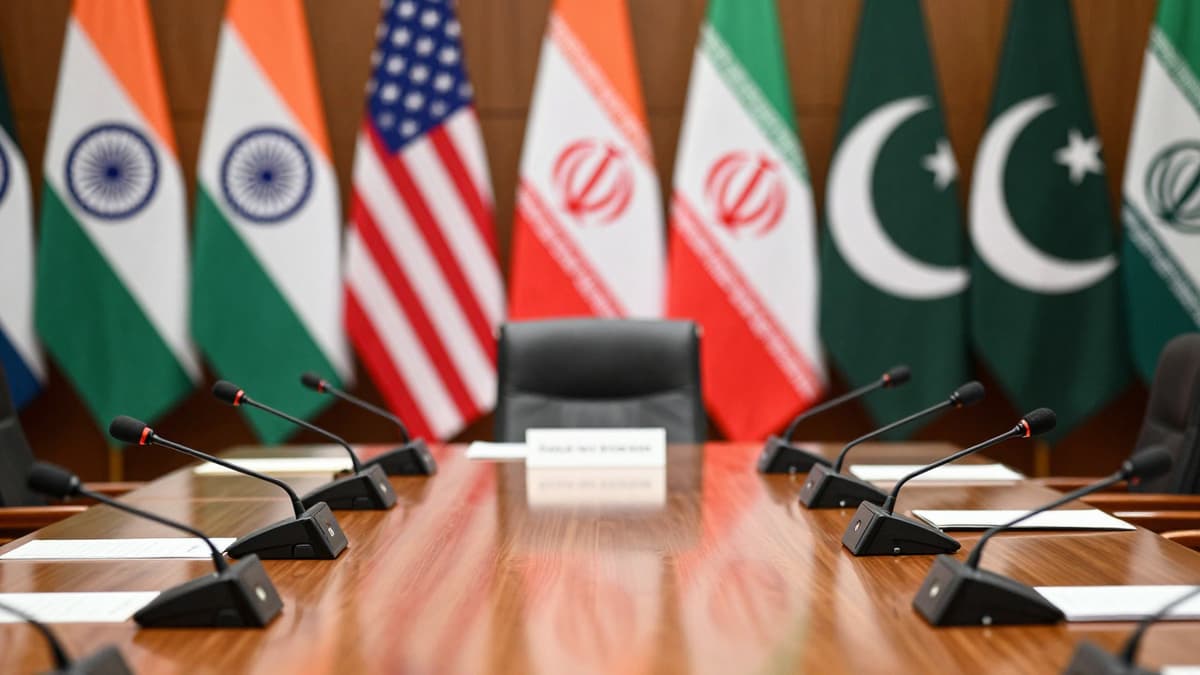
At a high-level all-party meeting, External Affairs Minister S Jaishankar firmly declared that India cannot serve as a broker, distinguishing its diplomatic approach from Pakistan's actions in the ongoing US-Iran tensions.
The Government of India officially dismissed suggestions that Pakistan has achieved diplomatic success by offering to mediate between the United States and Iran during a high-level all-party meeting convened on Wednesday in New Delhi. External Affairs Minister S Jaishankar explicitly stated that New Delhi cannot assume the role of a broker nation, distinguishing its strategic position from the actions of its neighbor. The minister emphasized that while India maintains strong ties with Iran and follows a policy of multi-alignment to serve its national interests, the country cannot replicate the intermediary role attempted by Pakistan in the region.
During the discussion, Jaishankar provided historical context to underscore India's position, recalling instances where Pakistan successfully inserted itself into major international conflicts. He noted that the neighbor had previously acted as an intermediary between China and the United States in 1971, and later facilitated talks between the US and Iran in 1981. Government sources clarified that the minister was not mocking current actions but rather putting the situation in perspective by highlighting Pakistan's established history of intervention. The minister also highlighted that there remains significant uncertainty regarding the format and future of US-Iran negotiations, specifically pointing to the sudden emergence of parliamentary speaker Mohammad Bagher Ghalibaf as Tehran's chief negotiator.
Beyond the diplomatic stance, the Prime Minister's recent interactions with US leadership were detailed to the gathering. Prime Minister Narendra Modi, in a conversation with Donald Trump on Tuesday, communicated that the ongoing war is detrimental to all parties involved. The Prime Minister impressed upon the US president the urgent need for a swift resolution to the conflict. This diplomatic engagement underscores the Indian government's active monitoring of global developments while maintaining its distinct strategic identity.
The all-party meeting, presided over by Defence Minister Rajnath Singh, attracted significant attention from opposition leaders who flagged several critical concerns regarding the government's foreign policy and domestic security implications. Mukul Wasnik of the Congress party, John Brittas of the CPM, Asaduddin Owaisi of the AIMIM, Supriya Sule of the NCP, and Sanjay Singh of the AAP were among the opposition MPs present. These leaders raised questions about Prime Minister Modi's visit to Israel immediately preceding the outbreak of the war and the Indian government's alleged silence regarding the assassination of Iran's supreme leader, Ayatollah Ali Khamenei.
Energy security was another focal point of the debate, with opposition MPs expressing deep concerns over the availability of oil and gas in the wake of regional instability. Finance Minister Nirmala Sitharaman, Home Minister Amit Shah, Petroleum Minister Hardeep Puri, and Parliamentary Affairs Minister Kiren Rijiju were among the other government officials present to address these anxieties. Hardeep Puri specifically assured the participants that India currently holds sufficient stocks of petrol and diesel to manage the situation. Furthermore, he confirmed that the government has actively moved to secure new sources of supply to ensure continued energy stability for the nation.
The Communist Party of India (Marxist-Leninist) Liberation (CPI-ML) and the Trinamool Congress (TMC) had different approaches to the meeting; notably, the TMC was the sole major opposition party that skipped the session. The Trinamool Congress leadership called for the issues to be discussed directly in Parliament rather than through the closed-door all-party meeting format. In response to the gathering, Kiren Rijiju stated that the government had clearly explained its position to address the specific concerns raised by the opposition parties. He emphasized that in such challenging situations, unity is essential, echoing Prime Minister Narendra Modi's appeal for the Parliament to rise together during times of crisis. Rijiju observed that the opposition parties had displayed a certain level of maturity during the proceedings.
Despite the absence of the TMC, the consensus among the participants and the government remained on the importance of standing together. The meeting concluded with a reaffirmation of India's multi-alignment strategy, which allows the country to maintain good equations with various nations, including Iran, without becoming a permanent broker in conflicts between other global powers. The discussion highlighted the complex geopolitical landscape where India seeks to balance its national interests with global stability, avoiding the pitfalls of being drawn into mediating roles that could compromise its strategic autonomy. The government's stance remains clear: while India is willing to support peace, it will not assume the role of a mediator in the US-Iran conflict, a role it views as historically and strategically belonging to other entities in the region.
The refusal by External Affairs Minister S Jaishankar to position India as a broker nation suggests a long-term strategy of maintaining strategic autonomy rather than engaging in active mediation roles that could entangle New Delhi in regional hostilities. Based on the historical precedents cited by Jaishankar, the likelihood of Pakistan continuing to insert itself into the US-Iran dynamic remains high, reinforcing India's decision to distance itself from such brokerages. As the format of US-Iran talks remains unclear, India's focus is expected to shift toward securing its energy supplies through diversified sources, a move the petroleum minister has already initiated. The government's emphasis on unity and the Prime Minister's appeal to the Parliament indicate that future foreign policy decisions will likely be driven by a collective national interest approach, ensuring that India's good relations with Iran are preserved without compromising its neutrality or becoming a geopolitical pawn in the broader US-Iran conflict.
Jun 8, 2026 00:51 UTC
Trump Claims Iran Nuclear Deal Imminent Despite Diplomatic Fractures
Jun 8, 2026 00:47 UTC
Iran Fires Missiles at Israel After Beirut Strike
Jun 7, 2026 22:00 UTC
US, Iran Peace Hops Fade 100 Days Into War
Jun 7, 2026 20:57 UTC
Iran Strikes Israel: IRGC Promises Week of Continuous Offensive
Jun 8, 2026 02:28 UTC
Trump Walks Out of Meet the Press After Rejecting Evidence Demands


