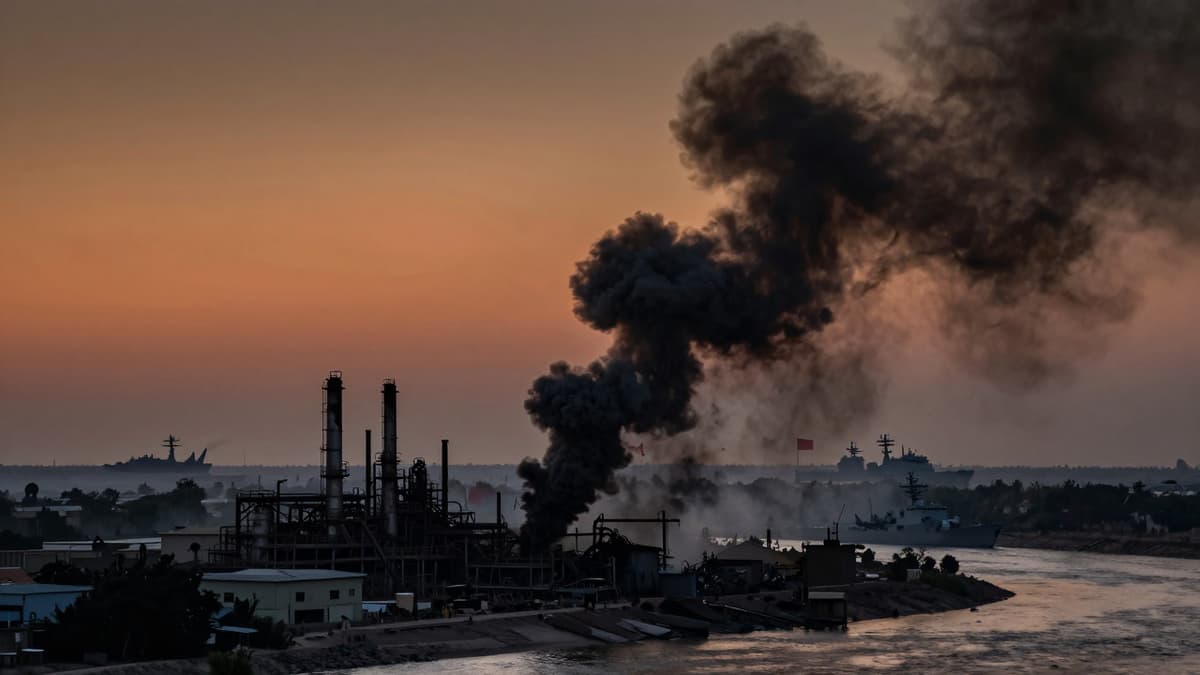
The Middle East conflict intensifies as Israel braces for a multi-front war, Iran warns of US ground invasion plans, and US military assets arrive in the region.
The Middle East conflict has entered its second month, marking a period where all major parties are doubling down on their positions while weighing further escalation. As the situation intensifies, Iran's parliament speaker has explicitly accused the US of secretly planning a ground invasion, even as the Israel Defense Forces state they are ready for a multi-front war. Simultaneously, the Pentagon has confirmed that more US troops have arrived in the region to bolster the US Central Command's strategic position.
In a significant development, Iran's parliament speaker Mohammad Bagher Ghalibaf has emerged as a senior civilian figure, accusing Washington of floating negotiations only to secretly plan a ground invasion. Ghalibaf stated that Tehran's forces are "waiting for them," signaling a high level of readiness and tension. This claim adds weight to the growing fear of a direct American ground presence, which was previously only a subject of speculation in some circles but is now articulated by a key Iranian official.
Meanwhile, the Israel Defense Forces (IDF) has declared that it is prepared for a "multi-front" war following recent escalations. The Houthis, a Yemen-based militia backed by Iran, have officially entered the expanding conflict by firing two missiles at southern Israel. While the IDF intercepted both missiles, the event prompted the military to reiterate that they have been fighting a multi-front war for the last two and a half years. This declaration underscores the complexity of the current multi-front war Israel faces, as threats now emanate from multiple directions simultaneously.
On the ground, the conflict has intensified through direct attacks and territorial shifts. Israeli Prime Minister Benjamin Netanyahu has ordered the expansion of Israel's security buffer zone in southern Lebanon. The IDF is now occupying land south of the Litani River and has destroyed several bridges, a move that aid groups warn cuts off tens of thousands of residents from essential lifelines. This action follows the initial strike on the southern buffer zone and has significantly altered the local geography and humanitarian landscape.
The reach of the conflict extends further across the region, with Iran's Islamic Revolutionary Guard Corps (IRGC) vowing to target American and Israeli-affiliated universities. The IRGC stated that these institutions are now considered "legitimate targets" until two universities are struck, raising the stakes for educational centers. This threat comes as Iranian state-affiliated media reports heavy bombardment across Tehran, including civilian areas and the military-linked site of Parchin. The intensity of these attacks suggests a broadening of the Iran US ground invasion threat perception, as civilian and educational targets are now explicitly mentioned in retaliation threats.
Infrastructure damage has become widespread, with strikes hitting industrial sites, aluminum smelters, and airports across the Middle East. Firefighters worked for hours to extinguish a massive blaze in central Israel after a weapon fragment struck an industrial site. Similar attacks targeted a major aluminum smelter in Bahrain, injuring two employees, and a major aluminum company in the UAE sustained significant damage. In Kuwait, a massive fire broke out at Kuwait International Airport after a drone attack hit fuel tanks, demonstrating the vulnerability of critical energy and transport infrastructure.
The human cost continues to rise, with the World Health Organization reporting that nine paramedics were killed and seven wounded in five separate attacks in southern Lebanon. This marks one of the deadliest days for medical workers in the region this month. Additionally, falling debris from a missile interception injured 11 people in Eshtaol, central Israel, as alerts were issued signaling incoming attacks from both Iran and Lebanon. These events highlight the immediate and pervasive danger facing civilians and emergency responders alike.
As the conflict escalates, the United States has moved to reinforce its presence. The USS Tripoli, carrying 3,500 sailors and Marines, has arrived in the Middle East. This deployment aligns with earlier reports suggesting a Marine Expeditionary Unit would be sent to the region. These units are traditionally utilized for large-scale evacuations, amphibious operations, raids, and assaults, indicating a significant shift in US strategic capabilities in the area. The arrival of these forces coincides with the US Central Command weighing its next steps as the Middle East conflict escalation continues to gather momentum.
Despite the militarization, diplomatic efforts are underway to de-escalate the situation. Foreign ministers from Egypt, Saudi Arabia, and Turkey met in Pakistan for four-way talks aimed at addressing the war's threat to their energy security and borders. During these discussions, Pakistan's prime minister appreciated the "remarkable restraint exercised by Saudi Arabia." These diplomatic channels remain crucial as the region seeks to manage the fallout from the widening war.
The global shipping industry also faces disruption, with the Houthi rebels continuing to attack vessels in the Red Sea. Their involvement now raises the specter of further disruption for a global shipping network already buffeted by Iran's closure of the Strait of Hormuz. In a partial de-escalation of the shipping blockade, Iran has agreed to allow 20 ships under Pakistani flags to pass through the Strait of Hormuz. Islamabad's Foreign Minister Ishaq Dar confirmed that two ships will cross the strait daily under this new agreement.
Amidst the chaos, a personal message attributed to Mojtaba Khamenei, the new Supreme Leader of Iran, was delivered to the head of a major Iraqi Shiite political party. The contents of this message remain unclear, as Khamenei has not been publicly seen since assuming his role. This lack of public visibility adds an element of uncertainty to the Iranian leadership's strategic direction.
Globally, the conflict has sparked widespread demonstrations. Cities across the world, from Tel Aviv and London to Beirut, Athens, and Dakar, have witnessed protests against the US and Israel's war with Iran. These protests reflect the deep international concern and opposition to the ongoing hostilities, signaling that the conflict has resonance far beyond the immediate combat zones. The convergence of military mobilization, infrastructure damage, and diplomatic maneuvering suggests a volatile period ahead for the Middle East.
The convergence of US troop deployments, Iranian threats against educational and civilian targets, and expanded Israeli buffer zones points to a prolonged and increasingly dangerous phase of the conflict. The explicit warning from the IRGC regarding university targets suggests that the scope of retaliation may shift towards soft targets, potentially broadening the conflict's impact on society. As the US Central Command assesses its strategy alongside the arrival of the USS Tripoli, the likelihood of a Middle East conflict escalation remains high. Regional powers' attempts at de-escalation through Pakistan and diplomatic talks offer a potential, yet fragile, counterbalance to the rising tensions. If the current trajectory of attacks and counter-attacks continues, the region faces a future where humanitarian corridors are severed, critical infrastructure remains vulnerable, and the specter of a US ground invasion, as alleged by Iranian officials, becomes a central point of contention.
Jun 8, 2026 00:51 UTC
Trump Claims Iran Nuclear Deal Imminent Despite Diplomatic Fractures
Jun 8, 2026 00:47 UTC
Iran Fires Missiles at Israel After Beirut Strike
Jun 7, 2026 22:00 UTC
US, Iran Peace Hops Fade 100 Days Into War
Jun 7, 2026 20:57 UTC
Iran Strikes Israel: IRGC Promises Week of Continuous Offensive
Jun 8, 2026 02:28 UTC
Trump Walks Out of Meet the Press After Rejecting Evidence Demands


