Iran rejects Trump's claim of a requested ceasefire as US strikes intensify, while Ryanair warns of supply issues and the UAE intercepts new missile barrages.
Iran has officially rejected US President Donald Trump's assertion that it requested a ceasefire, dismissing the claim as entirely "false and baseless." Simultaneously, the US military reports hitting over 12,300 Iranian targets, including ballistic missile sites and command centers. The escalating Iran-US military conflict has triggered immediate economic anxieties, with Ryanair's CEO warning of potential Ryanair jet fuel disruption in Europe starting in May if the war continues. Amidst the geopolitical tension, the United Arab Emirates confirmed intercepting hundreds of additional ballistic missiles and drones launched from Iran.
A little earlier, Ryanair's CEO Michael O'Leary warned that jet fuel supply in Europe could be disrupted from May if the conflict in the Middle East continues. In an interview with Sky News, O'Leary stated that the war's impact could put 25% of Ryanair's supplies at risk through May and June. He also highlighted a risk of "significantly higher" ticket prices through April, May, and June if the conflict extends further, even though fuel prices are currently secure. Conversely, a government source told the BBC that for those traveling overseas for Easter, there are no concerns and no fuel disruption is expected. The source added that the fuel industry and the government are looking at supply projections six weeks from now, with contingency plans being developed. Earlier, the trade body representing airlines in the UK said they "are currently not seeing disruption to jet fuel supply."
On the battlefield, the operational update from US Central Command (Centcom) reveals a staggering tally. The US says it has now hit "12,300+" Iranian targets, including command and control centers, ballistic missile sites, and storage bunkers. In addition to these strikes, more than 155 Iranian vessels have been "damaged or destroyed," according to Centcom. The update also details the types of aircraft involved in "13,000+" combat flights since the war started, which include F-22 and F-35 fighter jets, and B-1, B-2, and B-52 bombers. This massive scale of air operations underscores the intensity of the ongoing hostilities across the region.
In the United Arab Emirates, the reality of the war is palpable. Earlier today, the UAE defense ministry said it intercepted 35 drones and five ballistic missiles launched from Iran. That brings the total to 2,012 drones, 438 ballistic missiles, plus 19 cruise missiles intercepted since the start of the war. A woman in her 40s living in Dubai told reporters she can feel her building "shake" during the interceptions. She has avoided going out to see her friends for a month now, hearing loud blasts daily. "When [there is] a blast, it shakes the building... I rush to come in because [the] blast's so loud," she explained. She added that she avoids open areas and has not attended church for a month due to safety concerns.
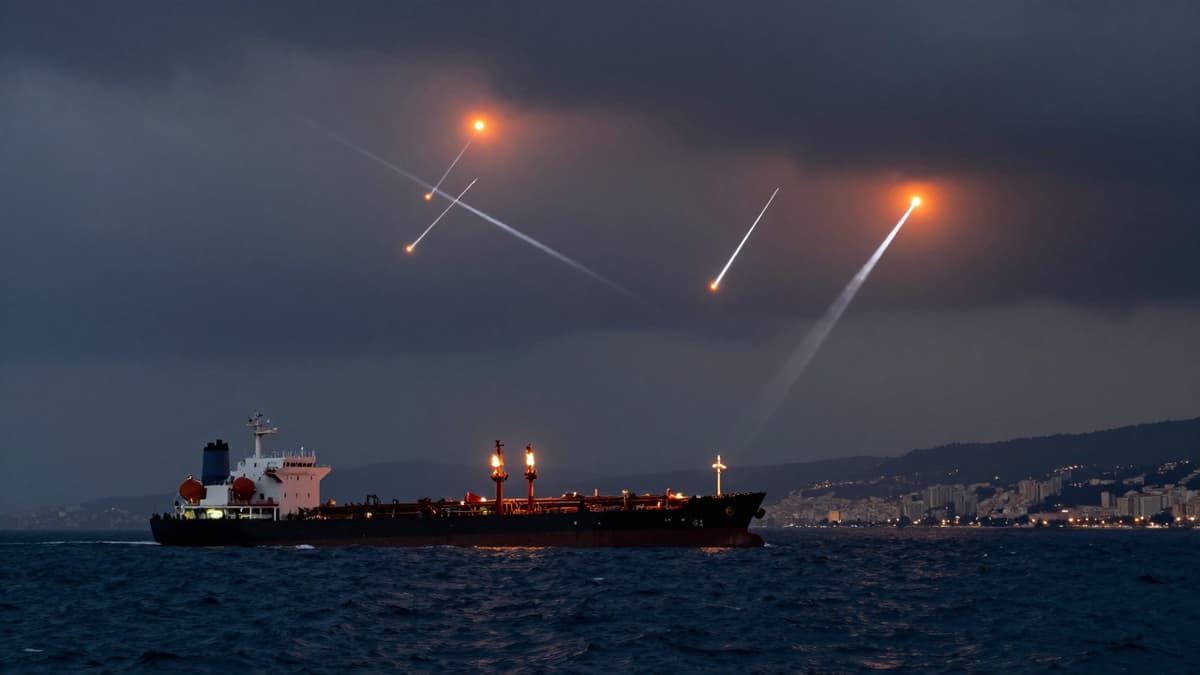
Under the UAE's cyber-crime laws, photographing, sharing, or posting images of sites where missiles or drones have struck is not allowed. At least one British man has been charged with filming missiles, with others detained. Criticism of the government is illegal in the UAE, which exercises strict control over the flow of information out of the country. Meanwhile, a Qatari tanker operated by a Qatari firm was evacuated early on Wednesday after being hit by an Iranian cruise missile. Qatar's ministry of defense confirmed the tanker, Aqua 1, leased by QatarEnergy, was struck in Qatari waters, but all 21 crew members escaped without injuries. The attack caused no impact on the environment, though the Islamic Revolutionary Guards Corps (IRGC) claimed the tanker, which it asserts is owned by Israel, was struck by an IRGC navy missile.
Humanitarian and diplomatic strains are also visible. Some 1,262 Iranians have returned from the United Arab Emirates since the start of the war, according to Iran's consulate in Dubai, as reported by the state broadcaster's Young Journalists Club. These travelers returned via Afghanistan and Armenia as direct travel options are suspended. Iranian media reports new restrictions on Iranian nationals traveling to or from the UAE. The Iranian Labour News Agency (ILNA) states that passport holders are no longer permitted to enter or transit through Dubai, even those with valid UAE residency permits or tourist visas. Iranian residents outside the UAE are temporarily unable to return, with limited exemptions subject to prior approval.
Amidst the chaos, public sentiment within Iran remains complex. It is still very difficult to contact those inside Iran amid a government-imposed internet outage, though some have connected via satellite internet Starlink. One man in his 30s in Tehran described Trump as "very unpredictable" and noted he doesn't want to reveal all his cards. A woman in her 20s expressed exhaustion, saying, "Honestly, I'm tired of everything and every politician. At this point, it feels like we're all in a circus." Another woman noted that while she felt hopeful when hearing fewer strikes, seeing reports that Trump might target infrastructure made her feel "sick of this kind of contradictory talk."
Trump to make TV address later
Trump is expected to make a TV address later in the day, delivering what is described as an "operational update" on the US operation, which officials believe is meeting or exceeding expectations. As part of the speech, Trump will highlight American military successes, such as destroying Iran's navy, degrading its missile manufacturing, combating proxy groups, and ensuring Iran will not have a nuclear weapon. The president is also expected to reiterate a timetable of two or three weeks for the operation. However, the White House official made no mention of peace negotiations, efforts to lower petrol prices, or ensuring freedom of navigation in the Strait of Hormuz. The situation remains rapidly changing, and Trump's thinking could evolve before the speech.
Undeterred by the ongoing strikes, thousands of Iranians turned out in Tehran for the funeral of Islamic Revolutionary Guard Corps naval commander Alireza Tangsiri, who Israel said was killed in an Israeli airstrike on 26 March. Meanwhile, in Israel, emergency personnel evacuated children from an impact site in Bnei Brak following a missile attack blamed on Iran, leaving fourteen injured. In Lebanon, the mayor of Houmine El Tahta surveyed the ruins of a house destroyed by a strike amidst escalating hostilities between Israel and Hezbollah. In Iraq, people watched smoke billow from an oil warehouse on the outskirts of Irbil following a suspected drone strike.
President Trump has threatened to leave the Nato alliance, citing the failure of allies to come to America's aid during the war in Iran. Nato is heavily reliant on the size and capabilities of the US military, and a US withdrawal could spell disaster for the transatlantic alliance. However, the president would face significant legislative hurdles if the country were to proceed. In 2023, Congress approved a measure explicitly aimed at preventing a US president from unilaterally withdrawing from the alliance without congressional approval. Doing so would require approval of two-thirds of the Senate or a specific act of Congress, a tough but not impossible hurdle. This measure was a bipartisan effort pushed for, in part, by then-Senator Marco Rubio, who is now Trump's secretary of state.
The upcoming presidential address serves as a critical inflection point, signaling a continuation of the military campaign rather than an immediate de-escalation. With the US claiming 12,300+ strikes and the UAE intercepting thousands of projectiles, the momentum suggests a prolonged period of UAE missile interceptions and offensive operations. Given the Ryanair jet fuel disruption warnings, the economic ripple effects of continued conflict in the Middle East are poised to intensify, potentially destabilizing supply chains and inflating costs for travelers across Europe. If the President maintains his stated two-to-three-week timeline, the region faces a critical window where diplomatic breakthroughs remain elusive, and the threat to civilian infrastructure, including oil tankers and commercial aviation, remains high. The intersection of military escalation and legislative barriers regarding NATO suggests a complex geopolitical landscape where military actions may proceed independently of alliance cohesion, leaving the future trajectory of the Iran-US military conflict uncertain and volatile.
Jun 8, 2026 00:51 UTC
Trump Claims Iran Nuclear Deal Imminent Despite Diplomatic Fractures
Jun 8, 2026 00:47 UTC
Iran Fires Missiles at Israel After Beirut Strike
Jun 7, 2026 22:00 UTC
US, Iran Peace Hops Fade 100 Days Into War
Jun 7, 2026 20:57 UTC
Iran Strikes Israel: IRGC Promises Week of Continuous Offensive
Jun 8, 2026 02:28 UTC
Trump Walks Out of Meet the Press After Rejecting Evidence Demands


