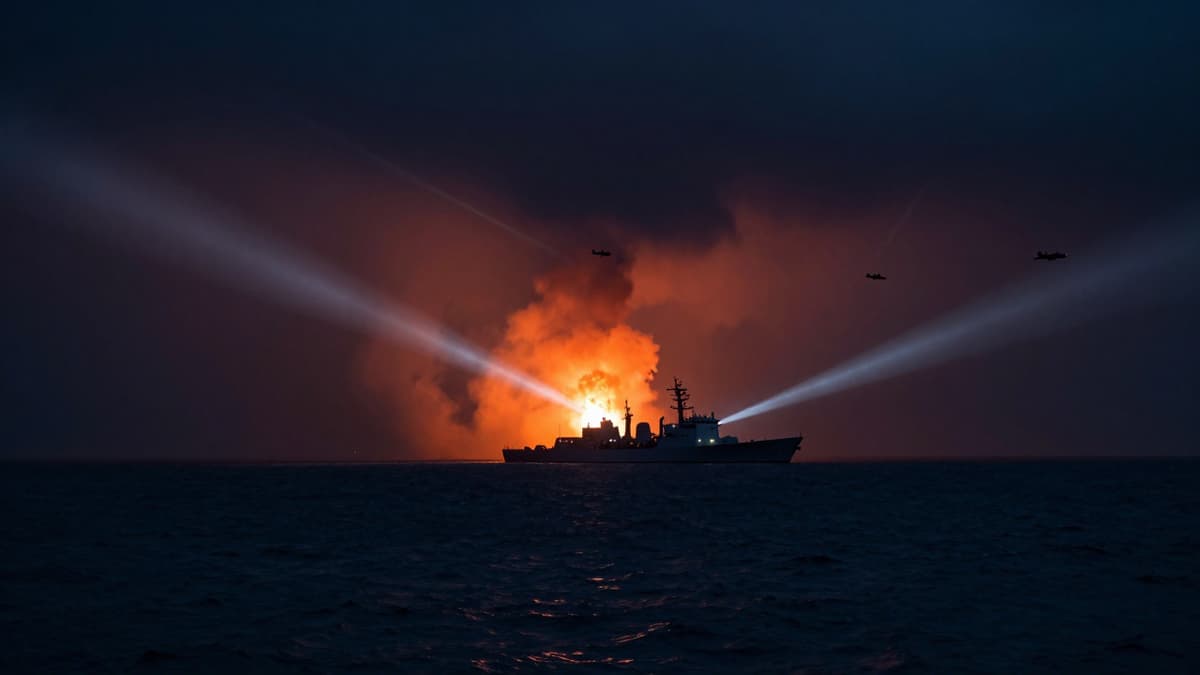
Israel claims an airstrike eliminated the top commander of Iran's naval forces, escalating tensions in a conflict that has already claimed thousands of civilian lives.
Israel's defense minister announced on Thursday that an Israeli air strike had killed the commander of Iran's Islamic Revolutionary Guard Corps navy. The assassination of Alireza Tangsiri was carried out on Wednesday night, a strike that also targeted other senior officers of the naval command, according to a video statement released by Israel Katz. This event marks a significant escalation in the ongoing hostilities, as the man directly responsible for the terrorist operation of mining and blocking the Strait of Hormuz to shipping has been blown up and eliminated, Katz declared.
Since the start of the United States-Israeli war on Iran on February 28, Israel has announced the assassination of several top Iranian officials. This includes Supreme Leader Ayatollah Ali Khamenei and security chief Ali Larijani, adding to a growing list of high-value targets neutralized in the conflict. The toll on civilians, however, remains far heavier than the military losses. In almost one month, at least 1,937 people have been killed, including 452 women and children, Iran's Deputy Health Minister Ali Jafarian told Al Jazeera. In addition, at least 24,800 people have been injured, including 4,000 women and 1,621 children, Jafarian added.
Earlier, Al Jazeera reported on the latest victims, identifying two teenage boys who were killed in Shiraz. Al Jazeera's Tohid Asadi, reporting from Tehran, noted that there was no official Iranian confirmation yet of Tangsiri's killing. However, he cautioned that if it is true, it is going to be another major blow for a country that has already experienced a lot of military commanders being killed. Tangsiri is especially significant given his role in Iran, exerting control over the strategically significant Strait of Hormuz. In recent days, he had issued strong warnings, specifically addressing the Israelis and Americans and specifically talking about the closure of the Strait of Hormuz.
The head of the Basij paramilitary forces, Brigadier General Gholamreza Soleimani, and Intelligence Minister Esmail Khatib were also assassinated in Israeli attacks. In recent days, Israeli forces have carried out several strikes targeting the naval assets of Iran. Last week, Israeli air attacks hit several Iranian naval ships in the Caspian Sea, including ones equipped with missile systems, support vessels and patrol craft. Iran has been blocking ships it perceives as linked to the US and Israeli war from the Strait of Hormuz, but it is letting a trickle of others through the crucial waterway.
Jasem Mohamed Albudaiwi, secretary-general of the Gulf Cooperation Council, a bloc of six Gulf Arab nations, said Iran was charging for safe passage through the strait. On Thursday, Malaysian Prime Minister Anwar Ibrahim said Iran was letting its tankers pass through the strait, after talks with Iranian, Turkish and other regional leaders. The situation in the Iran-Israel war continues to unfold with rapid changes in leadership and strategic control, leaving the region in a state of high alert and uncertainty. The killing of Tangsiri removes a key figure who had been central to Iran's strategy regarding the waterway, potentially altering the dynamics of shipping and regional security.
The strategic implications of Alireza Tangsiri's elimination suggest a potential shift in how the conflict is managed on the waterways. While Iran continues to block vessels linked to the US and Israel, the removal of the naval commander who orchestrated the mining operations could lead to either a de-escalation or a new, more unpredictable phase of tactics. The fact that Iran is now charging for safe passage indicates a shift from simple blockade tactics to a monetized control of the waterway, complicating international trade routes. With the leadership and command structure already questioned after previous assassinations, the region may face a leadership vacuum that could either precipitate a wider regional war or force a recalibration of defensive strategies. The future of the Strait of Hormuz depends heavily on how Iran's new command structure responds to these losses and whether the current policy of selective passage continues or escalates further.
Jun 8, 2026 02:17 UTC
Magnitude 7.8 Quake Shakes Philippines, Urging Immediate Evacuations
Join 50,000+ readers getting the global briefing every morning.
No spam. Unsubscribe anytime.
Jun 8, 2026 02:17 UTC
Magnitude 7.8 Quake Shakes Philippines, Urging Immediate Evacuations
Jun 8, 2026 00:51 UTC
Trump Claims Iran Nuclear Deal Imminent Despite Diplomatic Fractures
Jun 8, 2026 00:47 UTC
Iran Fires Missiles at Israel After Beirut Strike
Jun 7, 2026 22:38 UTC
Congress Party Claims Unity for INDIA Bloc Delhi Meeting


