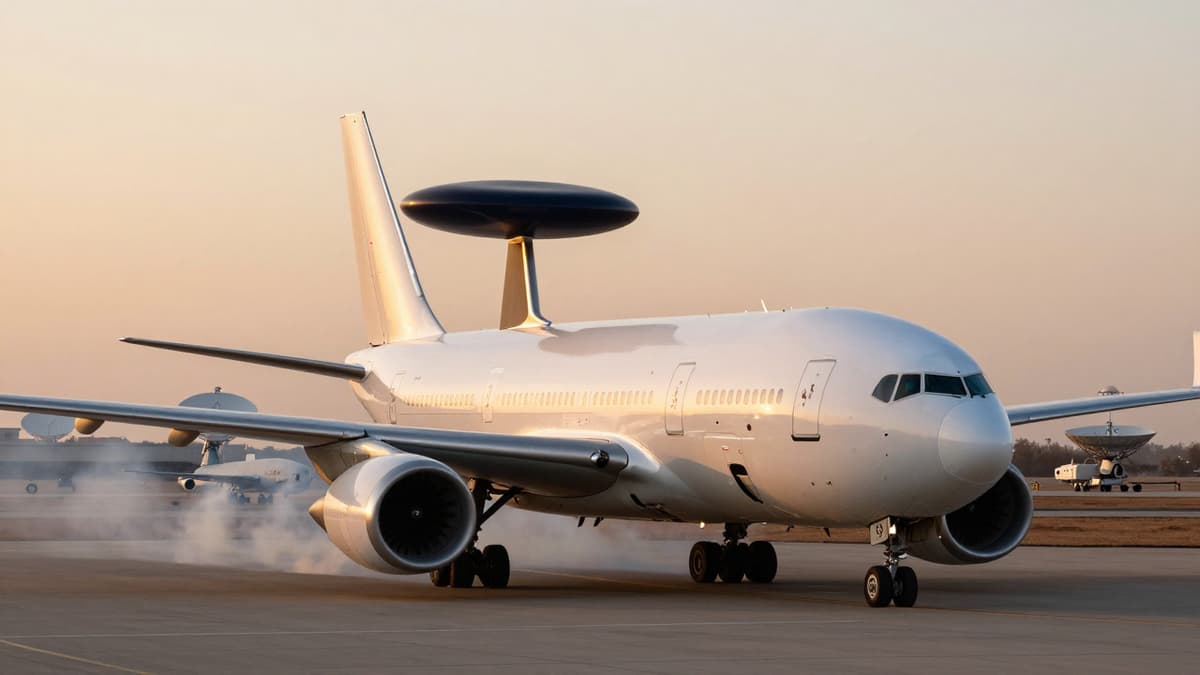
Iranian forces claim a devastating strike on US assets, hitting critical AWACS radar and refueling tankers at a key Saudi airbase, wounding fifteen soldiers in a major escalation.
As the United States and Israel launched a war on Iran on February 28, Tehran responded swiftly by firing missiles and drones not just at Israel, but at US assets across Gulf countries. The conflict has now expanded into a critical energy region, with Tehran explicitly targeting American infrastructure to counter the US air campaign. On Friday, a joint strike reportedly hit the Prince Sultan Air Base in Saudi Arabia, a facility run by the Saudi air force but also heavily utilized by US forces.
Media reports from The Wall Street Journal and Air & Space Forces Magazine indicate that the attack damaged multiple KC-135 tankers and an E-3 Sentry airborne warning and control system. The Associated Press, quoting unnamed sources, reported that at least 15 American soldiers were wounded, with five in serious condition. While the US military and Saudi Arabia have not officially commented, and Al Jazeera could not independently verify the reports, Iran has taken the opportunity to showcase its capabilities through satellite imagery and official statements.
Iranian spokesperson Ebrahim Zolfaghari released a video statement on Saturday claiming the Friday attack destroyed one refueling aircraft and put three others out of service. Satellite images from Press TV allegedly show the destruction of several aircraft at the base. If accurate, this marks the second attack on the base in a week, following a March 13 incident that reportedly damaged five KC-135 aircraft according to a US official.
Experts warn that the loss of an E-3 Sentry is a "big deal" that significantly impacts the US ability to see what is happening in the Gulf. Retired Air Force Colonel John Venable told the WSJ that the strike hurts the maintenance of situational awareness. Heather Penney, a former F-16 pilot and researcher at the Mitchell Institute, emphasized that the loss is incredibly problematic for airspace deconfliction and targeting, noting that these battle managers are crucial for the entire force's lethal effects.
The E-3 Sentry, introduced in 1977, is a modified Boeing 707/320 with a rotating radar dome capable of tracking activity over 375km away. It provides all-altitude, all-weather surveillance and early warning for joint operations, capable of eight hours of continuous flight without refueling. The US currently operates a fleet of 16 such aircraft, with six deployed to Europe and the Middle East during the conflict.
Losing these platforms creates immediate coverage gaps in the US air campaign. Kelly Grieco, a defense policy expert at the Stimson Center, described the loss as significant in the short term. The attack also highlights Iran's strategy of asymmetric warfare, utilizing proxy networks, drone swarms, and missile saturation to weaken Washington's airpower. This tactic has contributed to Iran blocking the Strait of Hormuz, sending oil prices above $100 per barrel.
John Phillips, a former military chief instructor, noted that while the disruption to command and control is real, the US may recover within weeks by deploying the E-7 Wedgetail. However, he warned that this shift exposes US "force enablers" to further attrition. Experts remain curious if the US will move toward more defended ship-based systems or shift airfields to provide greater standoff distance.
Since the war began, the US has reportedly lost 12 MQ-9 Reaper drones, which are essential for intelligence, strike, and reconnaissance against high-value targets. Iran has also claimed to hit various US assets, including satellite communication systems and radar for a THAAD missile defense system in Jordan, with damage estimated at $800 million.
Conflicting reports have emerged regarding specific aircraft. Iran claimed on March 19 to have hit a US F-35 stealth fighter, releasing footage of the alleged hit. However, US officials have not confirmed an F-35 was struck. On March 22, Iran stated it intercepted an F-15, but the US denied this on X, asserting no fighter aircraft have been shot down during "Operation Epic Fury," with over 8,000 combat flights flown.
A tragic friendly fire incident on March 1 resulted in the downing of three US F-15E Strike Eagle jets by a Kuwaiti F/A-18, though all six crew members ejected safely. Meanwhile, reports indicate the US and Israel are "burning through" their supply of Tomahawk missiles, with 850 fired so far, leaving the remaining stock in the Middle East at an "alarmingly low" level. The reported degradation of the AWACS capability adds a new dimension to this rapidly evolving and costly conflict.
The reported hit on the AWACS system at Prince Sultan Air Base marks a significant escalation in the US-Iran conflict, creating immediate gaps in the US ability to conduct coordinated aerial operations. With the US relying heavily on these platforms for battle space awareness and the loss of Tomahawk missiles raising concerns about ammunition stockpiles, future US strategies may necessitate a shift toward more dispersed airfields or enhanced ship-based defense systems. If Iran continues its saturation tactics, the long-term impact could force a renegotiation of conflict aims or a premature ceasefire, as the degradation of air command and control becomes a central liability for Washington.
Jun 8, 2026 02:17 UTC
Magnitude 7.8 Quake Shakes Philippines, Urging Immediate Evacuations
Join 50,000+ readers getting the global briefing every morning.
No spam. Unsubscribe anytime.
Jun 8, 2026 02:17 UTC
Magnitude 7.8 Quake Shakes Philippines, Urging Immediate Evacuations
Jun 8, 2026 00:51 UTC
Trump Claims Iran Nuclear Deal Imminent Despite Diplomatic Fractures
Jun 8, 2026 00:47 UTC
Iran Fires Missiles at Israel After Beirut Strike
Jun 7, 2026 22:38 UTC
Congress Party Claims Unity for INDIA Bloc Delhi Meeting


