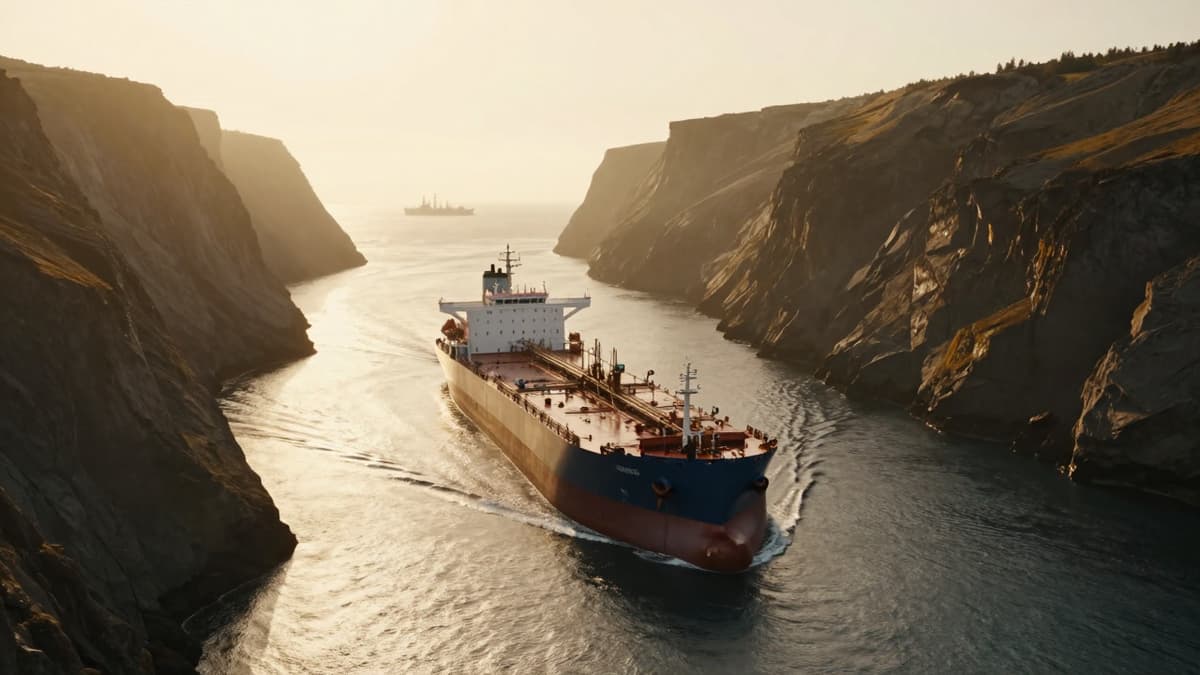
A new Iranian demand seeks sovereignty over the Strait of Hormuz, aiming to monetize global trade leverage through a controversial tolling system for energy shipments.
When an Iranian official outlined a new list of demands to end the war initiated by the United States and Israel, they introduced a significant addition absent from previous lists: recognition of Iran's sovereignty over the Strait of Hormuz. This narrow waterway, which typically carries a fifth of the world's oil and liquefied natural gas, has become the Islamic Republic's most potent strategic weapon. Tehran now aims to convert this strategic leverage into a source of potentially billions of dollars in annual revenue while simultaneously exerting pressure on the global economy.
Although Iran has long threatened to close the strait in response to attacks, few anticipated such a move would be effective or permanent. The success of this strategy has seemingly expanded Tehran's ambitions, with new demands suggesting an intent to lock in this leverage for the future. Shipping through the critical chokepoint has nearly halted due to Iranian attacks, sending global energy markets into turmoil and forcing nations far beyond the Persian Gulf to take emergency measures to secure fuel supplies.
Dina Esfandiary, the Middle East lead at Bloomberg Economics, noted that Iran appears surprised by the efficacy of its strategy. She stated that the country has discovered a new way to hold the global economy hostage cheaply and effectively. "One of the lessons learned in the war is that it has discovered this new leverage, and it's likely to use it again in the future," Esfandiary said. She added that monetizing this leverage is part of Tehran's discovery of its strategic value.
Washington is acutely aware of the risks posed by these developments. US Secretary of State Marco Rubio warned that a primary challenge following the war will be Tehran's attempts to establish a tolling system at Hormuz. Speaking after a G7 meeting in France, Rubio declared that such a move is illegal, unacceptable, and dangerous. He emphasized the importance of a global plan to confront the issue, with foreign ministers from the group stressing the absolute necessity to restore safe and toll-free freedom of navigation.
In a move highlighting the growing strategic weight of the waterway, Mojtaba Khamenei, purportedly the new supreme leader, used his first address to assert that the leverage of blocking the waterway must continue to be used. This marks a shift from previous negotiations where Iran sought sanctions relief and recognition of its right to peaceful nuclear technology, but not control over the strait.
Iran is now signaling that this leverage could be formalized. Lawmakers are considering a bill requiring countries using the strait for shipping fuel and goods to pay tolls. Additionally, an adviser to the supreme leader has spoken of a "new regime for the Strait of Hormuz" after the war. This proposed system would allow Tehran to impose maritime restrictions on adversaries, effectively tying access to one of the world's most critical shipping lanes to its geopolitical disputes.
James Kraska, a professor of international maritime law at the US Naval War College, stated that imposing transit fees violates the rules of transit passage. He explained that there is no legal basis under international law for a coastal state to charge fees in an international strait like Hormuz. While neither Iran nor the United States is a party to the UN Convention on the Law of the Sea (UNCLOS), Kraska noted that many of its core principles apply as customary international law. However, he acknowledged that Iran may still use its non-membership to bolster its case.
There is little historical precedent for a state successfully charging for passage through an international strait. The 19th-century attempt by Denmark to impose transit fees through the Danish Straits ended with the Copenhagen Convention of 1857, which abolished the Sound Dues permanently. Despite this, Iran is exploring what a tolling system could look like and how lucrative it might be.
Experts question whether Iran could establish a tolling system that would gain international acceptance, but if successful, revenues could rival those generated by Egypt's Suez Canal. CNN calculations suggest that normally, around 20 million barrels of crude oil and oil products pass through the Strait of Hormuz each day, roughly equivalent to 10 very large crude carriers (VLCCs). At a reported fee of $2 million per tanker, this translates to around $20 million a day, or about $600 million a month, from oil alone.
If LNG shipments are included, that figure could rise to more than $800 million a month. This amount is equivalent to about 15% to 20% of Iran's monthly oil export revenue in 2024. For comparison, Egypt earns between $700 and $800 million a month from the Suez Canal in a typical year, though revenues have dropped sharply recently due to Red Sea disruptions.
Monetization of the strait may also be driven by Iran's severe economic pressures. Esfandiary described charging for passage as a way for Tehran to make up for economic shortfalls under sanctions. She characterized it as a relatively easy and low-cost mechanism to compensate for restricted access to global markets, noting that Iran is among the world's most heavily sanctioned countries, second only to Russia.
Iran has repeatedly stated that the Strait of Hormuz remains open but not unconditionally. Officials clarify that "non-hostile" vessels may transit provided they coordinate with Iranian authorities. The foreign ministry conveyed this position in a letter to the UN Security Council and the International Maritime Organization. Tehran appears to be testing a controlled system of passage in practice. Ship-tracking data shows some tankers using a route closer to Iran's coast, with reports that certain operators may have paid for safe passage.
While no country, importer, or ship operator has publicly acknowledged paying a fee, and details remain unclear, shipping intelligence firm Lloyd's List reported that more than 20 vessels have used a new corridor through the strait. At least two ships are understood to have paid to do so, with one reportedly costing around $2 million. The Islamic Revolutionary Guard Corps has also established a registration system for approved vessels, while some governments are engaging directly with Tehran to secure transit for their tankers. Richard Meade, editor in chief of Lloyd's List, warned that the shipping industry is currently in a state of paralysis, suggesting the situation may worsen if negotiations do not progress.
Iran's demand for sovereignty over the Strait of Hormuz marks a definitive shift from defensive threats to proactive economic warfare. By formalizing a tolling system, Tehran seeks to institutionalize its leverage, potentially creating a new global precedent for maritime extortion. If this strategy succeeds, the Strait of Hormuz could generate billions in revenue, fundamentally altering the geopolitical landscape of the Persian Gulf. However, the illegal nature of such a move under international law suggests a continued clash between Tehran and global powers, likely leading to prolonged disruptions in global energy markets and heightened diplomatic tensions as nations scramble to secure alternative fuel supplies or enforce safe passage.
Jun 8, 2026 00:51 UTC
Trump Claims Iran Nuclear Deal Imminent Despite Diplomatic Fractures
Jun 8, 2026 00:47 UTC
Iran Fires Missiles at Israel After Beirut Strike
Jun 7, 2026 22:00 UTC
US, Iran Peace Hops Fade 100 Days Into War
Jun 7, 2026 20:57 UTC
Iran Strikes Israel: IRGC Promises Week of Continuous Offensive
Jun 8, 2026 02:28 UTC
Trump Walks Out of Meet the Press After Rejecting Evidence Demands


