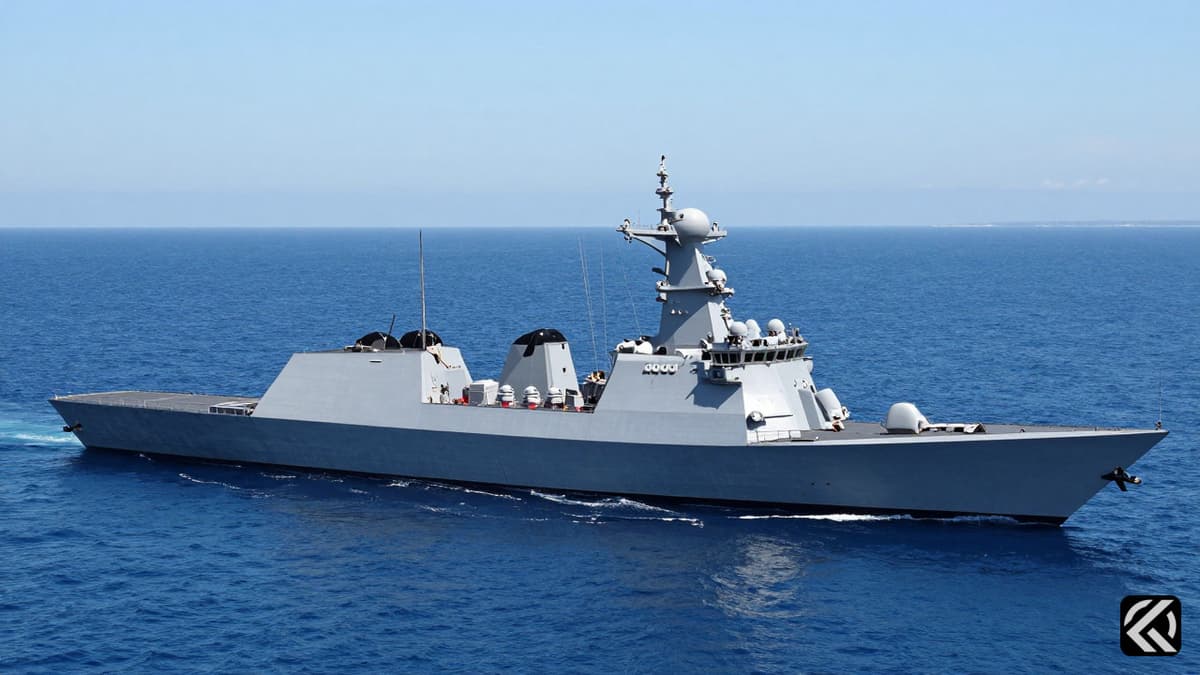
India's naval dominance grows as the stealth frigate INS Taragiri, featuring BrahMos missiles, officially joins the fleet today, marking a major leap in self-reliance.
The indigenous stealth frigate INS Taragiri, equipped with advanced weaponry, was officially commissioned into the Indian Navy on Friday, April 3, in Visakhapatnam. This significant induction marks a major milestone in India's push for self-reliant naval power and modernization.
Built by Mazagon Dock Shipbuilders Limited (MDL) in Mumbai, the new vessel represents a generational leap over earlier warship designs. The commissioning ceremony highlights the ship's sleeker form and significantly reduced radar cross-section, which enable it to operate with lethal stealth capabilities. This modernization effort aims to further strengthen the Indian Navy's operational posture amidst evolving geopolitical challenges and security demands.
The legacy of the new INS Taragiri bridges the past and present. The earlier INS Taragiri, a Leander-class frigate, served the Indian Navy for over three decades from 1980 to 2013. The new ship proudly carries forward this legacy while marking a quantum leap in capability through its advanced weapon systems and maritime capabilities. During an interaction with the crew ahead of the commissioning, the focus remained on the ship's transformation and its cutting-edge technology.
"The latest INS Taragiri combines stealth, automation, superior firepower and enhanced survivability," said Captain Hemanth Gopal, the Commanding Officer of the ship. He emphasized that the vessel symbolizes India's defense manufacturing ecosystem and the country's ability to design and deploy advanced naval platforms indigenously. The frigate, which is the fourth under Project 17A, is a massive 6,670-tonne warship that embodies the spirit of self-reliance in warship design and construction.
With indigenous content exceeding 75 per cent, the frigate demonstrates the maturity of India's domestic industrial ecosystem. The project involves more than 200 micro, small, and medium enterprises (MSMEs), aligning with the government's Aatmanirbhar Bharat initiative and supporting thousands of Indian jobs. Captain Gopal proudly stated that the stealth frigate is among the most advanced ships in the world, capable of multi-role operations across all domains.
When deployed, the ship's crew is confident that other navies will look at the vessel and ask, "Is this made in India?" The vessel is powered by a Combined Diesel or Gas (CODOG) propulsion system, designed for high speed and high endurance, facilitating multi-dimensional maritime operations. The ship's combat architecture includes indigenous systems, cutting-edge sonar technology, and torpedoes specifically for anti-submarine warfare.
Commanders Siddhartha Gupta, Abhishek Bali, and Akhilesh Sharma noted that with advanced engines, sensors, and weapon systems, the ship can seamlessly undertake anti-aircraft, anti-surface, and anti-submarine missions. Beyond high-intensity combat roles, the vessel is also configured for modern diplomatic engagements and humanitarian missions. Its flexible mission profile makes it ideal for operations ranging from presence missions to Humanitarian Assistance and Disaster Relief (HADR).
The INS Taragiri carries a world-class weapon suite, including supersonic surface-to-surface BrahMos missiles, medium-range surface-to-air missiles (MRSAM), an advanced anti-submarine warfare suite, and the MF-STAR radar. As one of the most advanced indigenous warships in the Indian Navy, it is central to the Navy's operational focus in the Indian Ocean Region (IOR), a vast and vital maritime zone.
"Taragiri is designed for high-speed, high-endurance missions. In emergencies, the ship can sprint rapidly across the IOR to respond and assist," Captain Gopal added.
As it prepares to join the fleet, INS Taragiri stands as a symbol of India's rising maritime power-a modern guardian of the nation's blue frontiers. The vessel's induction signifies a robust conclusion to a project that has successfully integrated domestic innovation with operational excellence, setting a new standard for naval warfare in the region.
The commissioning of the INS Taragiri solidifies the success of the Project 17A initiative, demonstrating that India can produce world-class naval assets entirely within its own industrial boundaries. The involvement of over 200 MSMEs indicates a deepening supply chain that will likely accelerate future defense production capabilities. As the Indian Navy continues to expand its fleet with stealth technology and advanced weaponry like the BrahMos missiles, the strategic depth of the nation's maritime defense is expected to increase significantly. The ship's ability to transition between combat and humanitarian roles suggests a versatile force capable of meeting diverse geopolitical demands in the Indian Ocean Region. This trajectory points toward a future where indigenous manufacturing not only meets domestic requirements but also establishes India as a premier exporter of high-end naval technology.
Jun 8, 2026 00:51 UTC
Trump Claims Iran Nuclear Deal Imminent Despite Diplomatic Fractures
Jun 8, 2026 00:47 UTC
Iran Fires Missiles at Israel After Beirut Strike
Jun 7, 2026 22:00 UTC
US, Iran Peace Hops Fade 100 Days Into War
Jun 7, 2026 20:57 UTC
Iran Strikes Israel: IRGC Promises Week of Continuous Offensive
Jun 8, 2026 02:28 UTC
Trump Walks Out of Meet the Press After Rejecting Evidence Demands


