Section
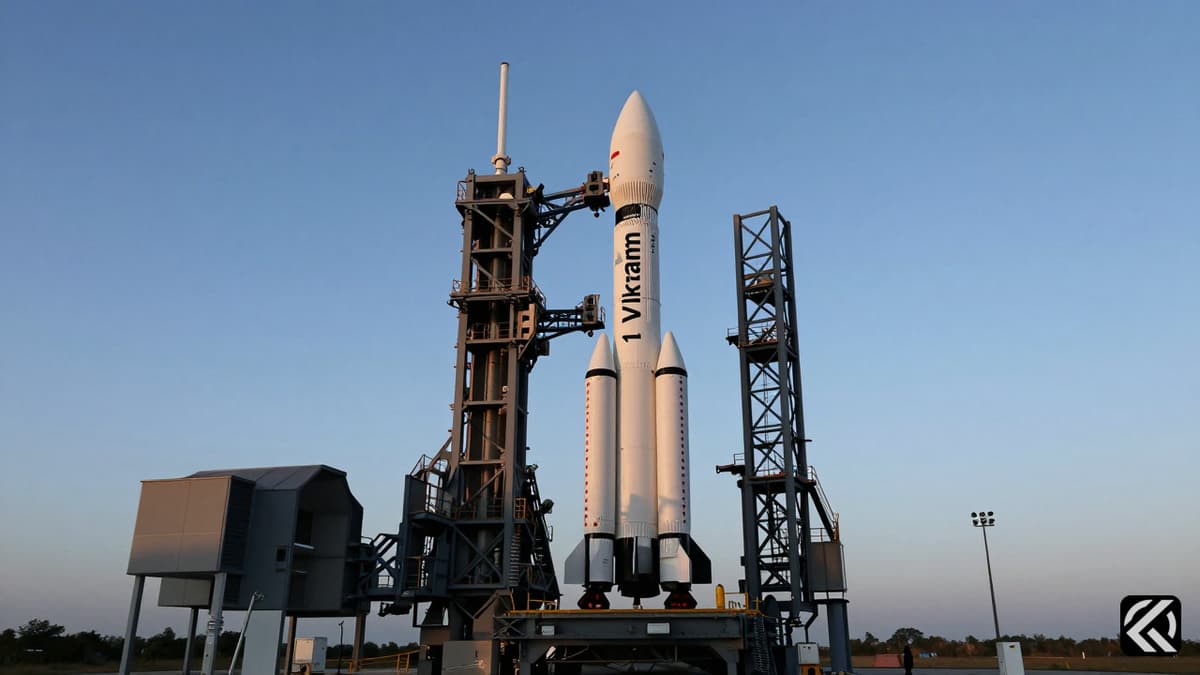
India’s space landscape shifts forever as Skyroot Aerospace becomes the first private entity to achieve orbital launch capability with its Vikram-1 rocket.
India has successfully tested its first private-sector orbital rocket, marking a significant milestone in New Delhi’s ambition to become a major player in the global space economy. The three-stage 22-metre Vikram-1 was launched from the Satish Dhawan Space Centre in Sriharikota, deploying customer payloads into a 450km (280-mile) low-Earth orbit. This accomplishment establishes India as the third country to achieve orbital launch capability through private enterprise, signaling a profound shift in the geopolitical dynamics of space access.
The launch, executed by Vikram-1, represents a critical validation of the technology and engineering prowess driving the nation’s burgeoning aerospace industry. According to the manufacturer, the test flight validated the rocket’s propulsion, avionics, telemetry, guidance, navigation, and control systems during flight. By placing payloads into orbit rather than merely reaching the edge of space, the mission demonstrated the operational readiness of private companies to perform complex orbital maneuvers previously reserved for state-run agencies.
The Vikram-1 rocket is not merely a proof-of-concept vehicle; it is designed for functional utility. It can carry a payload of up to 350kg (772lb) and is equipped with robotic arms capable of clearing space debris, addressing one of the most pressing challenges in modern orbital mechanics. The launch also carried experimental equipment, including a lab-grown diamond and a miniature 18-carat gold sculpture commemorating India’s national space programme, highlighting the intersection of commerce, science, and cultural celebration.
Skyroot Aerospace, the company behind this historic launch, celebrated the successful mission with a post on X stating, “Hello space, we have arrived!” Founded in 2018, Skyroot is among a new generation of Indian space startups that have attracted backing from global investors following the sector’s liberalisation. Earlier this year, it became the first space-sector company in the country to hit a $1bn valuation, underscoring the immense confidence investors have in the Indian private space sector.
The achievement has drawn high-level political recognition. India Prime Minister Narendra Modi hailed the achievement, saying that it will “encourage countless youngsters to dream bigger and innovate fearlessly.” This endorsement from the highest office in the land reinforces the strategic importance placed on space technology as a driver of economic and technological sovereignty. The Prime Minister’s comments suggest that the government views this launch not just as a technical success, but as a catalyst for national inspiration and future industrial growth.
This mission improves upon Skyroot’s earlier Vikram-S mission in 2022. That suborbital flight reached space but did not place payloads into orbit, serving as a crucial precursor to the current orbital capability. The transition from suborbital to orbital flight involves exponentially greater complexity, particularly in maintaining velocity and trajectory to counteract Earth’s gravity. The successful deployment of payloads into a 450km orbit confirms that Skyroot has mastered these fundamental requirements for commercial space operations.
The context of this launch is further enriched by India’s historical space achievements. India’s national space programme previously launched 104 satellites into orbit on one rocket in 2017, setting a record at the time. While the public-sector program has a long and distinguished history of cost-effective, high-volume launches, the entry of private entities like Skyroot introduces new dynamics of competition, innovation speed, and specialized service offerings. The collaboration between public infrastructure, such as the Satish Dhawan Space Centre, and private innovation marks a mature phase in India’s space strategy.
Skyroot plans further test flights before starting routine commercial missions. These subsequent tests will be critical in refining operational reliability and cost structures, which are the primary barriers to entry in the global launch market. By establishing a foothold in the low-Earth orbit segment, Skyroot positions itself to serve a growing market for small satellite deployments, scientific experiments, and potential debris management services. The robotic arms designed to clear debris suggest a forward-looking approach to sustainability, a niche that may become increasingly valuable as orbital congestion worsens.
The liberalisation of the sector has allowed startups to access capital and technology at a pace previously impossible under strict state monopolies. Global investors have recognized the potential of the Indian market, driven by its skilled workforce, lower operational costs, and growing domestic demand for satellite services. The $1bn valuation of Skyroot Aerospace is a testament to this market correction, reflecting the real value of intellectual property, engineering talent, and infrastructure development accumulated over the company’s eight-year history.
As India cements its status as a key player in the global space economy, the implications extend beyond aerospace. The technological spin-offs from rocket propulsion, avionics, and materials science can permeate other high-tech industries, including telecommunications, earth observation, and defense. The success of the Indian private space sector could spur further investments in related fields, creating a robust ecosystem that supports not just launch services but also downstream satellite manufacturing and data analytics.
This historic launch confirms that India’s private aerospace industry has moved from experimental phases to operational viability. With Skyroot Aerospace validating its orbital capabilities, the stage is set for increased commercial competition and international partnerships. The successful deployment of payloads and the integration of debris-clearing technology suggest a future where private entities play a central role in maintaining sustainable orbital environments. As further test flights occur and routine commercial missions begin, India is poised to capture a significant share of the global low-Earth orbit launch market, driving economic growth and technological leadership for decades to come.
Oct 3, 2026 04:08 UTC
FlyDubai Co-Pilot Banned in Oman Over Extremism Concerns
Oct 3, 2026 00:50 UTC
Israel-Mumbai Campaign Honors Captain Smit After Flydubai Incident
Oct 2, 2026 18:13 UTC
Captain Smit Machchhar’s Courage Saves Flydubai Flight FZ1073 From Disaster
Oct 2, 2026 16:45 UTC
Captain Smit Machchhar Saves Plane Mid-Fall
Sep 18, 2026 12:35 UTC
Bolivia's Newly Discovered Feline Species Named Leopardus tilcayo